 Add to Chrome
 Add to Firefox
 Add to Edge
Faster Completion, Less Learning: Generative AI Reduced Study Time on Math Problems and the Knowledge They Build
May 20, 2026
How much have students' ordinary learning processes shifted in response to generative AI, and how does that affect their durable learning outcomes? Self-report surveys show little change, while small-scale behavioral studies report widespread AI use without the scale or duration to measure learning consequences. We address both questions using a ten-year panel of $3.2$ million ALEKS learning interactions for the time-on-task analysis, complemented by ALEKS PPL placement-assessment data for the proctoring and retention analyses, with a quasi-experimental design exploiting within-curriculum variation in AI susceptibility: text-based word problems transcribable into AI prompts serve as the treated group; graph-based problems requiring interactive platform manipulation as the comparison. Learning time on AI-susceptible problems declines $2.8\%$ per quarter among college students after ChatGPT's release, cumulating to $26.9\%$ over eleven quarters; high-schoolers show $31.3\%$, middle-schoolers $9.0\%$, and Grade 5 students no detectable change. The divergence vanishes entirely under proctoring for college students, making general efficiency gains unlikely. Logistic fixed-effects models on randomly assigned proctored retention items yield a $25\%$ cumulative decline in odds of correct response; the same estimator on non-proctored assessment produces a large opposite-signed increase -- inconsistent with any platform, cohort, or curriculum explanation. These results are among the first large-scale behavioral and outcome evidence that generative AI has altered how students study and the knowledge they build -- the population-level indicator of \emph{cognitive surrender}, with direct implications for educational research, assessment governance, and AI policy.

TurtleBench: A Visual Programming Benchmark in Turtle Geometry
Oct 31, 2024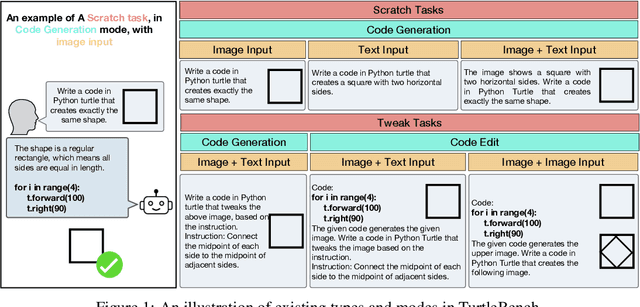
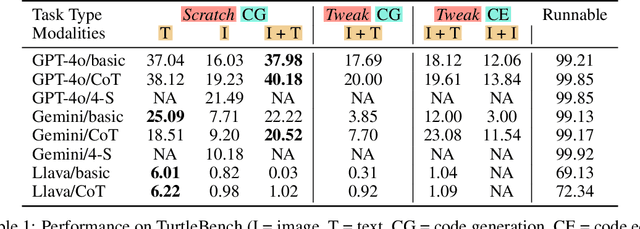
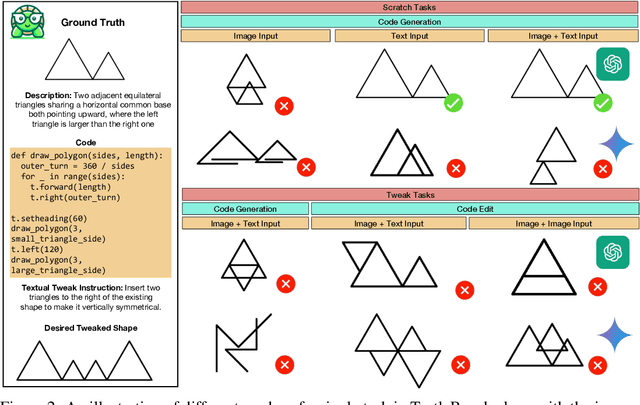

Humans have the ability to reason about geometric patterns in images and scenes from a young age. However, developing large multimodal models (LMMs) capable of similar reasoning remains a challenge, highlighting the need for robust evaluation methods to assess these capabilities. We introduce TurtleBench, a benchmark designed to evaluate LMMs' capacity to interpret geometric patterns -- given visual examples, textual instructions, or both -- and generate precise code outputs. Inspired by turtle geometry, a notion used to teach children foundational coding and geometric concepts, TurtleBench features tasks with patterned shapes that have underlying algorithmic logic. Our evaluation reveals that leading LMMs struggle significantly with these tasks, with GPT-4o achieving only 19\% accuracy on the simplest tasks and few-shot prompting only marginally improves their performance ($<2\%$). TurtleBench highlights the gap between human and AI performance in intuitive and visual geometrical understanding, setting the stage for future research in this area. TurtleBench stands as one of the few benchmarks to evaluate the integration of visual understanding and code generation capabilities in LMMs, setting the stage for future research. Code and Dataset for this paper is provided here: https://github.com/sinaris76/TurtleBench
Reconciling Different Theories of Learning with an Agent-based Model of Procedural Learning
Aug 23, 2024Computational models of human learning can play a significant role in enhancing our knowledge about nuances in theoretical and qualitative learning theories and frameworks. There are many existing frameworks in educational settings that have shown to be verified using empirical studies, but at times we find these theories make conflicting claims or recommendations for instruction. In this study, we propose a new computational model of human learning, Procedural ABICAP, that reconciles the ICAP, Knowledge-Learning-Instruction (KLI), and cognitive load theory (CLT) frameworks for learning procedural knowledge. ICAP assumes that constructive learning generally yields better learning outcomes, while theories such as KLI and CLT claim that this is not always true. We suppose that one reason for this may be that ICAP is primarily used for conceptual learning and is underspecified as a framework for thinking about procedural learning. We show how our computational model, both by design and through simulations, can be used to reconcile different results in the literature. More generally, we position our computational model as an executable theory of learning that can be used to simulate various educational settings.