 Add to Chrome
 Add to Firefox
 Add to Edge
Thinking Through Signs: PEEL as a Semiotic Scaffolding for Epistemically Accountable AI-Enabled Research
Jun 02, 2026
Large language models are reshaping research practice while quietly eroding researchers epistemic accountability. This commentary introduces PEEL - Protocols for Epistemically Engaged Literacy in AI, a working scaffolding that combines deterministic distant reading via Voyant Tools with LLM interpretation via Claude, grounded in Peircean semiotics and abductive reasoning. Applied to AI-generated condensations of three source texts, PEEL reveals systematic distortions in quantity, term frequency, and epistemic voice that are invisible without non-AI measurement -- and yields three design implications: deterministic instruments must accompany AI tools; fluency is not fidelity; epistemic authority must be designed in, not assumed.

Brazilian Lyrics-Based Music Genre Classification Using a BLSTM Network
Mar 06, 2020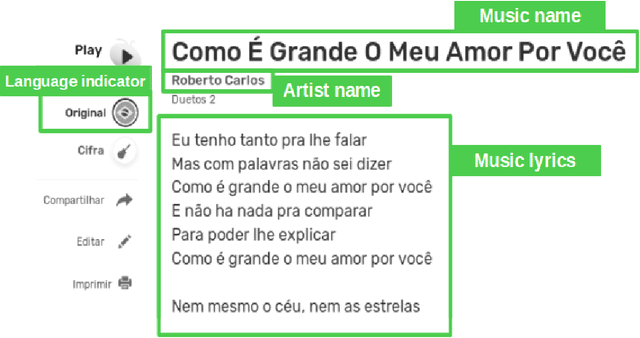
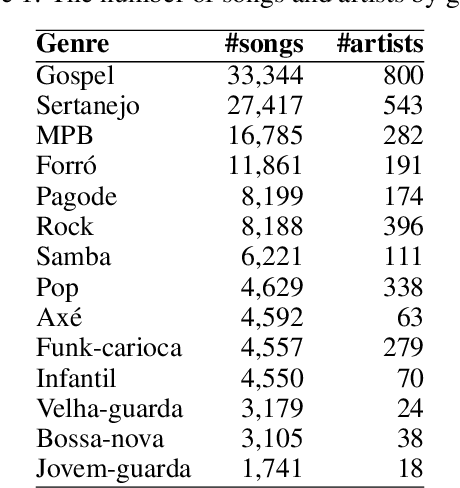
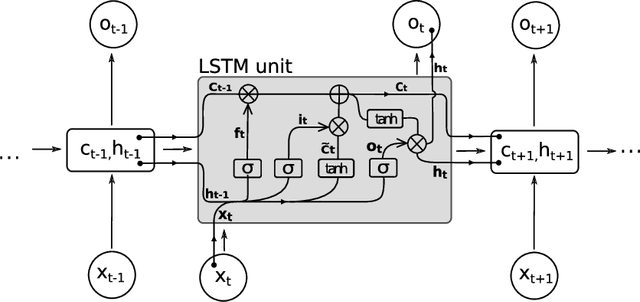
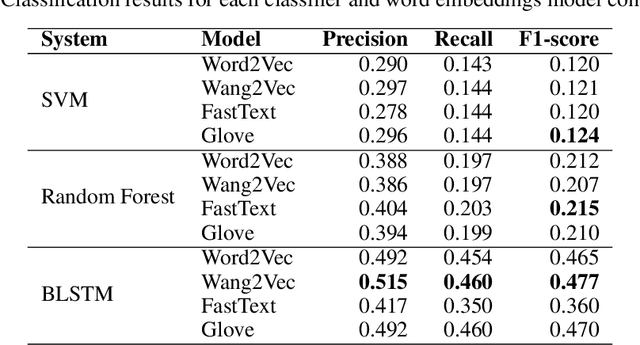
Organize songs, albums, and artists in groups with shared similarity could be done with the help of genre labels. In this paper, we present a novel approach for automatic classifying musical genre in Brazilian music using only the song lyrics. This kind of classification remains a challenge in the field of Natural Language Processing. We construct a dataset of 138,368 Brazilian song lyrics distributed in 14 genres. We apply SVM, Random Forest and a Bidirectional Long Short-Term Memory (BLSTM) network combined with different word embeddings techniques to address this classification task. Our experiments show that the BLSTM method outperforms the other models with an F1-score average of $0.48$. Some genres like "gospel", "funk-carioca" and "sertanejo", which obtained 0.89, 0.70 and 0.69 of F1-score, respectively, can be defined as the most distinct and easy to classify in the Brazilian musical genres context.