 Add to Chrome
 Add to Firefox
 Add to Edge
CAS2UML: A Handwritten Sketch-to-PlantUML Dataset for Class and Activity Diagrams
Aug 07, 2026
Automated UML generation from sketches and images is gaining renewed attention with the rise of large language models and multimodal AI. However, reproducible evaluation remains difficult due to the lack of public datasets with executable groundtruth models. We present CAS2UML, a public dataset of 557 handdrawn UML diagrams, including 271 class diagrams and 286 activity diagrams, each paired with manually validated PlantUML code. We also provide a PlantUML-based validation tool and reusable scripts for checking the syntactic correctness and renderability of generated UML artifacts, enabling reproducible benchmarking of sketch-to-UML approaches. The dataset, validation tool, processing scripts, documentation, and demonstration video are publicly available at: Dataset: https://huggingface.co/datasets/Seym0n /cas2uml_hand-drawn_to_plantuml_dataset; Tool and Scripts: https://github.com/Seym0n/handwritten-uml-dataset; Video: https://www.youtube.com/watch?v=KQrYeGgT3hs.

Towards Utility-based Prioritization of Requirements in Open Source Environments
Feb 17, 2021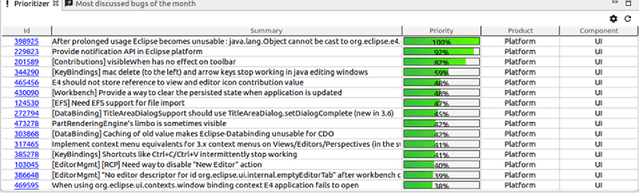
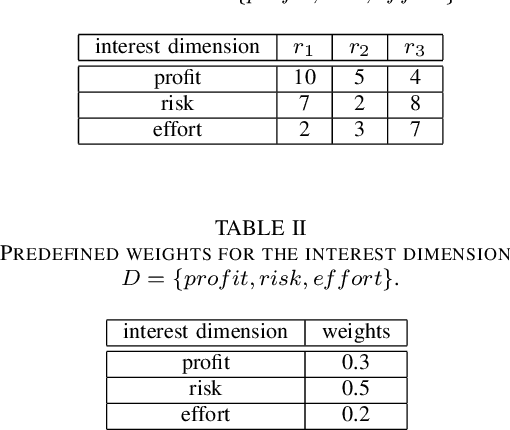


Requirements Engineering in open source projects such as Eclipse faces the challenge of having to prioritize requirements for individual contributors in a more or less unobtrusive fashion. In contrast to conventional industrial software development projects, contributors in open source platforms can decide on their own which requirements to implement next. In this context, the main role of prioritization is to support contributors in figuring out the most relevant and interesting requirements to be implemented next and thus avoid time-consuming and inefficient search processes. In this paper, we show how utility-based prioritization approaches can be used to support contributors in conventional as well as in open source Requirements Engineering scenarios. As an example of an open source environment, we use Bugzilla. In this context, we also show how dependencies can be taken into account in utility-based prioritization processes.