 Add to Chrome
 Add to Firefox
 Add to Edge
Bake It Till You Make It: Ultrafast Spatial Texture-Atlas Splatting
Jul 15, 2026
Recent extensions of 3D Gaussian Splatting (3DGS) capture fine color details using hash-grid-based appearance parameterization but incur high computational cost during fragment rendering. We introduce a decoupled radiance representation that models low-frequency geometry and view dependent appearance features with 2D surfels while representing high-frequency textures via a view-independent spatial hash grid that is baked into a compact texture atlas. By including sparsity-enhancing optimizations that penalize semi-transparency and per-primitive falloff, our method aggressively prunes insignificant surfels and achieves significantly faster and sparser reconstructions than prior work. Exploiting geometric sparsity and efficient GPU texture mapping, our approach achieves up to a fivefold speedup over 3DGS while preserving state-of-the-art visual fidelity, enabling real-time 4K rendering at 60 FPS on consumer hardware.

Hybrid Latents -- Geometry-Appearance-Aware Surfel Splatting
Apr 16, 2026We introduce a hybrid Gaussian-hash-grid radiance representation for reconstructing 2D Gaussian scene models from multi-view images. Similar to NeST splatting, our approach reduces the entanglement between geometry and appearance common in NeRF-based models, but adds per-Gaussian latent features alongside hash-grid features to bias the optimizer toward a separation of low- and high-frequency scene components. This explicit frequency-based decomposition reduces the tendency of high-frequency texture to compensate for geometric errors. Encouraging Gaussians with hard opacity falloffs further strengthens the separation between geometry and appearance, improving both geometry reconstruction and rendering efficiency. Finally, probabilistic pruning combined with a sparsity-inducing BCE opacity loss allows redundant Gaussians to be turned off, yielding a minimal set of Gaussians sufficient to represent the scene. Using both synthetic and real-world datasets, we compare against the state of the art in Gaussian-based novel-view synthesis and demonstrate superior reconstruction fidelity with an order of magnitude fewer primitives.
Lightweight Gradient-Aware Upscaling of 3D Gaussian Splatting Images
Mar 18, 2025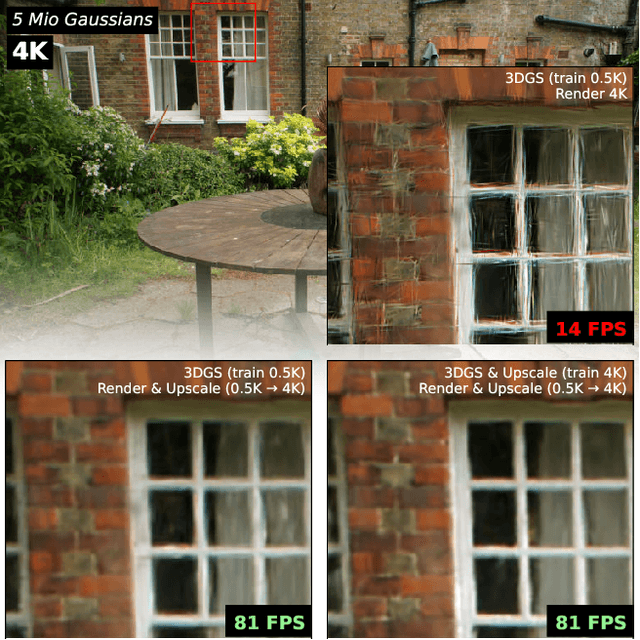

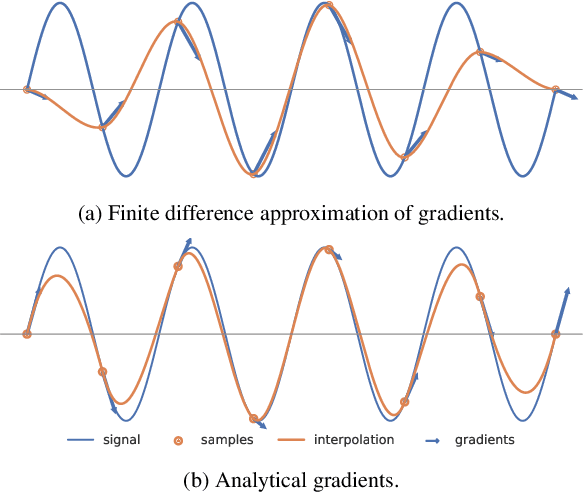
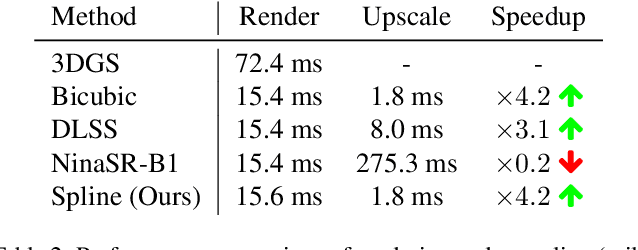
We introduce an image upscaling technique tailored for 3D Gaussian Splatting (3DGS) on lightweight GPUs. Compared to 3DGS, it achieves significantly higher rendering speeds and reduces artifacts commonly observed in 3DGS reconstructions. Our technique upscales low-resolution 3DGS renderings with a marginal increase in cost by directly leveraging the analytical image gradients of Gaussians for gradient-based bicubic spline interpolation. The technique is agnostic to the specific 3DGS implementation, achieving novel view synthesis at rates 3x-4x higher than the baseline implementation. Through extensive experiments on multiple datasets, we showcase the performance improvements and high reconstruction fidelity attainable with gradient-aware upscaling of 3DGS images. We further demonstrate the integration of gradient-aware upscaling into the gradient-based optimization of a 3DGS model and analyze its effects on reconstruction quality and performance.
APEBench: A Benchmark for Autoregressive Neural Emulators of PDEs
Oct 31, 2024We introduce the Autoregressive PDE Emulator Benchmark (APEBench), a comprehensive benchmark suite to evaluate autoregressive neural emulators for solving partial differential equations. APEBench is based on JAX and provides a seamlessly integrated differentiable simulation framework employing efficient pseudo-spectral methods, enabling 46 distinct PDEs across 1D, 2D, and 3D. Facilitating systematic analysis and comparison of learned emulators, we propose a novel taxonomy for unrolled training and introduce a unique identifier for PDE dynamics that directly relates to the stability criteria of classical numerical methods. APEBench enables the evaluation of diverse neural architectures, and unlike existing benchmarks, its tight integration of the solver enables support for differentiable physics training and neural-hybrid emulators. Moreover, APEBench emphasizes rollout metrics to understand temporal generalization, providing insights into the long-term behavior of emulating PDE dynamics. In several experiments, we highlight the similarities between neural emulators and numerical simulators.