 Add to Chrome
 Add to Firefox
 Add to Edge
Effect of User-Prompted Priors on Semi-Automated Cancer Lesion Segmentation in Whole-Body Computed Tomography
Jul 27, 2026
In clinical oncology studies, metastatic cancer is commonly evaluated using "Response Evaluation Criteria in Solid Tumors" (RECIST), in which the diameter of up to five lesions is measured and followed over the course of treatment. However, RECIST shows limited correlation with overall survival. Total tumour volume (TTV) is a stronger predictor but typically relies on manual ground-truth segmentation of all lesions, which is time-consuming and requires expert domain knowledge. Semi-automated approaches leveraging user-prompted priors, such as bounding boxes and single-slice contours, as inputs to automated segmentation methods can facilitate the generation of ground-truth segmentations. This work investigates the impact of different user-prompted priors on semi-automated cancer lesion segmentation performance in whole-body computed tomography. Across 3-fold cross-validation and external testing, more complex spatial priors consistently improved performance, with contour priors from three orthogonal planes (axial, coronal and sagittal) achieving the best results. On the external test (n=3865 lesions), this approach achieved a mean Dice score of 0.882, compared to a mean Dice score of 0.671 for the baseline model with no spatial prior. These findings suggest that the use of multi-plane orthogonal user-prompted priors can improve semi-automated tumour lesion segmentation and support efficient generation of high-quality volumetric ground-truth data.

Fast Graph-Cut Based Optimization for Practical Dense Deformable Registration of Volume Images
Oct 19, 2018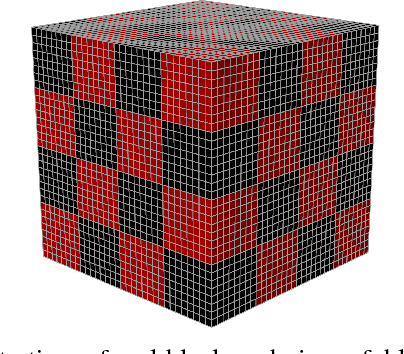
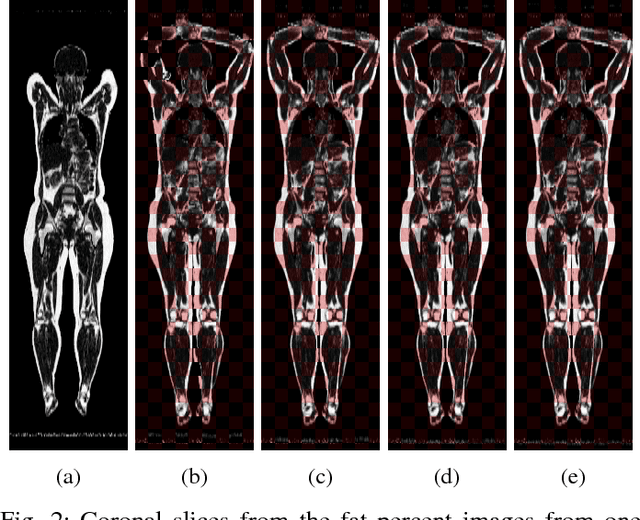
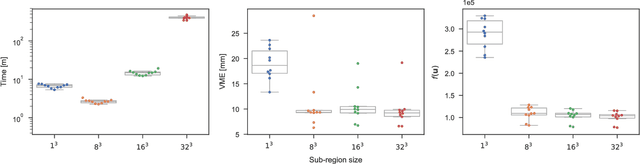
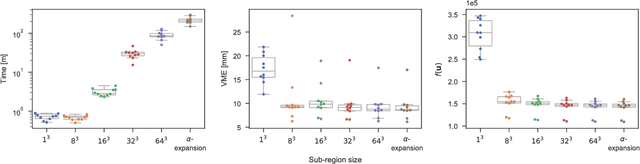
Objective: Deformable image registration is a fundamental problem in medical image analysis, with applications such as longitudinal studies, population modeling, and atlas based image segmentation. Registration is often phrased as an optimization problem, i.e., finding a deformation field that is optimal according to a given objective function. Discrete, combinatorial, optimization techniques have successfully been employed to solve the resulting optimization problem. Specifically, optimization based on $\alpha$-expansion with minimal graph cuts has been proposed as a powerful tool for image registration. The high computational cost of the graph-cut based optimization approach, however, limits the utility of this approach for registration of large volume images. Methods: Here, we propose to accelerate graph-cut based deformable registration by dividing the image into overlapping sub-regions and restricting the $\alpha$-expansion moves to a single sub-region at a time. Results: We demonstrate empirically that this approach can achieve a large reduction in computation time -- from days to minutes -- with only a small penalty in terms of solution quality. Conclusion: The reduction in computation time provided by the proposed method makes graph cut based deformable registration viable for large volume images. Significance: Graph cut based image registration has previously been shown to produce excellent results, but the high computational cost has hindered the adoption of the method for registration of large medical volume images. Our proposed method lifts this restriction, requiring only a small fraction of the computational cost to produce results of comparable quality.