 Add to Chrome
 Add to Firefox
 Add to Edge
Adaptive Reinforcement Learning for Robust Open Quantum System Control: A Multi-Task Framework with Temporal Optimization
May 26, 2026
We present a Multi-task Soft Actor-Critic (SAC) Reinforcement Learning framework designed for open-system quantum control across diverse Hamiltonians, which learns optimal pulse sequences while simultaneously discovering problem-specific evolution time T and number of control pulse segments N. Experimental results across 51 Hamiltonian variations demonstrate that the multi-task SAC model is able to generate control pulses that can drive a system, under environment noise, from its initial state to its target state with high fidelities, establishing essential foundations for universal quantum control applicable to realistic noisy quantum devices. Through progressive expansion of the training Hamiltonian set, we investigate if a single multi-task model trained using a given number of sample Hamiltonians can successfully accomplish state-transfer tasks for Hamiltonians drawn from the same Hamiltonian space but not encountered during training. In addition, our Robustness Infidelity Measure (RIM) analysis reveals that SAC trained policies exhibit superior robustness to pulse amplitude perturbations and decoherence rate variations compared to GRAPE-optimized controls.

A Case For Noisy Shallow Gate-Based Circuits In Quantum Machine Learning
Dec 13, 2021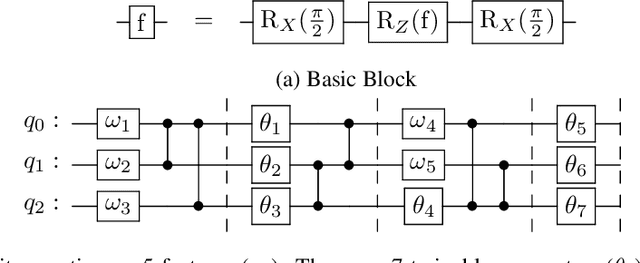


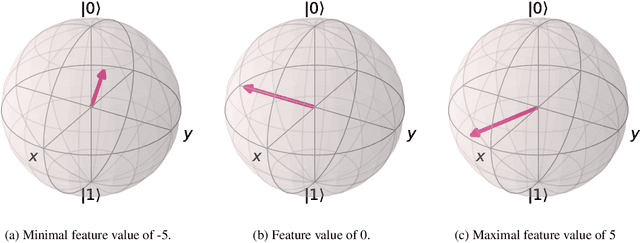
There is increasing interest in the development of gate-based quantum circuits for the training of machine learning models. Yet, little is understood concerning the parameters of circuit design, and the effects of noise and other measurement errors on the performance of quantum machine learning models. In this paper, we explore the practical implications of key circuit design parameters (number of qubits, depth etc.) using several standard machine learning datasets and IBM's Qiskit simulator. In total we evaluate over 6500 unique circuits with $n \approx 120700$ individual runs. We find that in general shallow (low depth) wide (more qubits) circuit topologies tend to outperform deeper ones in settings without noise. We also explore the implications and effects of different notions of noise and discuss circuit topologies that are more / less robust to noise for classification machine learning tasks. Based on the findings we define guidelines for circuit topologies that show near-term promise for the realisation of quantum machine learning algorithms using gate-based NISQ quantum computer.
Fairness in Machine Learning: A Survey
Oct 04, 2020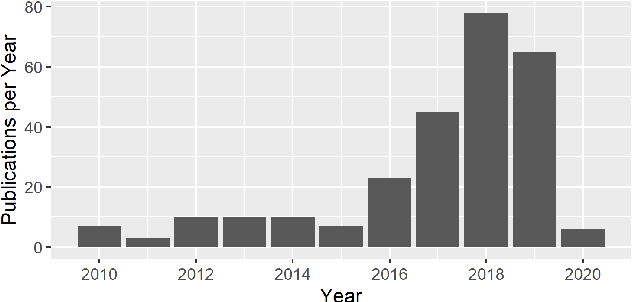

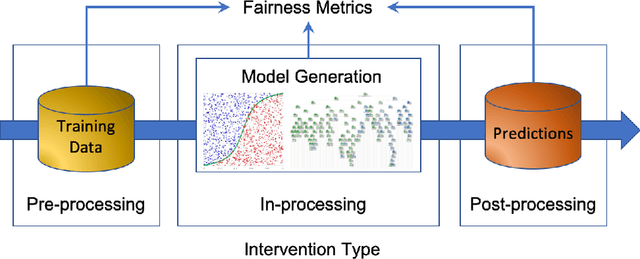
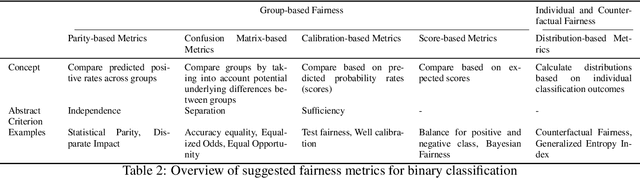
As Machine Learning technologies become increasingly used in contexts that affect citizens, companies as well as researchers need to be confident that their application of these methods will not have unexpected social implications, such as bias towards gender, ethnicity, and/or people with disabilities. There is significant literature on approaches to mitigate bias and promote fairness, yet the area is complex and hard to penetrate for newcomers to the domain. This article seeks to provide an overview of the different schools of thought and approaches to mitigating (social) biases and increase fairness in the Machine Learning literature. It organises approaches into the widely accepted framework of pre-processing, in-processing, and post-processing methods, subcategorizing into a further 11 method areas. Although much of the literature emphasizes binary classification, a discussion of fairness in regression, recommender systems, unsupervised learning, and natural language processing is also provided along with a selection of currently available open source libraries. The article concludes by summarising open challenges articulated as four dilemmas for fairness research.