 Add to Chrome
 Add to Firefox
 Add to Edge
Coronary artery calcification assessment in National Lung Screening Trial CT images (DeepCAC2)
Mar 25, 2026
Coronary artery calcification (CAC) is a strong predictor of cardiovascular risk but remains underutilized in clinical routine thoracic imaging due to the need for dedicated imaging protocols and manual annotation. We present DeepCAC2, a publicly available dataset containing automated CAC segmentations, coronary artery calcium scores, and derived risk categories generated from low-dose chest CT scans of the National Lung Screening Trial (NLST). Using a fully automated deep learning pipeline trained on expert-annotated cardiac CT data, we processed 127,776 CT scans from 26,228 individuals and generated standardized CAC segmentations and risk estimates for each acquisition. We already provide a public dashboard as a simple tool to visually inspect a random subset of 200 NLST patients of the dataset. The dataset will be released with DICOM-compatible segmentation objects and structured metadata to support reproducible downstream analysis. The deep learning pipeline will be made publicly available as a DICOM-compatible MHub.ai container. DeepCAC2 provides a transparent, large-scale, public, fully reproducible resource for research in cardiovascular risk assessment, opportunistic screening, and imaging biomarker development.

Artificial Intelligence-Based Opportunistic Coronary Calcium Screening in the Veterans Affairs National Healthcare System
Sep 16, 2024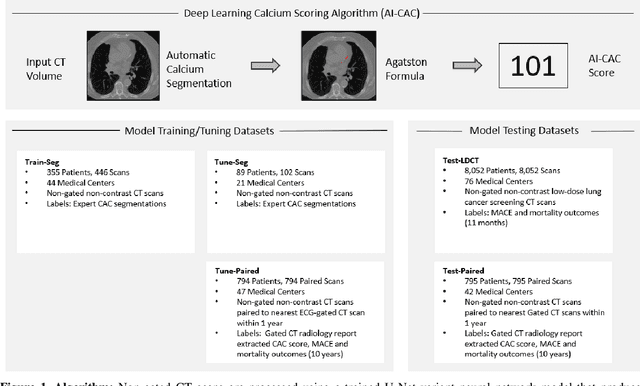
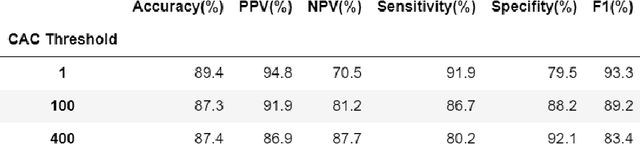
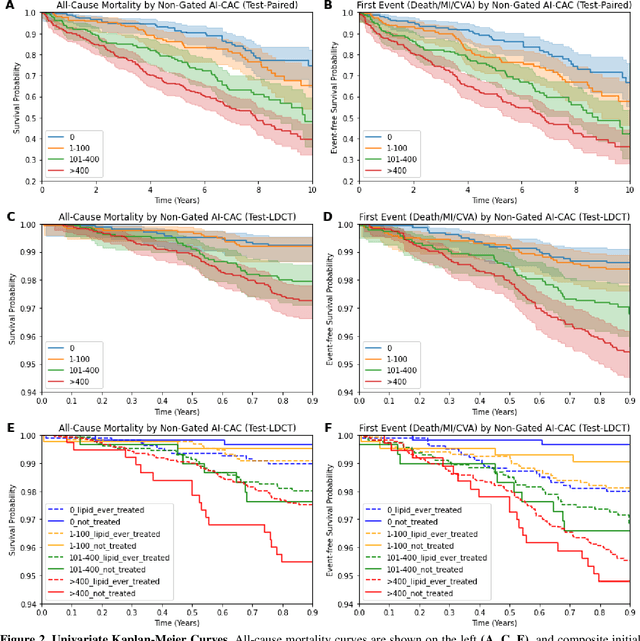
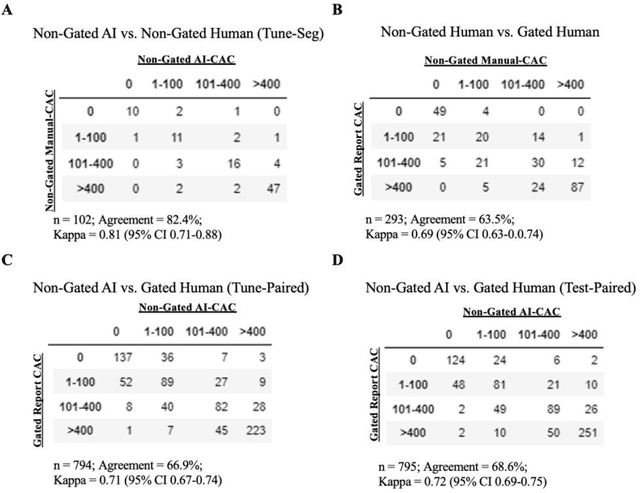
Coronary artery calcium (CAC) is highly predictive of cardiovascular events. While millions of chest CT scans are performed annually in the United States, CAC is not routinely quantified from scans done for non-cardiac purposes. A deep learning algorithm was developed using 446 expert segmentations to automatically quantify CAC on non-contrast, non-gated CT scans (AI-CAC). Our study differs from prior works as we leverage imaging data across the Veterans Affairs national healthcare system, from 98 medical centers, capturing extensive heterogeneity in imaging protocols, scanners, and patients. AI-CAC performance on non-gated scans was compared against clinical standard ECG-gated CAC scoring. Non-gated AI-CAC differentiated zero vs. non-zero and less than 100 vs. 100 or greater Agatston scores with accuracies of 89.4% (F1 0.93) and 87.3% (F1 0.89), respectively, in 795 patients with paired gated scans within a year of a non-gated CT scan. Non-gated AI-CAC was predictive of 10-year all-cause mortality (CAC 0 vs. >400 group: 25.4% vs. 60.2%, Cox HR 3.49, p < 0.005), and composite first-time stroke, MI, or death (CAC 0 vs. >400 group: 33.5% vs. 63.8%, Cox HR 3.00, p < 0.005). In a screening dataset of 8,052 patients with low-dose lung cancer-screening CTs (LDCT), 3,091/8,052 (38.4%) individuals had AI-CAC >400. Four cardiologists qualitatively reviewed LDCT images from a random sample of >400 AI-CAC patients and verified that 527/531 (99.2%) would benefit from lipid-lowering therapy. To the best of our knowledge, this is the first non-gated CT CAC algorithm developed across a national healthcare system, on multiple imaging protocols, without filtering intra-cardiac hardware, and compared against a strong gated CT reference. We report superior performance relative to previous CAC algorithms evaluated against paired gated scans that included patients with intra-cardiac hardware.