 Add to Chrome
 Add to Firefox
 Add to Edge
Time-frequency localization of bird calls in dense soundscapes
Jun 09, 2026
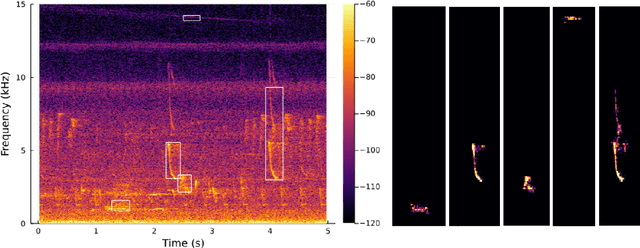
Passive acoustic monitoring enables large-scale observation of wildlife, but most bioacoustic classifiers only predict species presence in a time window without localizing vocalizations precisely in time or frequency, limiting downstream analyses. We formulate bird vocalization detection as an object detection task on spectrograms and train YOLO11 models to localize bird calls in dense tropical soundscapes from Singapore. We additionally introduce an open-source browser-based annotation tool and propose Intersection over Minimum (IoMin), an evaluation metric that better handles ambiguous acoustic boundaries than standard IoU and is better suited to the problem at hand. The best YOLO model nearly doubles baseline performance on in-distribution soundscapes from Singapore (81.8% vs. 42.1% IoMin@50 F1-score) while still outperforming the baseline on unseen out-of-distribution recordings from Hawaii (58.6% vs. 48.6%). These results suggest that object detection frameworks are a promising approach to time-frequency localization of animal vocalizations in complex soundscapes.

Semi-supervised classification of bird vocalizations
Feb 19, 2025
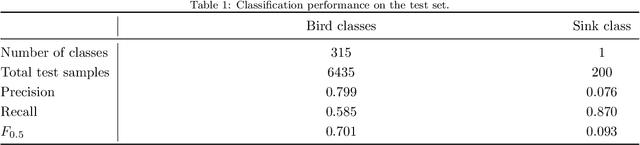

Changes in bird populations can indicate broader changes in ecosystems, making birds one of the most important animal groups to monitor. Combining machine learning and passive acoustics enables continuous monitoring over extended periods without direct human involvement. However, most existing techniques require extensive expert-labeled datasets for training and cannot easily detect time-overlapping calls in busy soundscapes. We propose a semi-supervised acoustic bird detector designed to allow both the detection of time-overlapping calls (when separated in frequency) and the use of few labeled training samples. The classifier is trained and evaluated on a combination of community-recorded open-source data and long-duration soundscape recordings from Singapore. It achieves a mean F0.5 score of 0.701 across 315 classes from 110 bird species on a hold-out test set, with an average of 11 labeled training samples per class. It outperforms the state-of-the-art BirdNET classifier on a test set of 103 bird species despite significantly fewer labeled training samples. The detector is further tested on 144 microphone-hours of continuous soundscape data. The rich soundscape in Singapore makes suppression of false positives a challenge on raw, continuous data streams. Nevertheless, we demonstrate that achieving high precision in such environments with minimal labeled training data is possible.