 Add to Chrome
 Add to Firefox
 Add to Edge
MzansiText and MzansiLM: An Open Corpus and Decoder-Only Language Model for South African Languages
Mar 21, 2026
Decoder-only language models can be adapted to diverse tasks through instruction finetuning, but the extent to which this generalizes at small scale for low-resource languages remains unclear. We focus on the languages of South Africa, where we are not aware of a publicly available decoder-only model that explicitly targets all eleven official written languages, nine of which are low-resource. We introduce MzansiText, a curated multilingual pretraining corpus with a reproducible filtering pipeline, and MzansiLM, a 125M-parameter language model trained from scratch. We evaluate MzansiLM on natural language understanding and generation using three adaptation regimes: monolingual task-specific finetuning, multilingual task-specific finetuning, and general multi-task instruction finetuning. Monolingual task-specific finetuning achieves strong performance on data-to-text generation, reaching 20.65 BLEU on isiXhosa and competing with encoder-decoder baselines over ten times larger. Multilingual task-specific finetuning benefits closely related languages on topic classification, achieving 78.5% macro-F1 on isiXhosa news classification. While MzansiLM adapts effectively to supervised NLU and NLG tasks, few-shot reasoning remains challenging at this model size, with performance near chance even for much larger decoder-only models. We release MzansiText and MzansiLM to provide a reproducible decoder-only baseline and clear guidance on adaptation strategies for South African languages at small scale.

Neural Morphological Tagging for Nguni Languages
May 19, 2025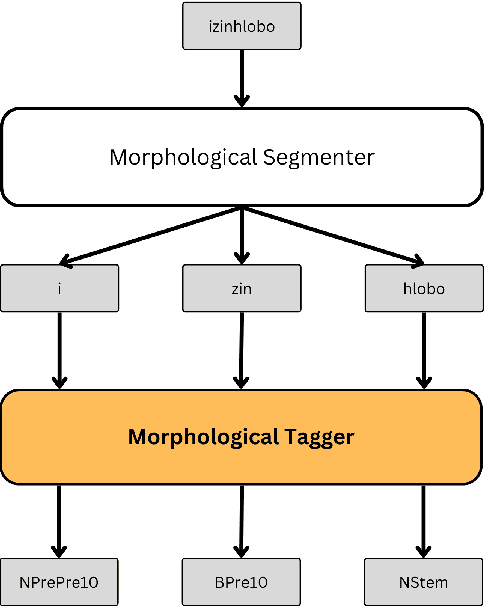
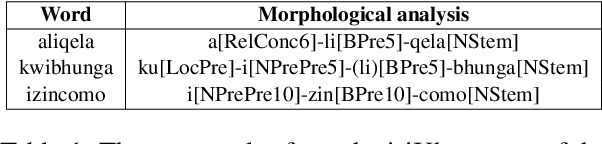

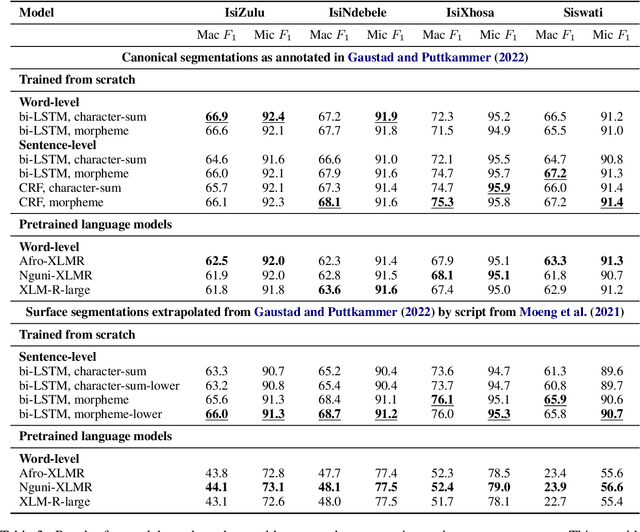
Morphological parsing is the task of decomposing words into morphemes, the smallest units of meaning in a language, and labelling their grammatical roles. It is a particularly challenging task for agglutinative languages, such as the Nguni languages of South Africa, which construct words by concatenating multiple morphemes. A morphological parsing system can be framed as a pipeline with two separate components, a segmenter followed by a tagger. This paper investigates the use of neural methods to build morphological taggers for the four Nguni languages. We compare two classes of approaches: training neural sequence labellers (LSTMs and neural CRFs) from scratch and finetuning pretrained language models. We compare performance across these two categories, as well as to a traditional rule-based morphological parser. Neural taggers comfortably outperform the rule-based baseline and models trained from scratch tend to outperform pretrained models. We also compare parsing results across different upstream segmenters and with varying linguistic input features. Our findings confirm the viability of employing neural taggers based on pre-existing morphological segmenters for the Nguni languages.