 Add to Chrome
 Add to Firefox
 Add to Edge
Three Modalities, Two Design Probes, One Prototype, and No Vision: Experience-Based Co-Design of a Multi-modal 3D Data Visualization Tool
Apr 10, 2026
Three-dimensional (3D) data visualizations, such as surface plots, are vital in STEM fields from biomedical imaging to spectroscopy, yet remain largely inaccessible to blind and low-vision (BLV) people. To address this gap, we conducted an Experience-Based Co-Design with BLV co-designers with expertise in non-visual data representations to create an accessible, multi-modal, web-native visualization tool. Using a multi-phase methodology, our team of five BLV and one non-BLV researcher(s) participated in two iterative sessions, comparing a low-fidelity tactile probe with a high-fidelity digital prototype. This process produced a prototype with empirically grounded features, including reference sonification, stereo and volumetric audio, and configurable buffer aggregation, which our co-designers validated as improving analytic accuracy and learnability. In this study, we target core analytic tasks essential for non-visual 3D data exploration: orientation, landmark and peak finding, comparing local maxima versus global trends, gradient tracing, and identifying occluded or partially hidden features. Our work offers accessibility researchers and developers a co-design protocol for translating tactile knowledge to digital interfaces, concrete design guidance for future systems, and opportunities to extend accessible 3D visualization into embodied data environments.

AltCanvas: A Tile-Based Image Editor with Generative AI for Blind or Visually Impaired People
Aug 05, 2024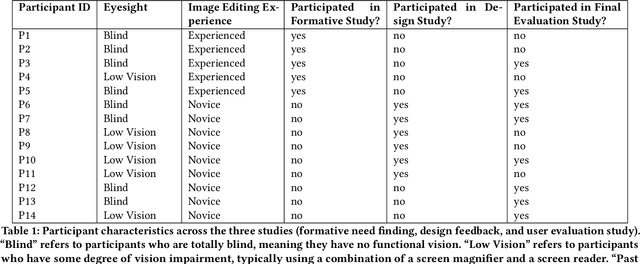
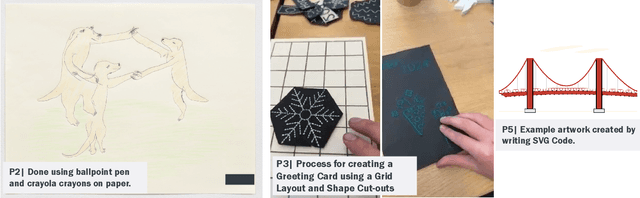
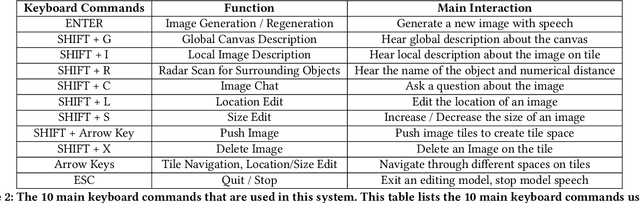
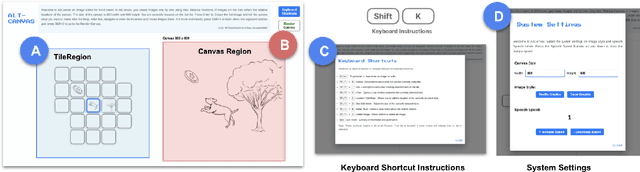
People with visual impairments often struggle to create content that relies heavily on visual elements, particularly when conveying spatial and structural information. Existing accessible drawing tools, which construct images line by line, are suitable for simple tasks like math but not for more expressive artwork. On the other hand, emerging generative AI-based text-to-image tools can produce expressive illustrations from descriptions in natural language, but they lack precise control over image composition and properties. To address this gap, our work integrates generative AI with a constructive approach that provides users with enhanced control and editing capabilities. Our system, AltCanvas, features a tile-based interface enabling users to construct visual scenes incrementally, with each tile representing an object within the scene. Users can add, edit, move, and arrange objects while receiving speech and audio feedback. Once completed, the scene can be rendered as a color illustration or as a vector for tactile graphic generation. Involving 14 blind or low-vision users in design and evaluation, we found that participants effectively used the AltCanvas workflow to create illustrations.