 Add to Chrome
 Add to Firefox
 Add to Edge
Context by Distinct Information: An Auditable Dirichlet-Process Working Memory for Long, Redundant Context Streams
Jul 11, 2026
Context engineering decides what information a model carries forward, and current designs meter it in tokens: compressing the past into a bounded recurrent state, keeping a key-value entry for every token, or imposing a fixed budget through a window or eviction rule. All three make the token the unit of memory even when the stream is redundant and the task depends on the distinct information it carries. Building on a companion mechanism paper that opens a cache slot only when an incoming key is novel, so memory scales with the number of distinct items rather than tokens, we develop that allocate-on-novelty cache as a working-memory component and organize context by how a task depends on the past: recall-carried information belongs in a content-addressed novelty cache, summary-carried information in a recurrent state, and locality-carried information in a recency window. The claim is empirical and bounded. On a matched character-level control, novelty-gated attention reaches full-attention performance while attending to about half the tokens, and coupling the cache with a state-space summary matches full-attention coupling at that reduced cost; the advantage grows as context lengthens, while a sliding window is preferable on short, locality-dominated spans. On next-code prediction over synthetic Medicare claims the coupled component leads full attention and every fixed-budget eviction policy at a thousand-event horizon, whereas cost forecasting over the same stream is summary-carried and the cache is neutral. The retained memory is an inspectable table of templates, codes, drugs, or places rather than an opaque state. The experiments are small-scale and use only public data; they establish the primitive that context can scale with distinct information rather than tokens, in a working memory that is content-addressable and auditable.

Remembering Distinct Items, Not Tokens: A Learnable Dirichlet-Process Cache Between State-Space Models and Attention
Jul 10, 2026Fixed-state sequence models compress an unbounded past into a bounded state, which caps their associative recall at roughly the state dimension; attention escapes the cap by keeping a key-value entry for every token, at quadratic compute and a cache that grows with the sequence. We study the middle ground: a sparse cache that allocates a slot only when an input is novel, so its size tracks the number of distinct items rather than the number of tokens. The allocation rule is the DP-means clustering rule, the small-variance limit of a Dirichlet-process mixture, used not as latent-variable inference but as the key-value memory operator for a deep recurrent backbone. We develop it in two forms, a static cache with a fixed concentration and a surprise-adaptive variant whose concentration follows the recent novelty rate. On a controlled associative-recall benchmark with redundancy we show that the cache matches full-attention recall while storing only the distinct items, that it dominates a fixed-budget eviction cache on the recall-versus-size frontier, and that on a state-space backbone it answers both a recall query and a long-range aggregate at the lowest memory of any model tested. The allocation is learnable end to end: a two-parameter novelty-threshold gate trained on the task loss alone recovers the rule exactly, whereas an over-parameterized gate fails, so the operative ingredient is the inductive bias rather than capacity. The evidence is a family of controlled mechanism studies at modest scale, with the distinct-items property confirmed on four real streams (recommendation, systems logs, clinical events, and insurance claims); a real-backbone, real-corpus language validation is pursued in a companion study.
Scaling Audio Models Efficiently: A Joint Study of Compute Constraints and Optimization Behavior
Jun 22, 2026In this paper, we investigate the tradeoffs between compute allocation and model performance for two speech processing tasks: Automatic Speech Recognition (ASR) and Speech Emotion Recognition (SER). We propose a unified framework that analyzes three fundamental compute dimensions: model size ($x_N$), input length ($x_T$), and representation resolution ($x_V$). Motivated by recent advances in compute optimal scaling for multimodal models, we systematically vary these dimensions to examine their influence on task performance under fixed computational budgets. Our study provides insights into how compute resources can be optimally distributed across model capacity, temporal context, and representational granularity, offering practical guidelines for the design of efficient speech models. Through experiments on LibriSpeech and CREMA-D datasets, we demonstrate non-linear scaling behavior and identify optimal operating points. Our results show that (1) increasing model size yields diminishing returns: scaling Tiny (39M) to Small (244M) reduces WER by 8.22%, whereas Small to Medium (769M) reduces WER by only 2.35%; (2) an optimal audio duration of approximately 4 seconds exists for SER; and (3) reducing encoder token resolution provides an effective mechanism for lowering inference cost, Large-v3 (1540M) with 750 frames requires 2572 GFLOPS whereas with 1500 frames requires 5228 GFLOPS, with less than 3% relative increase in WER. Additionally, LoRA-based adaptation enables efficient finetuning with minimal performance degradation.
A Stationarity-and-Coupling Criterion for Training-Free Time-Lagged Spectral Embeddings of Multivariate Time Series
Jun 11, 2026We study training-free fixed-length descriptors for multivariate time series and ask not merely whether such a descriptor performs well, but when it can be expected to work at all. Our object of study is $D(τ)$, built from a time-lagged correlation matrix truncated at the Marchenko-Pastur edge so that only signal-bearing eigenvalues survive and classified by cosine similarity to class centroids with zero learned parameters. The central contribution is not the descriptor but a falsifiable applicability criterion for it. Working from a stationary Gaussian VAR(1) model, we argue that $D(τ)$ separates two classes when the signals are approximately stationary and the class information lives in their cross-channel temporal coupling rather than in marginal per-channel power. We derive, semi-formally, three consequences: a distinguishability condition, why the static ($τ=0$) covariance collapses to chance, and why a stationary but power-discriminated paradigm defeats the descriptor. The criterion is operational: a two-part pre-flight test -- an augmented Dickey-Fuller stationarity check and a power-baseline saturation check -- predicts applicability before any training. We validate both halves on a mixed assortment. On four paradigms that satisfy the criterion (Sleep-EDF, BCI-IV-2a, MIT-BIH, ESC-50) the descriptor is competitive with strong baselines at a fraction of their cost, reaching $88.5\pm4.5\%$ under 20-subject leave-one-subject-out on Sleep-EDF on a single CPU thread. On three that violate it -- non-stationary ERPs, and financial-volatility and wearable-stress regimes that are power-discriminated -- it fails exactly as the pre-flight predicts, and these negatives are the more informative half. We are explicit that $D(τ)$ is not the most accurate representation; its value is a compact, training-free embedding whose domain of validity is known in advance.
Optimal Direct-Connect Topologies for Collective Communications
Feb 07, 2022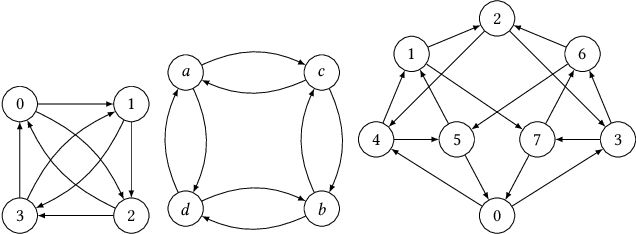
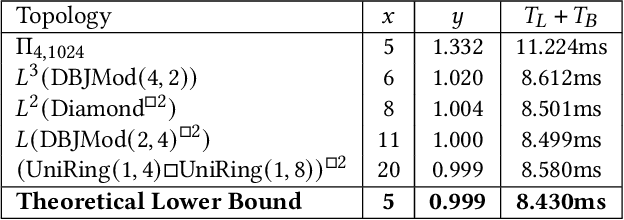
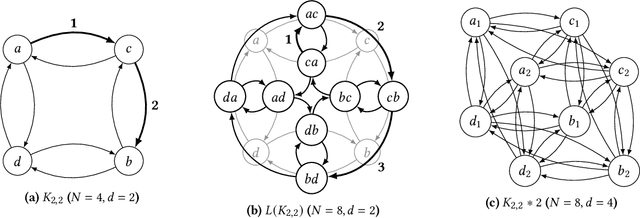
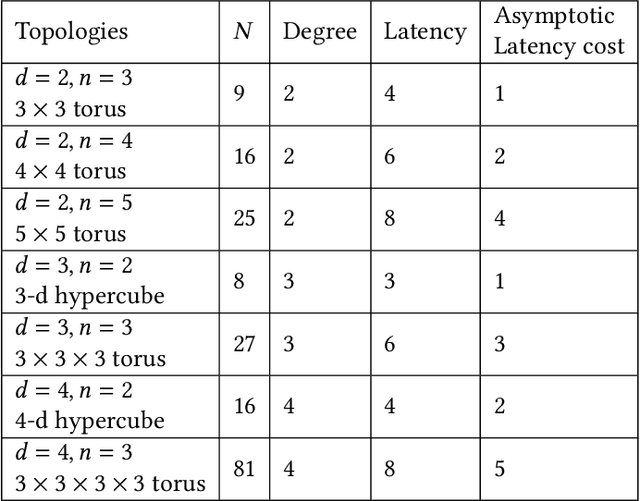
We consider the problem of distilling optimal network topologies for collective communications. We provide an algorithmic framework for constructing direct-connect topologies optimized for the latency-bandwidth tradeoff given a collective communication workload. Our algorithmic framework allows us to start from small base topologies and associated communication schedules and use a set of techniques that can be iteratively applied to derive much larger topologies and associated schedules. Our approach allows us to synthesize many different topologies and schedules for a given cluster size and degree constraint, and then identify the optimal topology for a given workload. We provide an analytical-model-based evaluation of the derived topologies and results on a small-scale optical testbed that uses patch panels for configuring a topology for the duration of an application's execution. We show that the derived topologies and schedules provide significant performance benefits over existing collective communications implementations.
Sparse Diffusion-Convolutional Neural Networks
Oct 26, 2017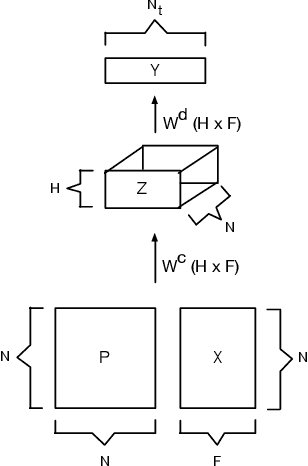
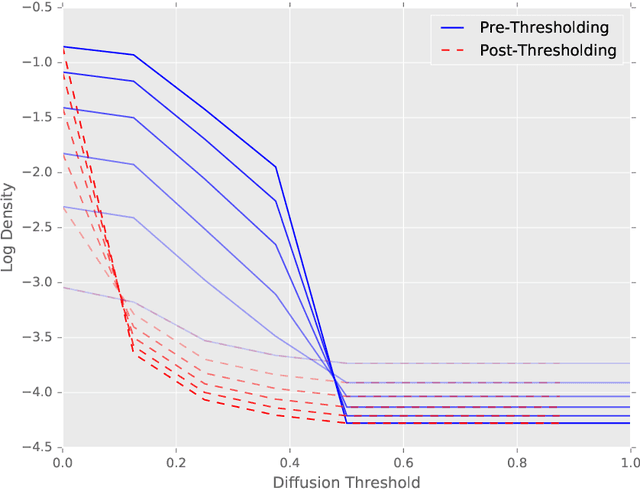
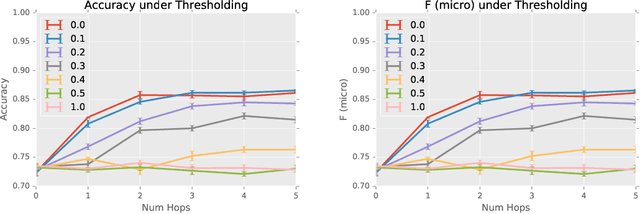
The predictive power and overall computational efficiency of Diffusion-convolutional neural networks make them an attractive choice for node classification tasks. However, a naive dense-tensor-based implementation of DCNNs leads to $\mathcal{O}(N^2)$ memory complexity which is prohibitive for large graphs. In this paper, we introduce a simple method for thresholding input graphs that provably reduces memory requirements of DCNNs to O(N) (i.e. linear in the number of nodes in the input) without significantly affecting predictive performance.