 Add to Chrome
 Add to Firefox
 Add to Edge
Federated Learning for Video Violence Detection: Complementary Roles of Lightweight CNNs and Vision-Language Models for Energy-Efficient Use
Nov 10, 2025
Deep learning-based video surveillance increasingly demands privacy-preserving architectures with low computational and environmental overhead. Federated learning preserves privacy but deploying large vision-language models (VLMs) introduces major energy and sustainability challenges. We compare three strategies for federated violence detection under realistic non-IID splits on the RWF-2000 and RLVS datasets: zero-shot inference with pretrained VLMs, LoRA-based fine-tuning of LLaVA-NeXT-Video-7B, and personalized federated learning of a 65.8M-parameter 3D CNN. All methods exceed 90% accuracy in binary violence detection. The 3D CNN achieves superior calibration (ROC AUC 92.59%) at roughly half the energy cost (240 Wh vs. 570 Wh) of federated LoRA, while VLMs provide richer multimodal reasoning. Hierarchical category grouping (based on semantic similarity and class exclusion) boosts VLM multiclass accuracy from 65.31% to 81% on the UCF-Crime dataset. To our knowledge, this is the first comparative simulation study of LoRA-tuned VLMs and personalized CNNs for federated violence detection, with explicit energy and CO2e quantification. Our results inform hybrid deployment strategies that default to efficient CNNs for routine inference and selectively engage VLMs for complex contextual reasoning.

Exploring Personalized Federated Learning Architectures for Violence Detection in Surveillance Videos
Apr 01, 2025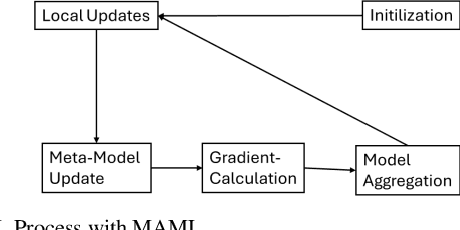
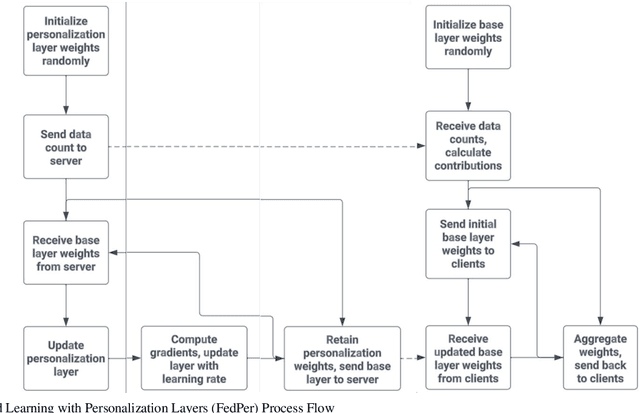
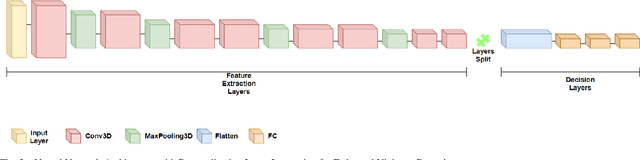
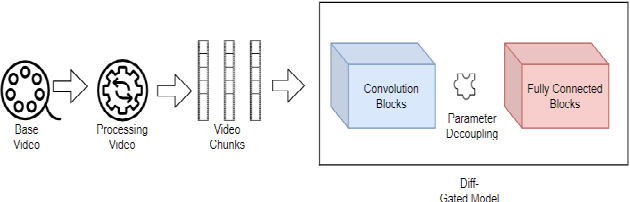
The challenge of detecting violent incidents in urban surveillance systems is compounded by the voluminous and diverse nature of video data. This paper presents a targeted approach using Personalized Federated Learning (PFL) to address these issues, specifically employing the Federated Learning with Personalization Layers method within the Flower framework. Our methodology adapts learning models to the unique data characteristics of each surveillance node, effectively managing the heterogeneous and non-IID nature of surveillance video data. Through rigorous experiments conducted on balanced and imbalanced datasets, our PFL models demonstrated enhanced accuracy and efficiency, achieving up to 99.3% accuracy. This study underscores the potential of PFL to significantly improve the scalability and effectiveness of surveillance systems, offering a robust, privacy-preserving solution for violence detection in complex urban environments.