 Add to Chrome
 Add to Firefox
 Add to Edge
Domain-Adaptive Climate Downscaling Under Temporal Distribution Shift
Jul 06, 2026
Deep-learning-based climate downscaling aims to learn relationships from historical low-resolution (LR) and high-resolution (HR) climate data to generate HR climate projections. However, this setting faces a temporal out-of-distribution (OOD) challenge: models trained on historical data are commonly applied to future projections whose distributions may differ substantially from the training period. This study investigates temporal OOD shift for daily temperature downscaling over the Continental United States using paired LR-HR model simulations. We propose a temporal domain-adaptive downscaling framework that combines supervised HR reconstruction on historical data with domain alignment between historical and future climate distributions. Experiments across future validation periods show that the proposed domain-adaptive model consistently outperforms statistical and deep-learning-based bias-correction methods, with the largest gains occurring when the temporal distribution shift is strongest. Spatial analyses indicate stronger improvements over high-elevation and topographically complex regions, along with higher spatiotemporal correlation with the HR target. The extreme analysis shows that domain adaptation also reduces upper-tail temperature bias relative to the non-adaptive model. These results demonstrate that temporal domain adaptation can improve the robustness of HR climate projections under non-stationary climate conditions.

climt-paraformer: Stable Emulation of Convective Parameterization using a Temporal Memory-aware Transformer
Apr 22, 2026Accurate representation of moist convective sub-grid-scale processes remains a major challenge in global climate models, as traditional parameterization schemes are both computationally expensive and difficult to scale. Neural network (NN) emulators offer a promising alternative by learning efficient mappings between atmospheric states and convective tendencies while retaining fidelity to the underlying physics. However, most existing NN-based parameterizations are memory-less and rely only on instantaneous inputs, even though convection evolves over time and depends on prior atmospheric states. Recent studies have begun to incorporate convective memory, but they often treat past states as independent features rather than modeling temporal dependencies explicitly. In this work, we develop a temporal memory-aware Transformer emulator for the Emanuel convective parameterization and evaluate it in a single-column climate model (SCM) under both offline and online configurations. The Transformer captures temporal correlations and nonlinear interactions across consecutive atmospheric states. Compared with baseline emulators, including a memory-less multilayer perceptron and a recurrent long short-term memory model, the Transformer achieves lower offline errors. Sensitivity analysis indicates that a memory length of approximately 100 minutes yields the best performance, whereas longer memory degrades performance. We further test the emulator in long-term coupled simulations and show that it remains stable over 10 years. Overall, this study demonstrates the importance of explicit temporal modeling for NN-based parameterizations.
Paraformer: Parameterization of Sub-grid Scale Processes Using Transformers
Dec 21, 2024
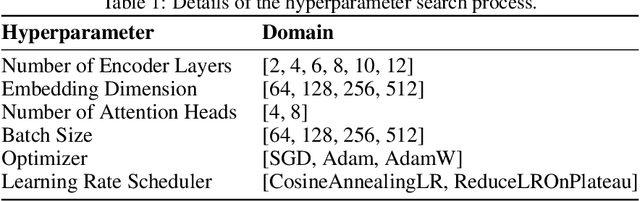
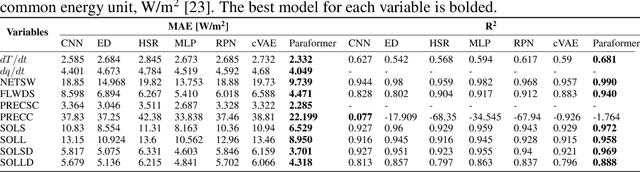
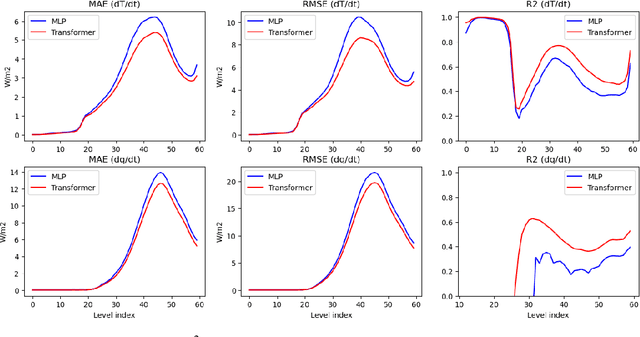
One of the major sources of uncertainty in the current generation of Global Climate Models (GCMs) is the representation of sub-grid scale physical processes. Over the years, a series of deep-learning-based parameterization schemes have been developed and tested on both idealized and real-geography GCMs. However, datasets on which previous deep-learning models were trained either contain limited variables or have low spatial-temporal coverage, which can not fully simulate the parameterization process. Additionally, these schemes rely on classical architectures while the latest attention mechanism used in Transformer models remains unexplored in this field. In this paper, we propose Paraformer, a "memory-aware" Transformer-based model on ClimSim, the largest dataset ever created for climate parameterization. Our results demonstrate that the proposed model successfully captures the complex non-linear dependencies in the sub-grid scale variables and outperforms classical deep-learning architectures. This work highlights the applicability of the attenuation mechanism in this field and provides valuable insights for developing future deep-learning-based climate parameterization schemes.