 Add to Chrome
 Add to Firefox
 Add to Edge
An Omnilingual-ASR-Based Speech-LLM System for the 2nd MLC-SLM Challenge
Jul 14, 2026
We describe our submission to Task 1 of the 2nd MLCSLM Challenge: a cascaded diarization-then-recognition system that combines DiariZen-Large-s80 (WavLM-Large) segmentation, CAM++ embedding-based two-speaker clustering, and a LoRA-adapted omniASR LLM 7B v2 recognizer, with no oracle segmentation or speaker labels at test time. On the official Development set (150 conversations, 21 language/accent categories) the system attains a macro tcpMER of 29.27%, versus 79.15% for the official baseline; on the Evaluation set it scores 50.23%. We also analyze two engineering choices that substantially affect tcpMER. First, embedding-based speaker clustering outperforms an end-to-end-style alternative that assigns speakers from ASR <sc> turn markers alone. Second, overlap-aware segmentation, although intended to raise diarization recall, increases tcpMER because overlapped speech is transcribed twice.

Transsion TSUP's speech recognition system for ASRU 2023 MADASR Challenge
Jul 20, 2023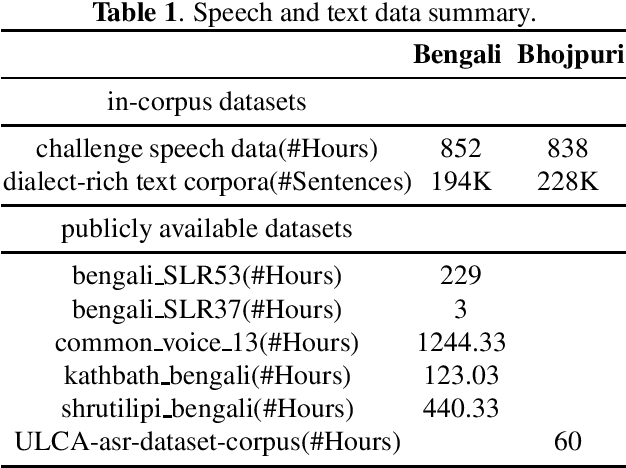
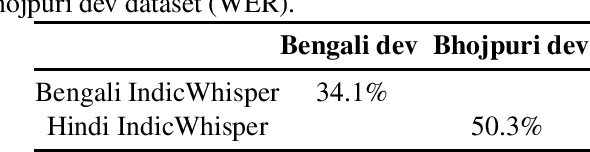
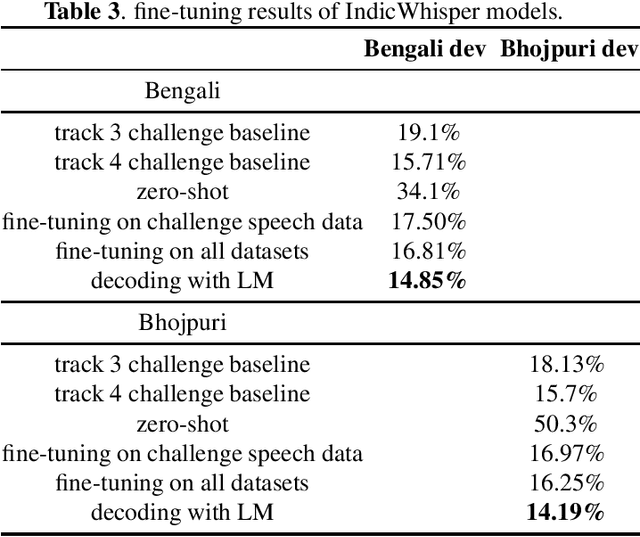
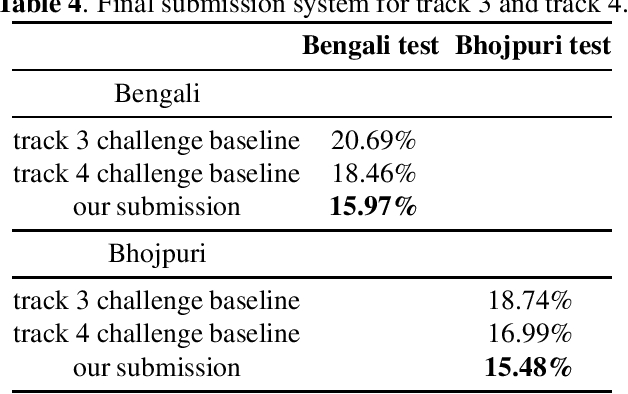
This paper presents a speech recognition system developed by the Transsion Speech Understanding Processing Team (TSUP) for the ASRU 2023 MADASR Challenge. The system focuses on adapting ASR models for low-resource Indian languages and covers all four tracks of the challenge. For tracks 1 and 2, the acoustic model utilized a squeezeformer encoder and bidirectional transformer decoder with joint CTC-Attention training loss. Additionally, an external KenLM language model was used during TLG beam search decoding. For tracks 3 and 4, pretrained IndicWhisper models were employed and finetuned on both the challenge dataset and publicly available datasets. The whisper beam search decoding was also modified to support an external KenLM language model, which enabled better utilization of the additional text provided by the challenge. The proposed method achieved word error rates (WER) of 24.17%, 24.43%, 15.97%, and 15.97% for Bengali language in the four tracks, and WER of 19.61%, 19.54%, 15.48%, and 15.48% for Bhojpuri language in the four tracks. These results demonstrate the effectiveness of the proposed method.