 Add to Chrome
 Add to Firefox
 Add to Edge
Truthful Online Preference Aggregation for LLM Fine-Tuning in Mobile Crowdsourcing
May 22, 2026
To better serve users' demands in mobile applications (e.g., navigation), mobile crowdsourcing platforms can iteratively align large language model (LLM)-generated content (e.g., AI-generated traffic condition predictions) with human feedback collected from crowdsourcing workers (e.g., mobile users). However, workers may strategically misreport their online preference feedback to maximize their influence or payment. Existing pipelines in mobile crowdsourcing (e.g., EM-based weight estimation) fail to identify the most accurate worker in this online setting, resulting in a linear regret $\mathcal{O}(T)$ over $T$ time slots. In this paper, we study truthful online preference aggregation for LLM fine-tuning in mobile crowdsourcing. We formulate a new dynamic Bayesian game to model the multi-agent online learning process between the platform and strategic mobile workers. We propose a novel online weighted aggregation mechanism that dynamically adjusts each worker's weight in the preference aggregation according to their feedback accuracy. We prove that our mechanism ensures truthful feedback from strategic workers and achieves a sublinear regret $\mathcal{O}(\sqrt{T})$ over $T$ time slots. We further extend our mechanism to a challenging scenario with limited worker feedback per time slot, still guaranteeing a sublinear regret $\mathcal{O}(\sqrt{T})$. Experiments on LLM fine-tuning with real-world datasets further demonstrate significant performance gains of our mechanisms over benchmark schemes.

Online Learning from Strategic Human Feedback in LLM Fine-Tuning
Dec 24, 2024Reinforcement learning from human feedback (RLHF) has become an essential step in fine-tuning large language models (LLMs) to align them with human preferences. However, human labelers are selfish and have diverse preferences. They may strategically misreport their online feedback to influence the system's aggregation towards their own preferences. Current practice simply averages labelers' feedback per time and fails to identify the most accurate human labeler, leading to linear regret $\mathcal{O}(T)$ for $T$ time slots. To our best knowledge, we are the first to study online learning mechanisms against strategic human labelers in the LLM fine-tuning process. We formulate a new dynamic Bayesian game and dynamically adjust human labelers' weights in the preference aggregation, ensuring their truthful feedback and sublinear regret $\mathcal{O}(T^{1/2})$. Simulation results demonstrate our mechanism's great advantages over the existing benchmark schemes.
Algorithm Design for Continual Learning in IoT Networks
Dec 24, 2024
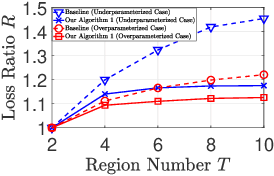
Continual learning (CL) is a new online learning technique over sequentially generated streaming data from different tasks, aiming to maintain a small forgetting loss on previously-learned tasks. Existing work focuses on reducing the forgetting loss under a given task sequence. However, if similar tasks continuously appear to the end time, the forgetting loss is still huge on prior distinct tasks. In practical IoT networks, an autonomous vehicle to sample data and learn different tasks can route and alter the order of task pattern at increased travelling cost. To our best knowledge, we are the first to study how to opportunistically route the testing object and alter the task sequence in CL. We formulate a new optimization problem and prove it NP-hard. We propose a polynomial-time algorithm to achieve approximation ratios of $\frac{3}{2}$ for underparameterized case and $\frac{3}{2} + r^{1-T}$ for overparameterized case, respectively, where $r:=1-\frac{n}{m}$ is a parameter of feature number $m$ and sample number $n$ and $T$ is the task number. Simulation results verify our algorithm's close-to-optimum performance.