 Add to Chrome
 Add to Firefox
 Add to Edge
HERMES: a multi-agent framework for structured knowledge extraction from ultra-long documents in geoscience
Aug 14, 2026
Authoritative scientific knowledge in geoscience remains largely trapped in legacy monographs and historical literature, where unstructured text and complex layouts hinder computational access. We introduce HERMES, a scalable multi-agent framework that extracts structured data from ultra-long scientific documents. Using a coordinating large language model, HERMES integrates domain constraints, validation rules and evidence tracing within a unified document-level extraction process that incorporates parsed text, tables, figures and captions. Applied to the 55-volume Treatise on Invertebrate Paleontology, the system produced a structured database of 32,277 fossil taxonomic entities and 451,878 attributes, released online at https://treatise.geolex.org. Extraction performance remained stable across fossil groups (average F1 scores of approximately 0.90 for entities and 0.91 for attributes), improving per-volume efficiency approximately sixfold relative to the tested fully manual baseline. Evaluation in palaeomagnetism and geochemistry, conducted without additional model training, demonstrated transfer across distinct geoscience domains. This work provides a practical pathway to transform historical scientific literature into FAIR-oriented structured data, offering a sustainable infrastructure for data-intensive disciplines and large-scale knowledge integration.

Fradulent User Detection Via Behavior Information Aggregation Network (BIAN) On Large-Scale Financial Social Network
Nov 04, 2022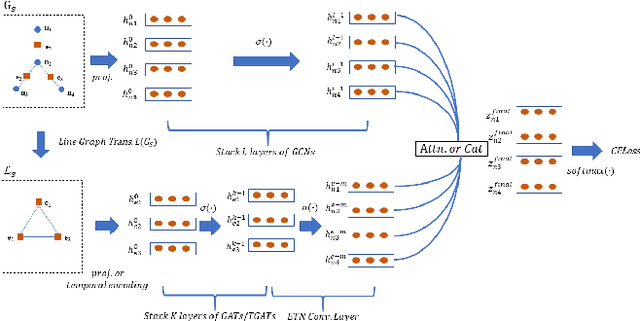


Financial frauds cause billions of losses annually and yet it lacks efficient approaches in detecting frauds considering user profile and their behaviors simultaneously in social network . A social network forms a graph structure whilst Graph neural networks (GNN), a promising research domain in Deep Learning, can seamlessly process non-Euclidean graph data . In financial fraud detection, the modus operandi of criminals can be identified by analyzing user profile and their behaviors such as transaction, loaning etc. as well as their social connectivity. Currently, most GNNs are incapable of selecting important neighbors since the neighbors' edge attributes (i.e., behaviors) are ignored. In this paper, we propose a novel behavior information aggregation network (BIAN) to combine the user behaviors with other user features. Different from its close "relatives" such as Graph Attention Networks (GAT) and Graph Transformer Networks (GTN), it aggregates neighbors based on neighboring edge attribute distribution, namely, user behaviors in financial social network. The experimental results on a real-world large-scale financial social network dataset, DGraph, show that BIAN obtains the 10.2% gain in AUROC comparing with the State-Of-The-Art models.