 Add to Chrome
 Add to Firefox
 Add to Edge
LUMOS: Democratizing SciML Workflows with L0-Regularized Learning for Unified Feature and Parameter Adaptation
Feb 26, 2026
The rapid growth of scientific machine learning (SciML) has accelerated discovery across diverse domains, yet designing effective SciML models remains a challenging task. In practice, building such models often requires substantial prior knowledge and manual expertise, particularly in determining which input features to use and how large the model should be. We introduce LUMOS, an end-to-end framework based on L0-regularized learning that unifies feature selection and model pruning to democratize SciML model design. By employing semi-stochastic gating and reparameterization techniques, LUMOS dynamically selects informative features and prunes redundant parameters during training, reducing the reliance on manual tuning while maintaining predictive accuracy. We evaluate LUMOS across 13 diverse SciML workloads, including cosmology and molecular sciences, and demonstrate its effectiveness and generalizability. Experiments on 13 SciML models show that LUMOS achieves 71.45% parameter reduction and a 6.4x inference speedup on average. Furthermore, Distributed Data Parallel (DDP) training on up to eight GPUs confirms the scalability of

PAC Learnability under Explanation-Preserving Graph Perturbations
Feb 07, 2024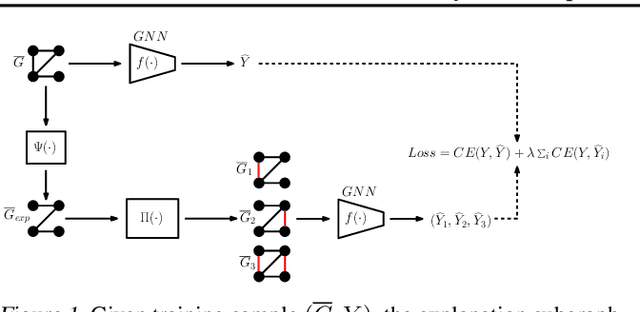
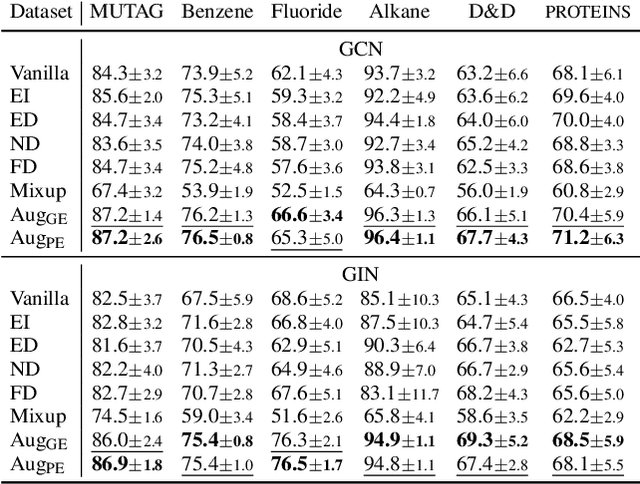
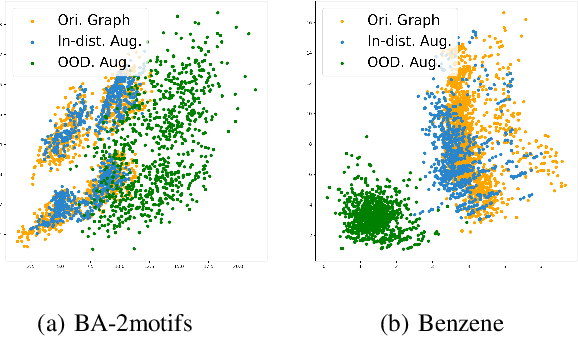
Graphical models capture relations between entities in a wide range of applications including social networks, biology, and natural language processing, among others. Graph neural networks (GNN) are neural models that operate over graphs, enabling the model to leverage the complex relationships and dependencies in graph-structured data. A graph explanation is a subgraph which is an `almost sufficient' statistic of the input graph with respect to its classification label. Consequently, the classification label is invariant, with high probability, to perturbations of graph edges not belonging to its explanation subgraph. This work considers two methods for leveraging such perturbation invariances in the design and training of GNNs. First, explanation-assisted learning rules are considered. It is shown that the sample complexity of explanation-assisted learning can be arbitrarily smaller than explanation-agnostic learning. Next, explanation-assisted data augmentation is considered, where the training set is enlarged by artificially producing new training samples via perturbation of the non-explanation edges in the original training set. It is shown that such data augmentation methods may improve performance if the augmented data is in-distribution, however, it may also lead to worse sample complexity compared to explanation-agnostic learning rules if the augmented data is out-of-distribution. Extensive empirical evaluations are provided to verify the theoretical analysis.
HurriCast: An Automatic Framework Using Machine Learning and Statistical Modeling for Hurricane Forecasting
Sep 12, 2023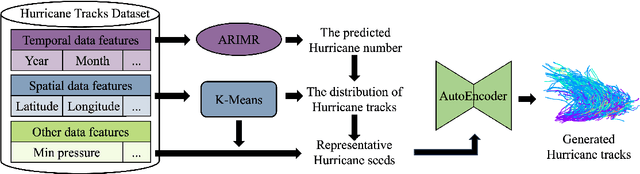
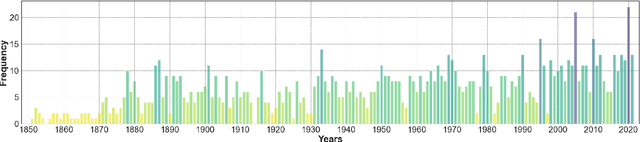
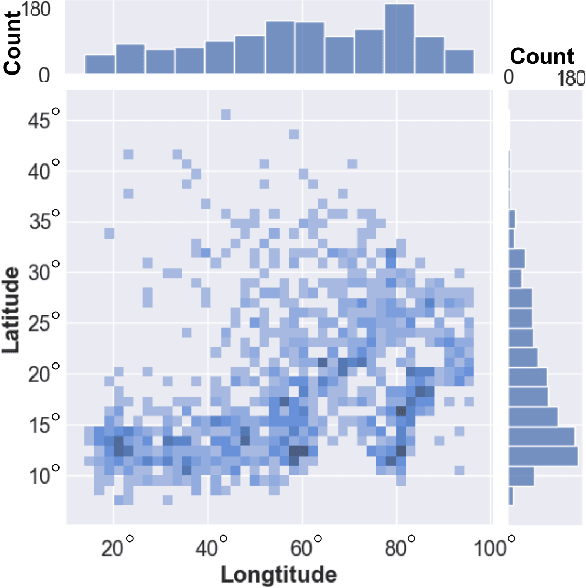
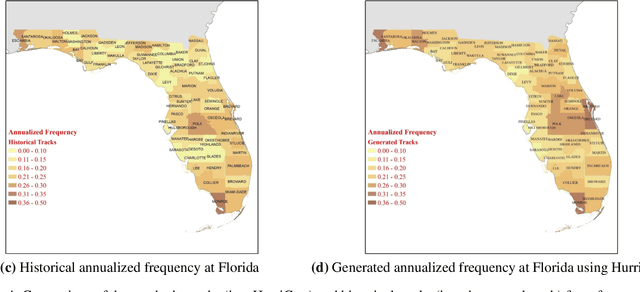
Hurricanes present major challenges in the U.S. due to their devastating impacts. Mitigating these risks is important, and the insurance industry is central in this effort, using intricate statistical models for risk assessment. However, these models often neglect key temporal and spatial hurricane patterns and are limited by data scarcity. This study introduces a refined approach combining the ARIMA model and K-MEANS to better capture hurricane trends, and an Autoencoder for enhanced hurricane simulations. Our experiments show that this hybrid methodology effectively simulate historical hurricane behaviors while providing detailed projections of potential future trajectories and intensities. Moreover, by leveraging a comprehensive yet selective dataset, our simulations enrich the current understanding of hurricane patterns and offer actionable insights for risk management strategies.