 Add to Chrome
 Add to Firefox
 Add to Edge
Back to the Future: The Role of Past and Future Context Predictability in Incremental Language Production
Nov 12, 2025
Contextual predictability shapes both the form and choice of words in online language production. The effects of the predictability of a word given its previous context are generally well-understood in both production and comprehension, but studies of naturalistic production have also revealed a poorly-understood backward predictability effect of a word given its future context, which may be related to future planning. Here, in two studies of naturalistic speech corpora, we investigate backward predictability effects using improved measures and more powerful language models, introducing a new principled and conceptually motivated information-theoretic predictability measure that integrates predictability from both the future and the past context. Our first study revisits classic predictability effects on word duration. Our second study investigates substitution errors within a generative framework that independently models the effects of lexical, contextual, and communicative factors on word choice, while predicting the actual words that surface as speech errors. We find that our proposed conceptually-motivated alternative to backward predictability yields qualitatively similar effects across both studies. Through a fine-grained analysis of substitution errors, we further show that different kinds of errors are suggestive of how speakers prioritize form, meaning, and context-based information during lexical planning. Together, these findings illuminate the functional roles of past and future context in how speakers encode and choose words, offering a bridge between contextual predictability effects and the mechanisms of sentence planning.

SPACER: A Parallel Dataset of Speech Production And Comprehension of Error Repairs
Mar 20, 2025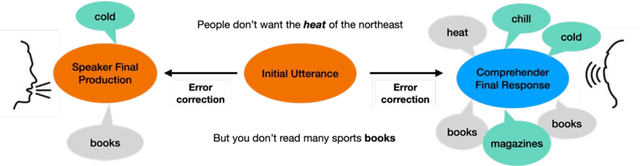
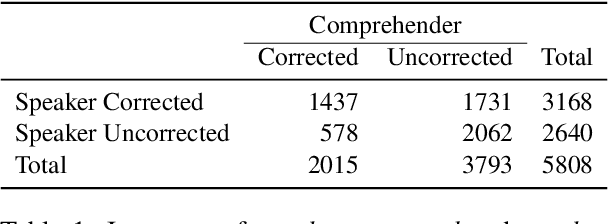

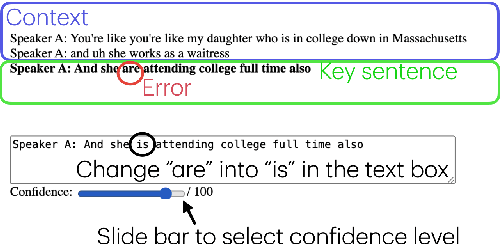
Speech errors are a natural part of communication, yet they rarely lead to complete communicative failure because both speakers and comprehenders can detect and correct errors. Although prior research has examined error monitoring and correction in production and comprehension separately, integrated investigation of both systems has been impeded by the scarcity of parallel data. In this study, we present SPACER, a parallel dataset that captures how naturalistic speech errors are corrected by both speakers and comprehenders. We focus on single-word substitution errors extracted from the Switchboard corpus, accompanied by speaker's self-repairs and comprehenders' responses from an offline text-editing experiment. Our exploratory analysis suggests asymmetries in error correction strategies: speakers are more likely to repair errors that introduce greater semantic and phonemic deviations, whereas comprehenders tend to correct errors that are phonemically similar to more plausible alternatives or do not fit into prior contexts. Our dataset enables future research on integrated approaches toward studying language production and comprehension.