 Add to Chrome
 Add to Firefox
 Add to Edge
SECite: Analyzing and Summarizing Citations in Software Engineering Literature
Jan 12, 2026
Identifying the strengths and limitations of a research paper is a core component of any literature review. However, traditional summaries reflect only the authors' self-presented perspective. Analyzing how other researchers discuss and cite the paper can offer a deeper, more practical understanding of its contributions and shortcomings. In this research, we introduce SECite, a novel approach for evaluating scholarly impact through sentiment analysis of citation contexts. We develop a semi-automated pipeline to extract citations referencing nine research papers and apply advanced natural language processing (NLP) techniques with unsupervised machine learning to classify these citation statements as positive or negative. Beyond sentiment classification, we use generative AI to produce sentiment-specific summaries that capture the strengths and limitations of each target paper, derived both from clustered citation groups and from the full text. Our findings reveal meaningful patterns in how the academic community perceives these works, highlighting areas of alignment and divergence between external citation feedback and the authors' own presentation. By integrating citation sentiment analysis with LLM-based summarization, this study provides a comprehensive framework for assessing scholarly contributions.

EmoXpt: Analyzing Emotional Variances in Human Comments and LLM-Generated Responses
Jan 11, 2025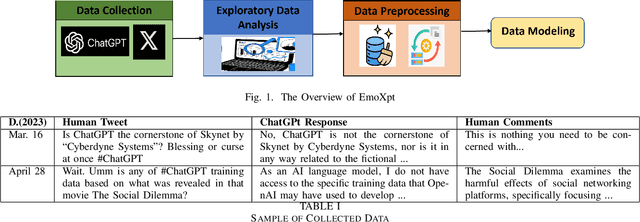
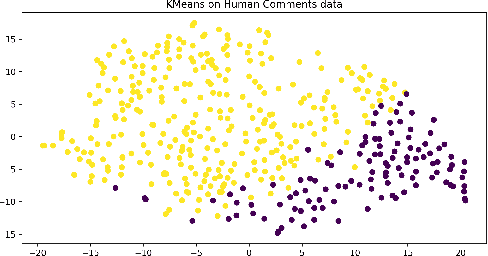
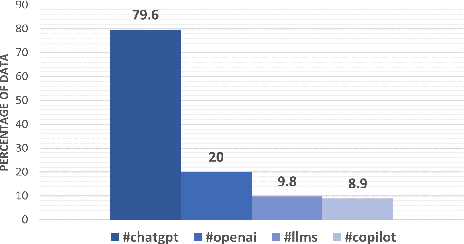
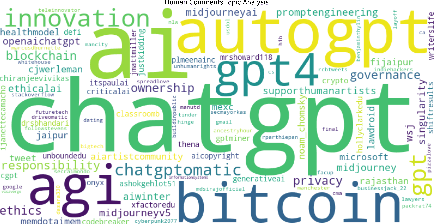
The widespread adoption of generative AI has generated diverse opinions, with individuals expressing both support and criticism of its applications. This study investigates the emotional dynamics surrounding generative AI by analyzing human tweets referencing terms such as ChatGPT, OpenAI, Copilot, and LLMs. To further understand the emotional intelligence of ChatGPT, we examine its responses to selected tweets, highlighting differences in sentiment between human comments and LLM-generated responses. We introduce EmoXpt, a sentiment analysis framework designed to assess both human perspectives on generative AI and the sentiment embedded in ChatGPT's responses. Unlike prior studies that focus exclusively on human sentiment, EmoXpt uniquely evaluates the emotional expression of ChatGPT. Experimental results demonstrate that LLM-generated responses are notably more efficient, cohesive, and consistently positive than human responses.