 Add to Chrome
 Add to Firefox
 Add to Edge
D-CLING: Prior-Preserving Depth-Conditioned Fine-Tuning for Navigation Foundation Models
May 19, 2026
Navigation Foundation Models (NFMs) trained on large cross-embodied datasets have demonstrated powerful generalizability in various scenarios. Adopting in-domain fine-tuning for an NFM efficiently calibrates the visuomotor policy, promising further improvement even in a novel scenario. However, the fine-tuned models still suffer from poor obstacle avoidance or fail to properly reach the provided goals. Furthermore, model updates using a small subset of data typically erode the pre-trained prior, compromising the pre-training generalization. Consequently, fine-tuning deteriorates the capability of the model for robust and accurate navigation. In this work, we present a novel fine-tuning method that leverages large-scale pre-training while efficiently learning in novel setups, such as environments or camera configurations. In particular, inspired by ControlNet, we fine-tune an NFM by attaching a trainable copy of the pre-trained backbone using zero-initialized residual pathways, thereby learning geometric cues. This design enables the model to efficiently acquire in-domain geometry while preserving pre-trained knowledge across various behaviors. Despite its simplicity, our comprehensive evaluation of real-world navigation suggests that our proposal effectively enables robust long-horizon navigation with minimal collisions and human intervention. Additionally, our offline analysis shows that the proposed method maintains or further improves action prediction capabilities beyond the fine-tuned dataset, providing a key insight into continual learning for general navigation. The project page: https://toyotafrc.github.io/DCLING-Proj/

CLIP-Loc: Multi-modal Landmark Association for Global Localization in Object-based Maps
Feb 08, 2024
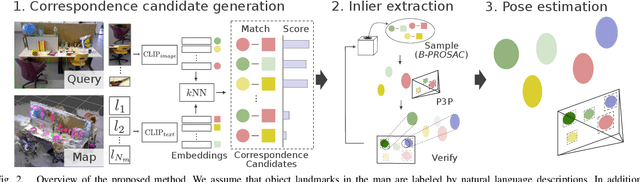
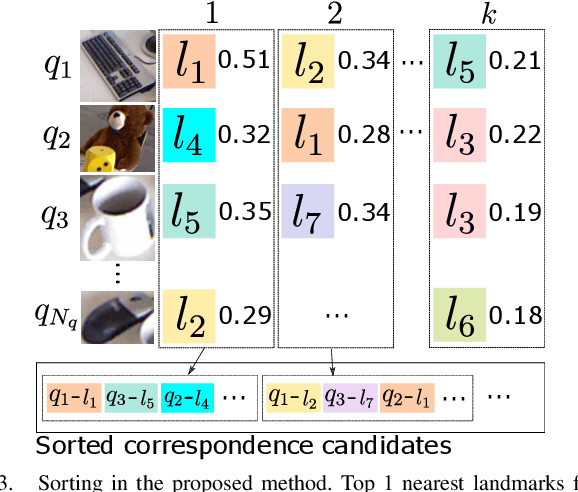
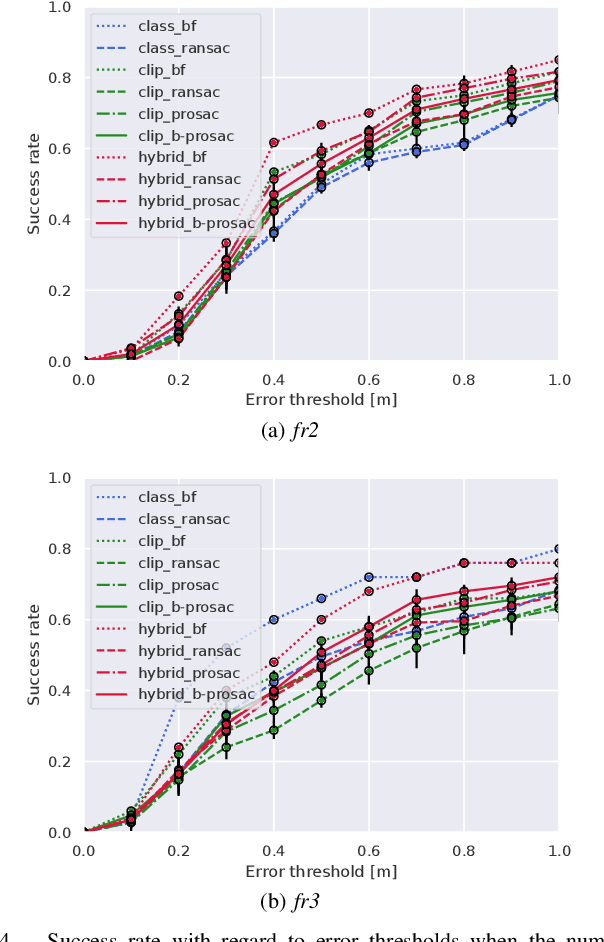
This paper describes a multi-modal data association method for global localization using object-based maps and camera images. In global localization, or relocalization, using object-based maps, existing methods typically resort to matching all possible combinations of detected objects and landmarks with the same object category, followed by inlier extraction using RANSAC or brute-force search. This approach becomes infeasible as the number of landmarks increases due to the exponential growth of correspondence candidates. In this paper, we propose labeling landmarks with natural language descriptions and extracting correspondences based on conceptual similarity with image observations using a Vision Language Model (VLM). By leveraging detailed text information, our approach efficiently extracts correspondences compared to methods using only object categories. Through experiments, we demonstrate that the proposed method enables more accurate global localization with fewer iterations compared to baseline methods, exhibiting its efficiency.