 Add to Chrome
 Add to Firefox
 Add to Edge
GeneralThinker: Domain-General Reasoning through Likelihood-Guided Answer-Conditioned Optimization
May 27, 2026
Reinforcement learning with verifiable rewards improves language model reasoning, but its reliance on domain-specific verifiers, sparse outcome rewards, and coarse-grained credit assignment limits its applicability. We introduce GeneralThinker, an on-policy framework that reformulates reasoning supervision as dense answer-conditioned optimization, enabling response-level evaluation and token-level credit assignment without domain-specific verifiers. GeneralThinker evaluates generated reasoning trajectories using the likelihood of the ground-truth answer and derives token-wise compatibility signals for fine-grained credit assignment. To stabilize optimization, it constrains token-level updates through clipping and direction-preserving modulation. Across 11 benchmarks spanning mathematics, STEM, and general reasoning, GeneralThinker achieves the best average performance. Further analyses show that uncontrolled token-level modulation can destabilize training, whereas controlled modulation makes fine-grained credit assignment consistently effective.

SpiralThinker: Latent Reasoning through an Iterative Process with Text-Latent Interleaving
Nov 12, 2025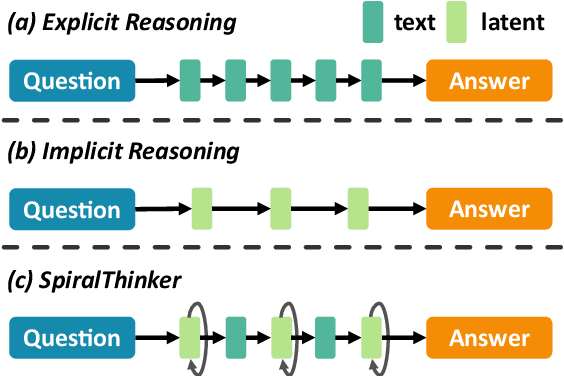
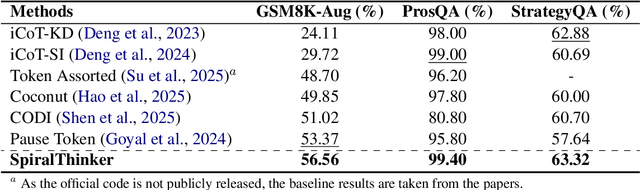
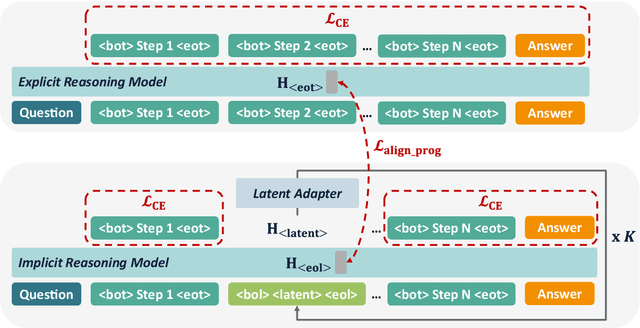

Recent advances in large reasoning models have been driven by reinforcement learning and test-time scaling, accompanied by growing interest in latent rather than purely textual reasoning. However, existing latent reasoning methods lack mechanisms to ensure stable evolution of latent representations and a systematic way to interleave implicit and explicit reasoning. We introduce SpiralThinker, a unified framework that performs iterative updates over latent representations, enabling extended implicit reasoning without generating additional tokens. A progressive alignment objective combined with structured annotations maintains coherence between latent and textual reasoning. Across mathematical, logical, and commonsense reasoning tasks, SpiralThinker achieves the best overall performance among latent reasoning approaches, consistently surpassing previous methods across all benchmarks. Detailed analyses reveal that both iteration and alignment are indispensable, the numbers of latent tokens and iterations exhibit dataset-specific optima, and appropriate alignment proves critical for an effective iterative process. Overall, SpiralThinker bridges iterative computation and latent reasoning, demonstrating that aligned iterative updates can reliably steer reasoning in the latent space.
TinyThinker: Distilling Reasoning through Coarse-to-Fine Knowledge Internalization with Self-Reflection
Dec 11, 2024Large Language Models exhibit impressive reasoning capabilities across diverse tasks, motivating efforts to distill these capabilities into smaller models through generated reasoning data. However, direct training on such synthesized reasoning data may lead to superficial imitation of reasoning process, rather than fostering a genuine integration of reasoning capabilities with underlying knowledge. To address this, we propose TinyThinker, a framework introducing two novel approaches. First, we introduce a three-stage process that incrementally guides the student model through the reasoning process, progressively refining knowledge from coarse to fine granularity. Second, we develop a two-phase training framework comprising an initial reasoning acquisition phase followed by a self-reflection phase utilizing self-generated data. Experiments on commonsense reasoning benchmarks demonstrate that TinyThinker achieves superior performance compared to baselines. Ablation studies further validate the effectiveness of each component in our framework. TinyThinker is extendable to other knowledge-intensive reasoning tasks, offering an alternative strategy for developing effective reasoning capabilities in smaller language models. Codes are available at https://github.com/shengminp/TinyThinker