 Add to Chrome
 Add to Firefox
 Add to Edge
BRICKS-WM: Building Reusability via Interface Composition Kinetics for Structured World Models
Jun 15, 2026
Model-based Reinforcement Learning (MBRL) has achieved remarkable success in continuous control by leveraging latent world models. However, prevailing approaches typically rely on monolithic latent dynamics, entangling environment dynamics into a coupled process. This coupling severely limits reusability: altering the agent necessitates retraining the entire world from scratch, even if the environment remains constant. To address this, we introduce BRICKS-WM (Building Reusability via Interface Composition Kinetics for Structured World Models), a framework for the modular assembly of structured world models. Driven by the insight that the physical world is composed of independent entities, we posit that global dynamics can be modeled as a composition of distinct dynamical modules interacting via latent interfaces. As a minimal instantiation, we factorize the latent state space into an actuated Agent module and an external Background module, bridged by a learned latent interface. Unlike prior object-centric methods that prioritize visual segmentation, BRICKS-WM enforces a functional separation in transition dynamics, ensuring that background dynamics remains agnostic to the agent's dynamics. Empirically, BRICKS-WM achieves control performance comparable to strong monolithic baselines when trained from scratch, and enables the reuse of frozen background dynamics across agents.

Continual Quadruped Robots Coordination via Semantic Skill Discovery
Jun 06, 2026Multi-quadruped coordination has attracted increasing attention due to its enhanced payload capacity, broader contact coverage, and improved adaptability to challenging tasks. Existing methods for multi-quadruped manipulation typically focus on predefined or closed task families, often relying on multi-agent reinforcement learning (MARL) to train task-specific coordination policies. However, such methods struggle in open-ended continual learning settings, where tasks arrive sequentially and robots are expected to acquire new coordination skills while reusing previously learned ones without catastrophic forgetting. To address this challenge, we propose Conquer, a semantic skill-library framework that formulates continual multi-quadruped coordination as a retrieve-adapt-update process. First, to accommodate varying team sizes across tasks, we design a team-structured Self-Allies-Goal (SAG) backbone that supports variable-cardinality robot teams by explicitly modeling each robot's own state, teammate context, and task goal. For each incoming task, Conquer constructs a task-level semantic descriptor from pre-execution information and retrieves a relevant skill from the library for adaptation. After successful execution, Conquer updates the skill library by extracting trajectory-level semantic descriptors and organizing them according to semantic distance, thereby enabling continual skill accumulation and cross-task knowledge transfer. Simulation experiments show that Conquer achieves a final average success rate of 95.6%, demonstrating strong forward transfer and negligible catastrophic forgetting. Real-world rollouts on Unitree Go2 teams further validate the deployment feasibility of Conquer for practical multi-quadruped coordination. Simulation and real-robot demonstration videos are available at: https://conquer-project.pages.dev/.
Reward Models in Deep Reinforcement Learning: A Survey
Jun 18, 2025In reinforcement learning (RL), agents continually interact with the environment and use the feedback to refine their behavior. To guide policy optimization, reward models are introduced as proxies of the desired objectives, such that when the agent maximizes the accumulated reward, it also fulfills the task designer's intentions. Recently, significant attention from both academic and industrial researchers has focused on developing reward models that not only align closely with the true objectives but also facilitate policy optimization. In this survey, we provide a comprehensive review of reward modeling techniques within the deep RL literature. We begin by outlining the background and preliminaries in reward modeling. Next, we present an overview of recent reward modeling approaches, categorizing them based on the source, the mechanism, and the learning paradigm. Building on this understanding, we discuss various applications of these reward modeling techniques and review methods for evaluating reward models. Finally, we conclude by highlighting promising research directions in reward modeling. Altogether, this survey includes both established and emerging methods, filling the vacancy of a systematic review of reward models in current literature.
SeMOPO: Learning High-quality Model and Policy from Low-quality Offline Visual Datasets
Jun 13, 2024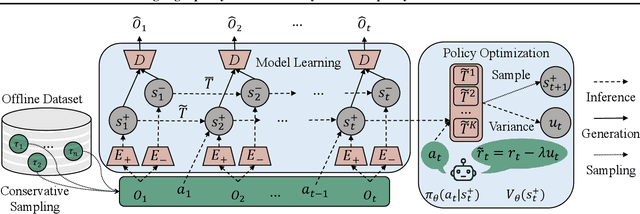
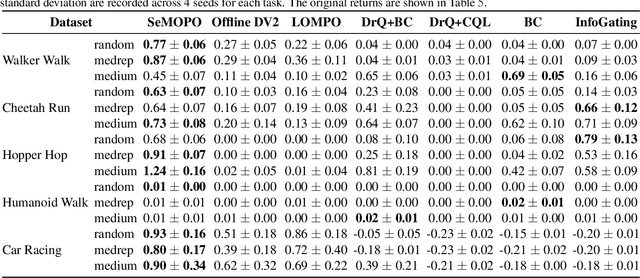
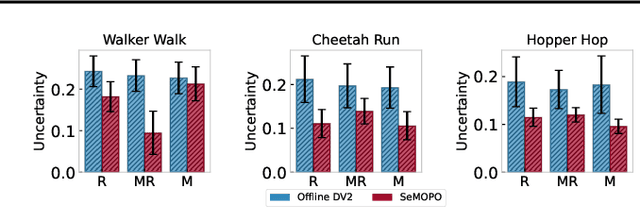
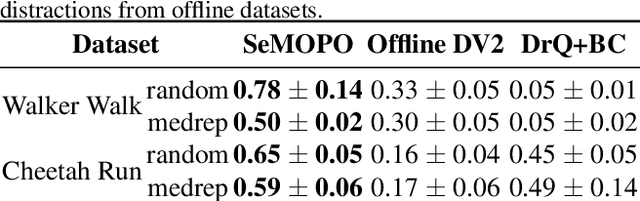
Model-based offline reinforcement Learning (RL) is a promising approach that leverages existing data effectively in many real-world applications, especially those involving high-dimensional inputs like images and videos. To alleviate the distribution shift issue in offline RL, existing model-based methods heavily rely on the uncertainty of learned dynamics. However, the model uncertainty estimation becomes significantly biased when observations contain complex distractors with non-trivial dynamics. To address this challenge, we propose a new approach - \emph{Separated Model-based Offline Policy Optimization} (SeMOPO) - decomposing latent states into endogenous and exogenous parts via conservative sampling and estimating model uncertainty on the endogenous states only. We provide a theoretical guarantee of model uncertainty and performance bound of SeMOPO. To assess the efficacy, we construct the Low-Quality Vision Deep Data-Driven Datasets for RL (LQV-D4RL), where the data are collected by non-expert policy and the observations include moving distractors. Experimental results show that our method substantially outperforms all baseline methods, and further analytical experiments validate the critical designs in our method. The project website is \href{https://sites.google.com/view/semopo}{https://sites.google.com/view/semopo}.
DIDA: Denoised Imitation Learning based on Domain Adaptation
Apr 04, 2024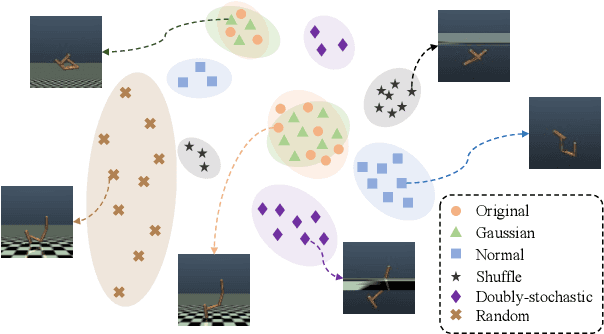
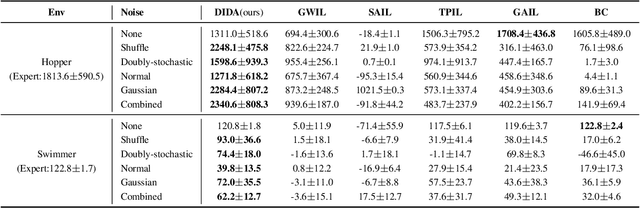
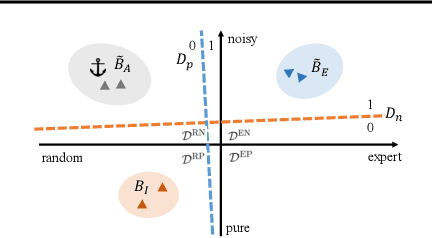
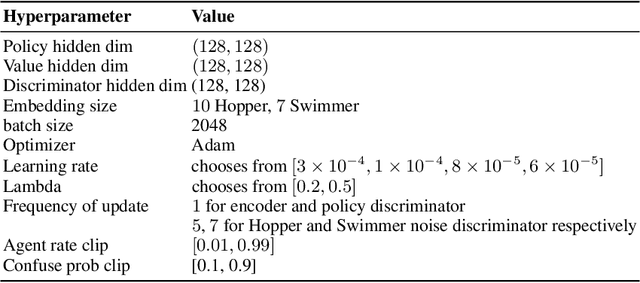
Imitating skills from low-quality datasets, such as sub-optimal demonstrations and observations with distractors, is common in real-world applications. In this work, we focus on the problem of Learning from Noisy Demonstrations (LND), where the imitator is required to learn from data with noise that often occurs during the processes of data collection or transmission. Previous IL methods improve the robustness of learned policies by injecting an adversarially learned Gaussian noise into pure expert data or utilizing additional ranking information, but they may fail in the LND setting. To alleviate the above problems, we propose Denoised Imitation learning based on Domain Adaptation (DIDA), which designs two discriminators to distinguish the noise level and expertise level of data, facilitating a feature encoder to learn task-related but domain-agnostic representations. Experiment results on MuJoCo demonstrate that DIDA can successfully handle challenging imitation tasks from demonstrations with various types of noise, outperforming most baseline methods.
SENSOR: Imitate Third-Person Expert's Behaviors via Active Sensoring
Apr 04, 2024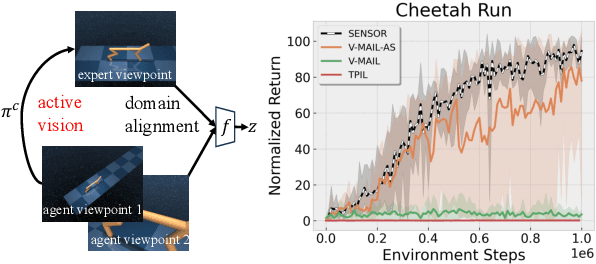
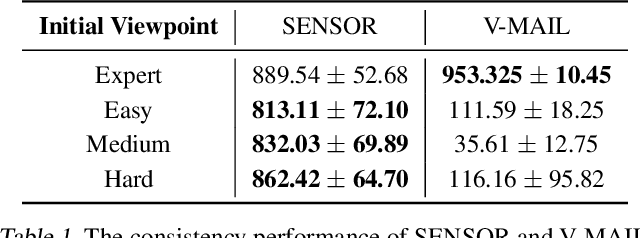
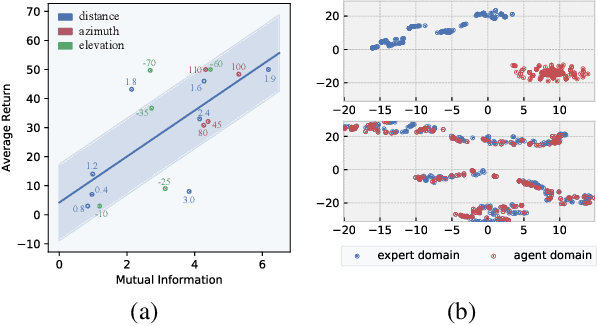
In many real-world visual Imitation Learning (IL) scenarios, there is a misalignment between the agent's and the expert's perspectives, which might lead to the failure of imitation. Previous methods have generally solved this problem by domain alignment, which incurs extra computation and storage costs, and these methods fail to handle the \textit{hard cases} where the viewpoint gap is too large. To alleviate the above problems, we introduce active sensoring in the visual IL setting and propose a model-based SENSory imitatOR (SENSOR) to automatically change the agent's perspective to match the expert's. SENSOR jointly learns a world model to capture the dynamics of latent states, a sensor policy to control the camera, and a motor policy to control the agent. Experiments on visual locomotion tasks show that SENSOR can efficiently simulate the expert's perspective and strategy, and outperforms most baseline methods.
AD3: Implicit Action is the Key for World Models to Distinguish the Diverse Visual Distractors
Mar 15, 2024Model-based methods have significantly contributed to distinguishing task-irrelevant distractors for visual control. However, prior research has primarily focused on heterogeneous distractors like noisy background videos, leaving homogeneous distractors that closely resemble controllable agents largely unexplored, which poses significant challenges to existing methods. To tackle this problem, we propose Implicit Action Generator (IAG) to learn the implicit actions of visual distractors, and present a new algorithm named implicit Action-informed Diverse visual Distractors Distinguisher (AD3), that leverages the action inferred by IAG to train separated world models. Implicit actions effectively capture the behavior of background distractors, aiding in distinguishing the task-irrelevant components, and the agent can optimize the policy within the task-relevant state space. Our method achieves superior performance on various visual control tasks featuring both heterogeneous and homogeneous distractors. The indispensable role of implicit actions learned by IAG is also empirically validated.
SeMAIL: Eliminating Distractors in Visual Imitation via Separated Models
Jun 19, 2023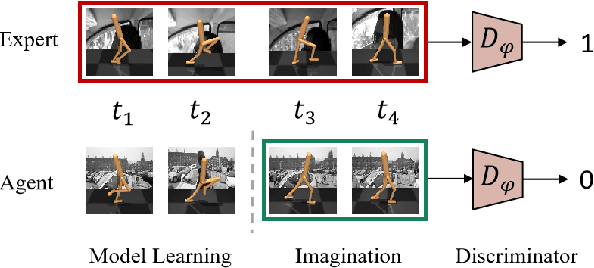
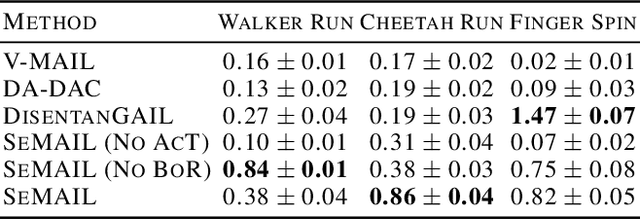
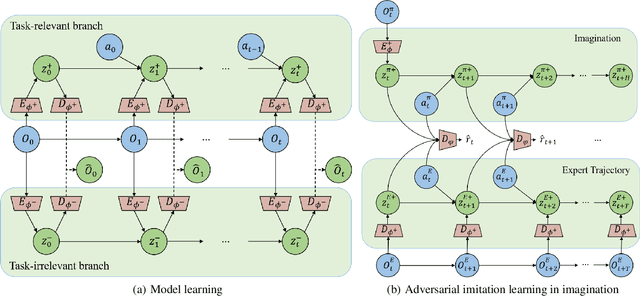

Model-based imitation learning (MBIL) is a popular reinforcement learning method that improves sample efficiency on high-dimension input sources, such as images and videos. Following the convention of MBIL research, existing algorithms are highly deceptive by task-irrelevant information, especially moving distractors in videos. To tackle this problem, we propose a new algorithm - named Separated Model-based Adversarial Imitation Learning (SeMAIL) - decoupling the environment dynamics into two parts by task-relevant dependency, which is determined by agent actions, and training separately. In this way, the agent can imagine its trajectories and imitate the expert behavior efficiently in task-relevant state space. Our method achieves near-expert performance on various visual control tasks with complex observations and the more challenging tasks with different backgrounds from expert observations.