 Add to Chrome
 Add to Firefox
 Add to Edge
Federated learning with heavy-tailed gradient noise and communication noise: a variance-reduction based algorithm
Jun 21, 2026
Federated learning (FL) is an emerging distributed machine learning paradigm that enables local devices to jointly train a global model while keeping data decentralized and private. We propose a variance-reduction based algorithm, VRA-FedSGD, for FL in the presence of heavy-tailed gradient noise and communication noise, where these noises are prevalent in large-scale machine learning over wireless networks and Internet of Things deployments. VRA-FedSGD employs a momentum variance reduction technique together with a nonlinear mapping to mitigate heavy-tailed gradient noise, and uses a variance-reduced aggregation mechanism to suppress heavy-tailed communication noise. In the mean sense, VRA-FedSGD achieves a convergence rate of {\small$\mathcal{O}\left(K^{-(p-1)/(2p-1)}\right)$} for nonconvex objective functions, where $p$ is the tail index of heavy-tailed noise. In the almost sure sense, VRA-FedSGD achieves a convergence rate of $\tilde{\mathcal{O}}\left(K^{-(1-1/(p-ε))}\right)$ for strongly convex objective functions, where $ε$ is an arbitrarily small constant. Simulated experiments on a logistic regression problem with real-world data verify the effectiveness of VRA-FedSGD.

DyGASR: Dynamic Generalized Exponential Splatting with Surface Alignment for Accelerated 3D Mesh Reconstruction
Nov 14, 2024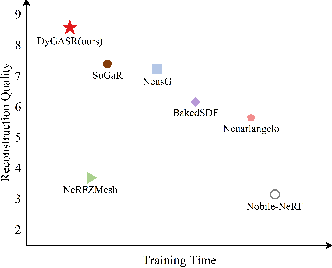
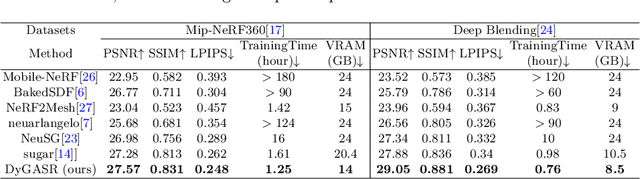
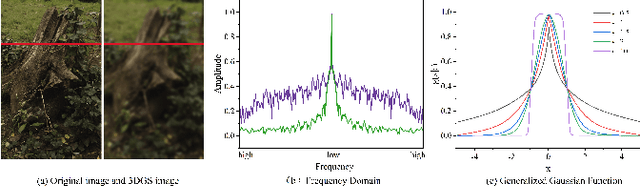
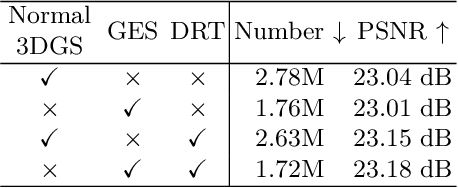
Recent advancements in 3D Gaussian Splatting (3DGS), which lead to high-quality novel view synthesis and accelerated rendering, have remarkably improved the quality of radiance field reconstruction. However, the extraction of mesh from a massive number of minute 3D Gaussian points remains great challenge due to the large volume of Gaussians and difficulty of representation of sharp signals caused by their inherent low-pass characteristics. To address this issue, we propose DyGASR, which utilizes generalized exponential function instead of traditional 3D Gaussian to decrease the number of particles and dynamically optimize the representation of the captured signal. In addition, it is observed that reconstructing mesh with Generalized Exponential Splatting(GES) without modifications frequently leads to failures since the generalized exponential distribution centroids may not precisely align with the scene surface. To overcome this, we adopt Sugar's approach and introduce Generalized Surface Regularization (GSR), which reduces the smallest scaling vector of each point cloud to zero and ensures normal alignment perpendicular to the surface, facilitating subsequent Poisson surface mesh reconstruction. Additionally, we propose a dynamic resolution adjustment strategy that utilizes a cosine schedule to gradually increase image resolution from low to high during the training stage, thus avoiding constant full resolution, which significantly boosts the reconstruction speed. Our approach surpasses existing 3DGS-based mesh reconstruction methods, as evidenced by extensive evaluations on various scene datasets, demonstrating a 25\% increase in speed, and a 30\% reduction in memory usage.