 Add to Chrome
 Add to Firefox
 Add to Edge
SkipCat: Rank-Maximized Low-Rank Compression of Large Language Models via Shared Projection and Block Skipping
Dec 15, 2025
Large language models (LLM) have achieved remarkable performance across a wide range of tasks. However, their substantial parameter sizes pose significant challenges for deployment on edge devices with limited computational and memory resources. Low-rank compression is a promising approach to address this issue, as it reduces both computational and memory costs, making LLM more suitable for resource-constrained environments. Nonetheless, naïve low-rank compression methods require a significant reduction in the retained rank to achieve meaningful memory and computation savings. For a low-rank model, the ranks need to be reduced by more than half to yield efficiency gains. Such aggressive truncation, however, typically results in substantial performance degradation. To address this trade-off, we propose SkipCat, a novel low-rank compression framework that enables the use of higher ranks while achieving the same compression rates. First, we introduce an intra-layer shared low-rank projection method, where multiple matrices that share the same input use a common projection. This reduces redundancy and improves compression efficiency. Second, we propose a block skipping technique that omits computations and memory transfers for selected sub-blocks within the low-rank decomposition. These two techniques jointly enable our compressed model to retain more effective ranks under the same compression budget. Experimental results show that, without any additional fine-tuning, our method outperforms previous low-rank compression approaches by 7% accuracy improvement on zero-shot tasks under the same compression rate. These results highlight the effectiveness of our rank-maximized compression strategy in preserving model performance under tight resource constraints.

Q-YOLOP: Quantization-aware You Only Look Once for Panoptic Driving Perception
Jul 10, 2023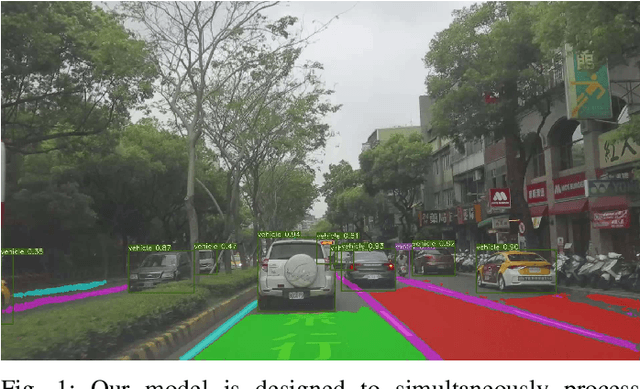
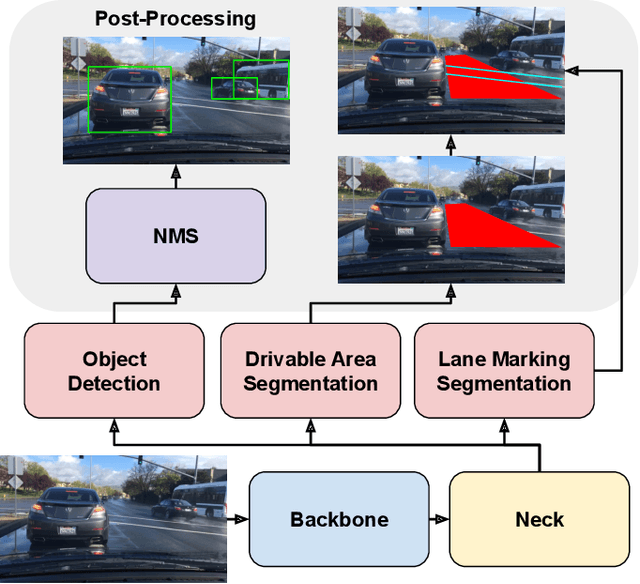

In this work, we present an efficient and quantization-aware panoptic driving perception model (Q- YOLOP) for object detection, drivable area segmentation, and lane line segmentation, in the context of autonomous driving. Our model employs the Efficient Layer Aggregation Network (ELAN) as its backbone and task-specific heads for each task. We employ a four-stage training process that includes pretraining on the BDD100K dataset, finetuning on both the BDD100K and iVS datasets, and quantization-aware training (QAT) on BDD100K. During the training process, we use powerful data augmentation techniques, such as random perspective and mosaic, and train the model on a combination of the BDD100K and iVS datasets. Both strategies enhance the model's generalization capabilities. The proposed model achieves state-of-the-art performance with an mAP@0.5 of 0.622 for object detection and an mIoU of 0.612 for segmentation, while maintaining low computational and memory requirements.
Mitigating Forgetting in Online Continual Learning via Contrasting Semantically Distinct Augmentations
Nov 10, 2022Online continual learning (OCL) aims to enable model learning from a non-stationary data stream to continuously acquire new knowledge as well as retain the learnt one, under the constraints of having limited system size and computational cost, in which the main challenge comes from the "catastrophic forgetting" issue -- the inability to well remember the learnt knowledge while learning the new ones. With the specific focus on the class-incremental OCL scenario, i.e. OCL for classification, the recent advance incorporates the contrastive learning technique for learning more generalised feature representation to achieve the state-of-the-art performance but is still unable to fully resolve the catastrophic forgetting. In this paper, we follow the strategy of adopting contrastive learning but further introduce the semantically distinct augmentation technique, in which it leverages strong augmentation to generate more data samples, and we show that considering these samples semantically different from their original classes (thus being related to the out-of-distribution samples) in the contrastive learning mechanism contributes to alleviate forgetting and facilitate model stability. Moreover, in addition to contrastive learning, the typical classification mechanism and objective (i.e. softmax classifier and cross-entropy loss) are included in our model design for faster convergence and utilising the label information, but particularly equipped with a sampling strategy to tackle the tendency of favouring the new classes (i.e. model bias towards the recently learnt classes). Upon conducting extensive experiments on CIFAR-10, CIFAR-100, and Mini-Imagenet datasets, our proposed method is shown to achieve superior performance against various baselines.