 Add to Chrome
 Add to Firefox
 Add to Edge
ParetoSlider: Diffusion Models Post-Training for Continuous Reward Control
Apr 22, 2026
Reinforcement Learning (RL) post-training has become the standard for aligning generative models with human preferences, yet most methods rely on a single scalar reward. When multiple criteria matter, the prevailing practice of ``early scalarization'' collapses rewards into a fixed weighted sum. This commits the model to a single trade-off point at training time, providing no inference-time control over inherently conflicting goals -- such as prompt adherence versus source fidelity in image editing. We introduce ParetoSlider, a multi-objective RL (MORL) framework that trains a single diffusion model to approximate the entire Pareto front. By training the model with continuously varying preference weights as a conditioning signal, we enable users to navigate optimal trade-offs at inference time without retraining or maintaining multiple checkpoints. We evaluate ParetoSlider across three state-of-the-art flow-matching backbones: SD3.5, FluxKontext, and LTX-2. Our single preference-conditioned model matches or exceeds the performance of baselines trained separately for fixed reward trade-offs, while uniquely providing fine-grained control over competing generative goals.

Enhancing Consistency-Based Image Generation via Adversarialy-Trained Classification and Energy-Based Discrimination
May 25, 2024
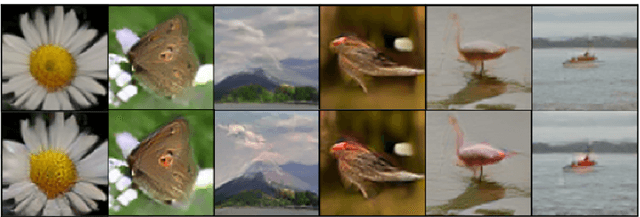


The recently introduced Consistency models pose an efficient alternative to diffusion algorithms, enabling rapid and good quality image synthesis. These methods overcome the slowness of diffusion models by directly mapping noise to data, while maintaining a (relatively) simpler training. Consistency models enable a fast one- or few-step generation, but they typically fall somewhat short in sample quality when compared to their diffusion origins. In this work we propose a novel and highly effective technique for post-processing Consistency-based generated images, enhancing their perceptual quality. Our approach utilizes a joint classifier-discriminator model, in which both portions are trained adversarially. While the classifier aims to grade an image based on its assignment to a designated class, the discriminator portion of the very same network leverages the softmax values to assess the proximity of the input image to the targeted data manifold, thereby serving as an Energy-based Model. By employing example-specific projected gradient iterations under the guidance of this joint machine, we refine synthesized images and achieve an improved FID scores on the ImageNet 64x64 dataset for both Consistency-Training and Consistency-Distillation techniques.