 Add to Chrome
 Add to Firefox
 Add to Edge
MOSAIC: Masked Outsourcing of Secure AI Computations
Jul 31, 2026
We address the challenge of securely and efficiently outsourcing AI computations from a trusted but computationally weak client to an untrusted but powerful server, in the setting where the client holds both the input and the model, and the server must learn neither. We present MOSAIC, whose core is a novel matrix-multiplication masking protocol that scales to far larger matrices than prior work, enabling the safe outsourcing of modern workloads such as large transformer inference. By introducing small amounts of noise to the multiplication result and thereby relaxing correctness, MOSAIC achieves optimal asymptotic client overhead and concrete runtimes orders of magnitude faster than prior work. Its security reduces to the decisional LWE and LPN assumptions. Because this noise accumulates across the many layers of a transformer, a key technical challenge is bounding error growth; MOSAIC addresses this with an error-scaling mechanism based on random Hadamard rotations. On large 70B transformer models, MOSAIC's perplexity is comparable to popular quantization approaches and even matches full-precision BF16 inference on HumanEval. Finally, we present an end-to-end implementation showing how ideas like MOSAIC can promise a path towards large-scale confidential AI in modern data centers. Non-confidential inference is already distributed across phase (prefill/decode), layer, and time to maximize utilization of heterogeneous hardware, using RDMA-like networking to move activations, cached KV values, and weights across nodes. MOSAIC enables scaling of confidential compute by keeping the trusted computing base (TCB) small and outsourcing the bulk of the AI computation to untrusted accelerators.

Learning Numeric Optimal Differentially Private Truncated Additive Mechanisms
Jul 27, 2021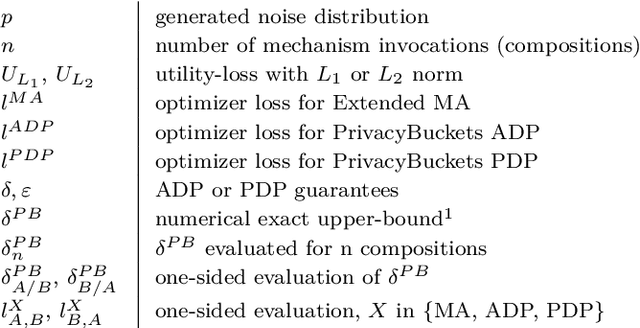
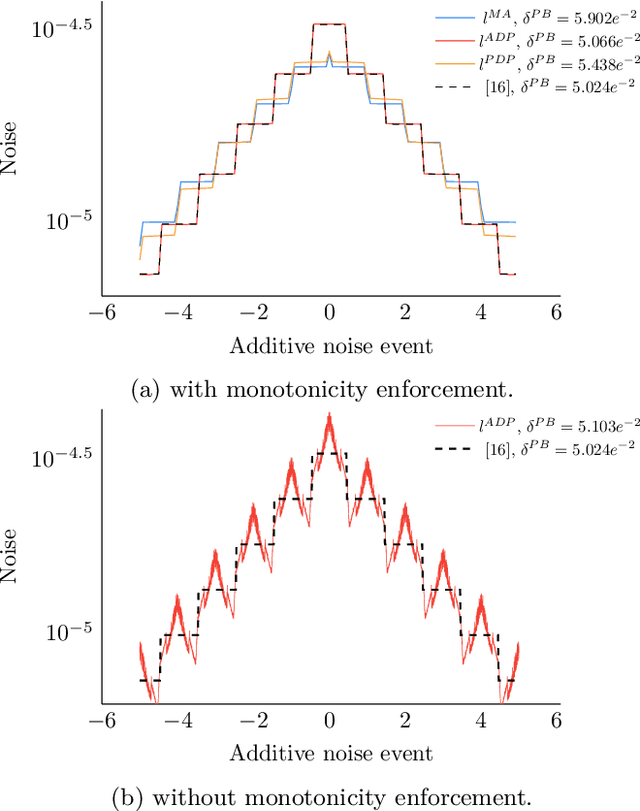
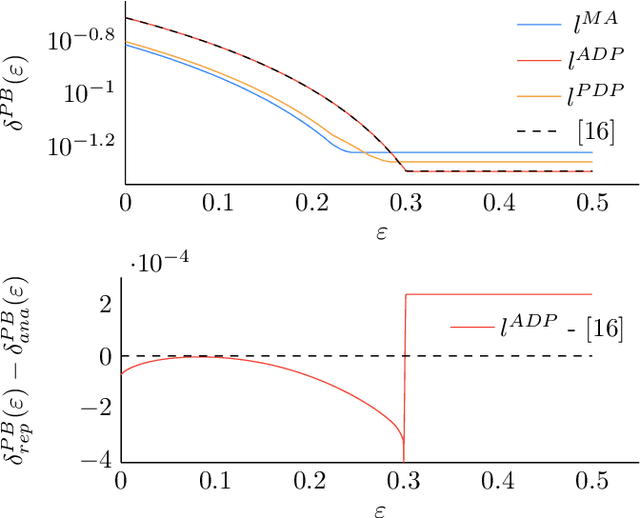
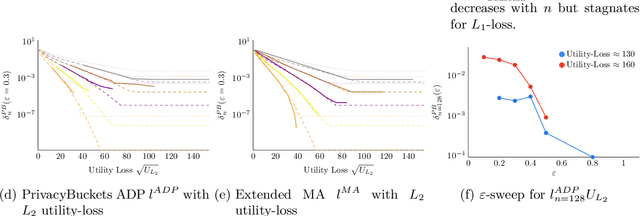
Differentially private (DP) mechanisms face the challenge of providing accurate results while protecting their inputs: the privacy-utility trade-off. A simple but powerful technique for DP adds noise to sensitivity-bounded query outputs to blur the exact query output: additive mechanisms. While a vast body of work considers infinitely wide noise distributions, some applications (e.g., real-time operating systems) require hard bounds on the deviations from the real query, and only limited work on such mechanisms exist. An additive mechanism with truncated noise (i.e., with bounded range) can offer such hard bounds. We introduce a gradient-descent-based tool to learn truncated noise for additive mechanisms with strong utility bounds while simultaneously optimizing for differential privacy under sequential composition, i.e., scenarios where multiple noisy queries on the same data are revealed. Our method can learn discrete noise patterns and not only hyper-parameters of a predefined probability distribution. For sensitivity bounded mechanisms, we show that it is sufficient to consider symmetric and that\new{, for from the mean monotonically falling noise,} ensuring privacy for a pair of representative query outputs guarantees privacy for all pairs of inputs (that differ in one element). We find that the utility-privacy trade-off curves of our generated noise are remarkably close to truncated Gaussians and even replicate their shape for $l_2$ utility-loss. For a low number of compositions, we also improved DP-SGD (sub-sampling). Moreover, we extend Moments Accountant to truncated distributions, allowing to incorporate mechanism output events with varying input-dependent zero occurrence probability.