 Add to Chrome
 Add to Firefox
 Add to Edge
(HB-ARFM) History-Bootstrapped Flow Matching for Inverse Boiling Reconstruction
May 29, 2026
Reconstructing spatiotemporal fields from partial observations is fundamental to scientific inference, from inferring atmospheric states from satellite data to recovering fluid states from imaging. When observations are incomplete, the inverse problem is fundamentally ill-posed: even when the underlying PDE dynamics are Markovian in the full state, partial observation operators induce a non-Markovian posterior that cannot be resolved from a single timestep. We propose a history-bootstrapped autoregressive flow matching (HB-ARFM) for spatiotemporal inverse reconstruction under partial observability. Observation history bootstraps the initial reconstruction via conditional flow matching, reducing ambiguities. The same conditional transport model is then applied autoregressively, conditioning on both new observations and past predictions to propagate the reconstruction forward in time. We evaluate the method on boiling dynamics reconstruction, recovering full velocity and temperature fields from interface geometry and motion. Across two inverse tasks with varying observation sparsity, HB-ARFM produces physically and temporally valid reconstructions where other models fail.

NUCLEUS-MoE: Unified Model of Pool Boiling for Liquid Cooling
May 26, 2026Two-phase boiling enables heat transfer rates an order of magnitude higher than single-phase cooling, but it remains difficult to model due to the strong coupling between phase change, turbulence, and transport, as well as extreme sensitivity to fluid properties and thermodynamic conditions. Existing learning-based surrogates are either condition- or fluid-specific, limiting generalization and requiring separate models. We present NUCLEUS, a mixture-of-experts model for pool boiling that replaces collections of specialized surrogates with a single architecture. NUCLEUS combines neighborhood attention, signed distance field reinitialization for interface consistency, and expert routing that exhibits emergent specialization across distinct boiling dynamics. Trained on high-fidelity simulations of pool boiling, NUCLEUS jointly models saturated and subcooled boiling across three fluid classes (dielectrics, refrigerants, and cryogens), resolving failure modes of prior models on extreme fluids. We show that expert routing exhibits coherent spatial structure and specialization without explicit supervision. Quantitatively, NUCLEUS matches or exceeds baselines while maintaining physical consistency across heterogeneous boiling configurations. We also show zero-shot and few-shot generalization capabilities on downstream tasks such as a new fluid (Opteon 2P50 developed for immersion cooling). These results demonstrate that mixture-of-experts models are a scalable pathway toward unified surrogate modeling of boiling dynamics and lay the groundwork for broader generalization across scientific ML.
BubbleML: A Multi-Physics Dataset and Benchmarks for Machine Learning
Jul 27, 2023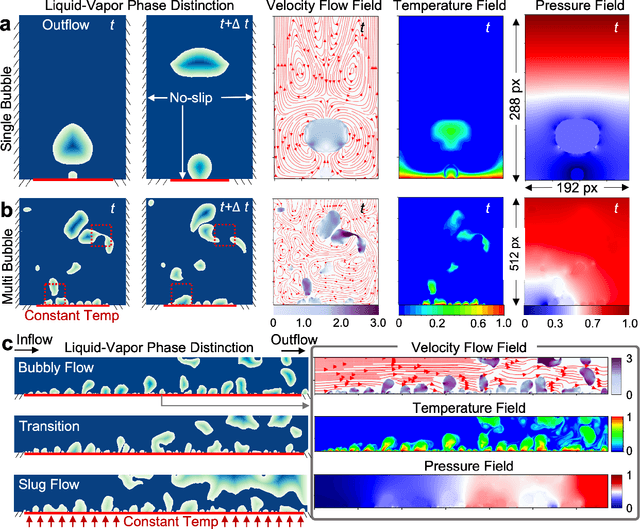
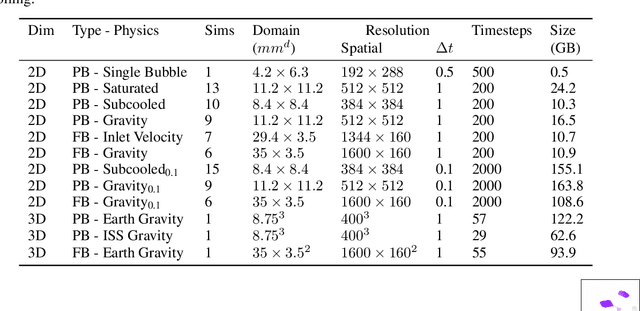
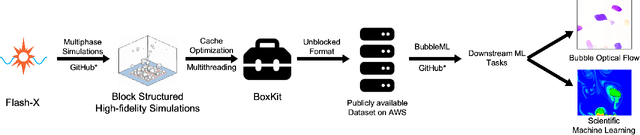

In the field of phase change phenomena, the lack of accessible and diverse datasets suitable for machine learning (ML) training poses a significant challenge. Existing experimental datasets are often restricted, with limited availability and sparse ground truth data, impeding our understanding of this complex multi-physics phenomena. To bridge this gap, we present the BubbleML Dataset(https://github.com/HPCForge/BubbleML) which leverages physics-driven simulations to provide accurate ground truth information for various boiling scenarios, encompassing nucleate pool boiling, flow boiling, and sub-cooled boiling. This extensive dataset covers a wide range of parameters, including varying gravity conditions, flow rates, sub-cooling levels, and wall superheat, comprising 51 simulations. BubbleML is validated against experimental observations and trends, establishing it as an invaluable resource for ML research. Furthermore, we showcase its potential to facilitate exploration of diverse downstream tasks by introducing two benchmarks: (a) optical flow analysis to capture bubble dynamics, and (b) operator networks for learning temperature dynamics. The BubbleML dataset and its benchmarks serve as a catalyst for advancements in ML-driven research on multi-physics phase change phenomena, enabling the development and comparison of state-of-the-art techniques and models.