 Add to Chrome
 Add to Firefox
 Add to Edge
Wastewater Pipe Rating Model Using Natural Language Processing
Feb 22, 2022
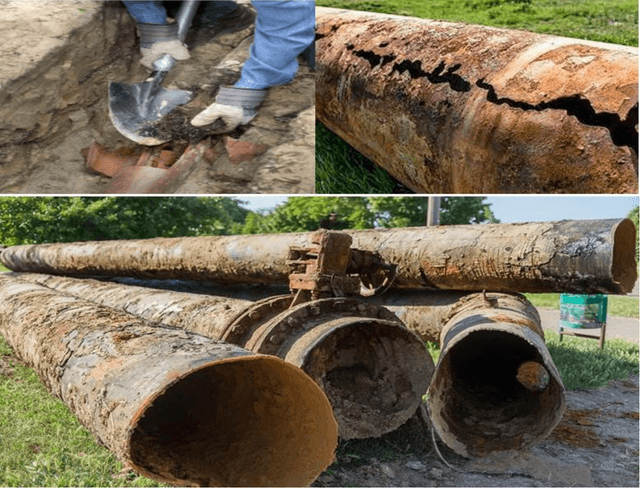
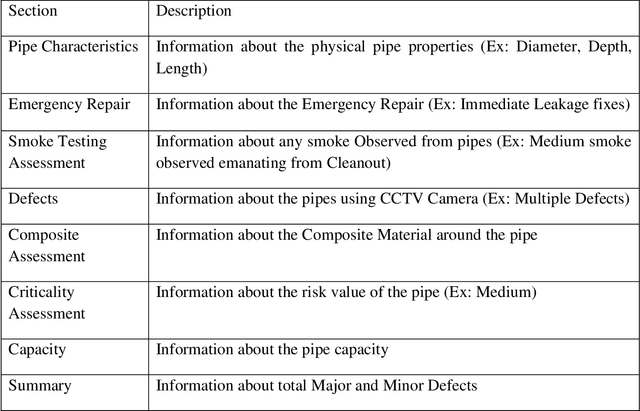
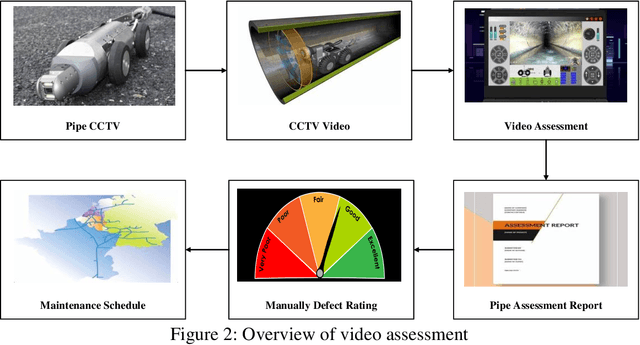
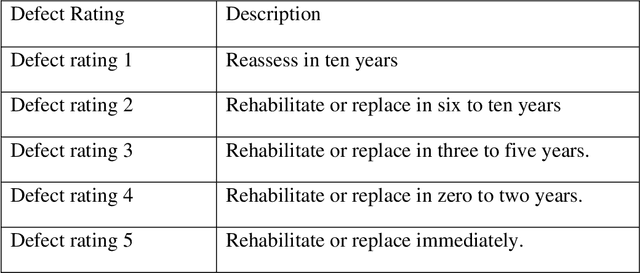
Closed-circuit video (CCTV) inspection has been the most popular technique for visually evaluating the interior status of pipelines in recent decades. Certified inspectors prepare the pipe repair document based on the CCTV inspection. The traditional manual method of assessing sewage structural conditions from pipe repair documents takes a long time and is prone to human mistakes. The automatic identification of necessary texts has received little attention. By building an automated framework employing Natural Language Processing (NLP), this study presents an effective technique to automate the identification of the pipe defect rating of the pipe repair documents. NLP technologies are employed to break down textual material into grammatical units in this research. Further analysis entails using words to discover pipe defect symptoms and their frequency and then combining that information into a single score. Our model achieves 95.0% accuracy,94.9% sensitivity, 94.4% specificity, 95.9% precision score, and 95.7% F1 score, showing the potential of the proposed model to be used in large-scale pipe repair documents for accurate and efficient pipeline failure detection to improve the quality of the pipeline. Keywords: Sewer pipe inspection, Defect detection, Natural language processing, Text recognition

Wastewater Pipe Condition Rating Model Using K- Nearest Neighbors
Feb 22, 2022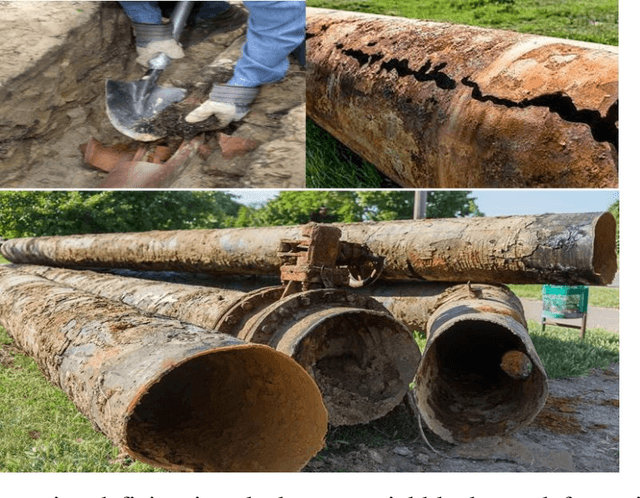
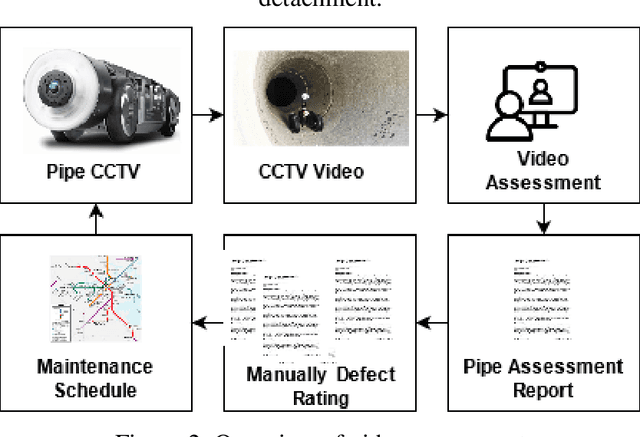
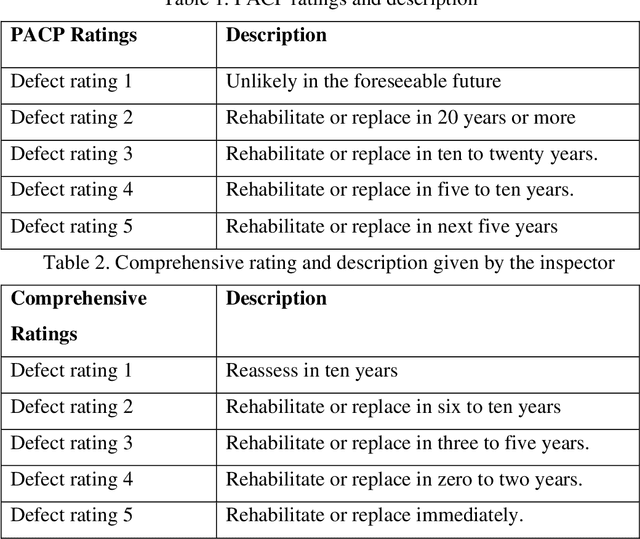
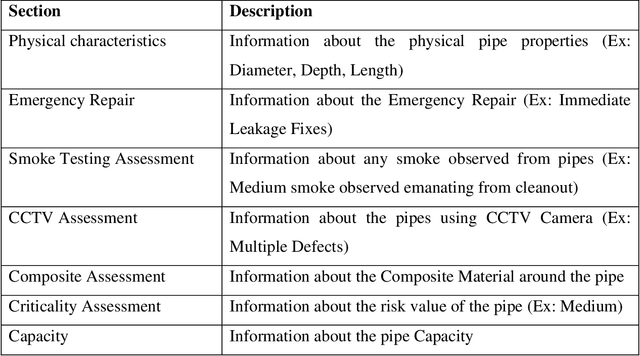
Risk-based assessment in pipe condition mainly focuses on prioritizing the most critical assets by evaluating the risk of pipe failure. This paper's goal is to classify a comprehensive pipe rating model which is obtained based on a series of pipe physical, external, and hydraulic characteristics that are identified for the proposed methodology. The traditional manual method of assessing sewage structural conditions takes a long time. By building an automated process using K-Nearest Neighbors (K-NN), this study presents an effective technique to automate the identification of the pipe defect rating using the pipe repair data. First, we performed the Shapiro Wilks Test for 1240 data from the Dept. of Engineering & Environmental Services, Shreveport, Louisiana Phase 3 with 12 variables to determine if factors could be incorporated in the final rating. We then developed a K-Nearest Neighbors model to classify the final rating from the statistically significant factors identified in Shapiro Wilks Test. This classification process allows recognizing the worst condition of wastewater pipes that need to be replaced immediately. This comprehensive model is built according to the industry-accepted and used guidelines to estimate the overall condition. Finally, for validation purposes, the proposed model is applied to a small portion of a US wastewater collection system in Shreveport, Louisiana. Keywords: Pipe rating, Shapiro Wilks Test, K-Nearest Neighbors (KNN), Failure, Risk analysis
Predicting the spread of COVID-19 in Delhi, India using Deep Residual Recurrent Neural Networks
Oct 09, 2021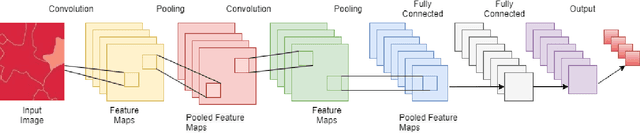

Detecting the spread of coronavirus will go a long way toward reducing human and economic loss. Unfortunately, existing Epidemiological models used for COVID 19 prediction models are too slow and fail to capture the COVID-19 development in detail. This research uses Partial Differential Equations to improve the processing speed and accuracy of forecasting of COVID 19 governed by SEIRD model equations. The dynamics of COVID 19 were extracted using Convolutional Neural Networks and Deep Residual Recurrent Neural Networks from data simulated using PDEs. The DRRNNs accuracy is measured using Mean Squared Error. The DRRNNs COVID-19 prediction model has been shown to have accurate COVID-19 predictions. In addition, we concluded that DR-RNNs can significantly advance the ability to support decision-making in real time COVID-19 prediction.
A Review of Physics-based Machine Learning in Civil Engineering
Oct 09, 2021

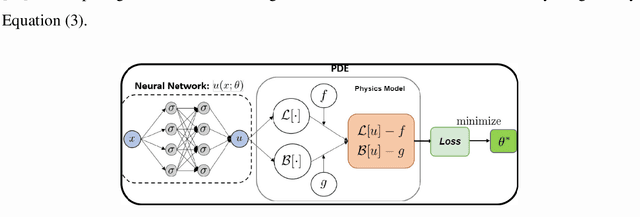

The recent development of machine learning (ML) and Deep Learning (DL) increases the opportunities in all the sectors. ML is a significant tool that can be applied across many disciplines, but its direct application to civil engineering problems can be challenging. ML for civil engineering applications that are simulated in the lab often fail in real-world tests. This is usually attributed to a data mismatch between the data used to train and test the ML model and the data it encounters in the real world, a phenomenon known as data shift. However, a physics-based ML model integrates data, partial differential equations (PDEs), and mathematical models to solve data shift problems. Physics-based ML models are trained to solve supervised learning tasks while respecting any given laws of physics described by general nonlinear equations. Physics-based ML, which takes center stage across many science disciplines, plays an important role in fluid dynamics, quantum mechanics, computational resources, and data storage. This paper reviews the history of physics-based ML and its application in civil engineering.
Natural Language Processing Accurately Categorizes Indications, Findings and Pathology Reports from Multicenter Colonoscopy
Aug 25, 2021


Colonoscopy is used for colorectal cancer (CRC) screening. Extracting details of the colonoscopy findings from free text in electronic health records (EHRs) can be used to determine patient risk for CRC and colorectal screening strategies. We developed and evaluated the accuracy of a deep learning model framework to extract information for the clinical decision support system to interpret relevant free-text reports, including indications, pathology, and findings notes. The Bio-Bi-LSTM-CRF framework was developed using Bidirectional Long Short-term Memory (Bi-LSTM) and Conditional Random Fields (CRF) to extract several clinical features from these free-text reports including indications for the colonoscopy, findings during the colonoscopy, and pathology of resected material. We trained the Bio-Bi-LSTM-CRF and existing Bi-LSTM-CRF models on 80% of 4,000 manually annotated notes from 3,867 patients. These clinical notes were from a group of patients over 40 years of age enrolled in four Veterans Affairs Medical Centers. A total of 10% of the remaining annotated notes were used to train hyperparameter and the remaining 10% were used to evaluate the accuracy of our model Bio-Bi-LSTM-CRF and compare to Bi-LSTM-CRF.
Physics-Informed Neural Network Method for Solving One-Dimensional Advection Equation Using PyTorch
Mar 21, 2021

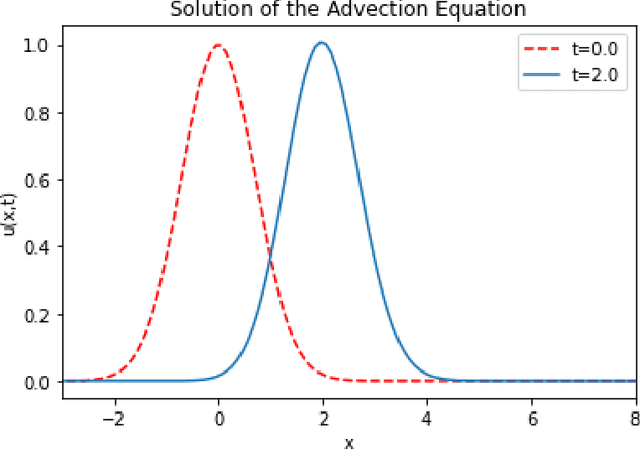
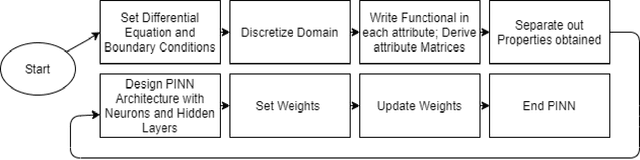
Numerical solutions to the equation for advection are determined using different finite-difference approximations and physics-informed neural networks (PINNs) under conditions that allow an analytical solution. Their accuracy is examined by comparing them to the analytical solution. We used a machine learning framework like PyTorch to implement PINNs. PINNs approach allows training neural networks while respecting the PDEs as a strong constraint in the optimization as apposed to making them part of the loss function. In standard small-scale circulation simulations, it is shown that the conventional approach incorporates a pseudo diffusive effect that is almost as large as the effect of the turbulent diffusion model; hence the numerical solution is rendered inconsistent with the PDEs. This oscillation causes inaccuracy and computational uncertainty. Of all the schemes tested, only the PINNs approximation accurately predicted the outcome. We assume that the PINNs approach can transform the physics simulation area by allowing real-time physics simulation and geometry optimization without costly and time-consuming simulations on large supercomputers.