 Add to Chrome
 Add to Firefox
 Add to Edge
AGSP-DSA: An Adaptive Graph Signal Processing Framework for Robust Multimodal Fusion with Dynamic Semantic Alignment
Jan 26, 2026
In this paper, we introduce an Adaptive Graph Signal Processing with Dynamic Semantic Alignment (AGSP DSA) framework to perform robust multimodal data fusion over heterogeneous sources, including text, audio, and images. The requested approach uses a dual-graph construction to learn both intra-modal and inter-modal relations, spectral graph filtering to boost the informative signals, and effective node embedding with Multi-scale Graph Convolutional Networks (GCNs). Semantic aware attention mechanism: each modality may dynamically contribute to the context with respect to contextual relevance. The experimental outcomes on three benchmark datasets, including CMU-MOSEI, AVE, and MM-IMDB, show that AGSP-DSA performs as the state of the art. More precisely, it achieves 95.3% accuracy, 0.936 F1-score, and 0.924 mAP on CMU-MOSEI, improving MM-GNN by 2.6 percent in accuracy. It gets 93.4% accuracy and 0.911 F1-score on AVE and 91.8% accuracy and 0.886 F1-score on MM-IMDB, which demonstrate good generalization and robustness in the missing modality setting. These findings verify the efficiency of AGSP-DSA in promoting multimodal learning in sentiment analysis, event recognition and multimedia classification.

TrajSyn: Privacy-Preserving Dataset Distillation from Federated Model Trajectories for Server-Side Adversarial Training
Dec 17, 2025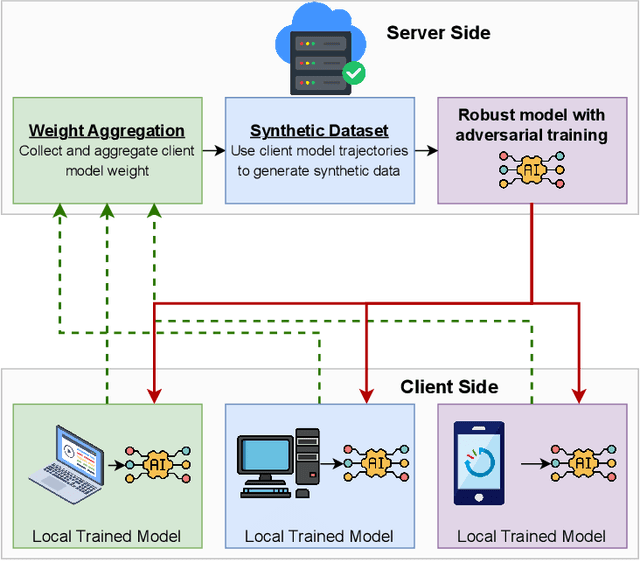
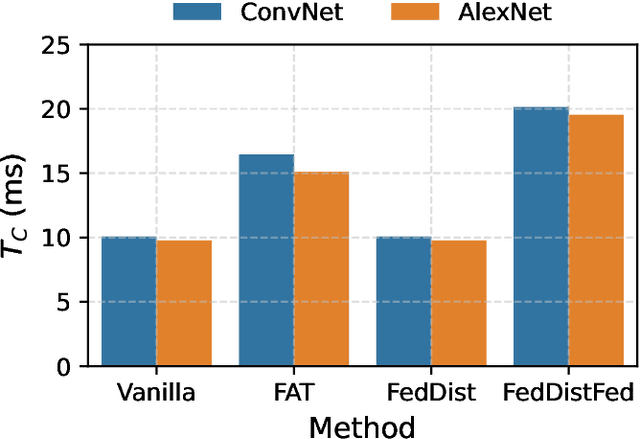

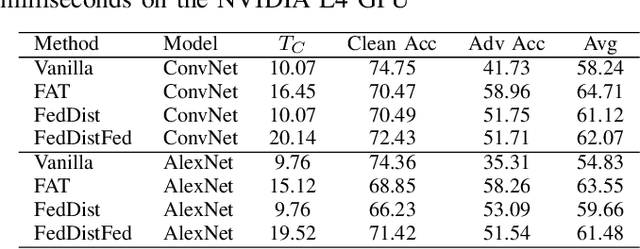
Deep learning models deployed on edge devices are increasingly used in safety-critical applications. However, their vulnerability to adversarial perturbations poses significant risks, especially in Federated Learning (FL) settings where identical models are distributed across thousands of clients. While adversarial training is a strong defense, it is difficult to apply in FL due to strict client-data privacy constraints and the limited compute available on edge devices. In this work, we introduce TrajSyn, a privacy-preserving framework that enables effective server-side adversarial training by synthesizing a proxy dataset from the trajectories of client model updates, without accessing raw client data. We show that TrajSyn consistently improves adversarial robustness on image classification benchmarks with no extra compute burden on the client device.