 Add to Chrome
 Add to Firefox
 Add to Edge
OnlyDense: Reduced-Order Modeling for Lagrangian simulation
Jun 08, 2026
In science and engineering, Lagrangian simulation methods such as Smooth Particle Hydrodynamics (SPH) or Material Point Method (MPM) are often employed to study the behavior of dynamic systems. However, these methods can be prohibitively computationally expensive, particularly when simulating multi-scale spatial or temporal phenomena, e.g., void growth and coalescence within macro-scale geometries, structural failure of spacecraft components resulting from hypervelocity impact of space debris particles, etc. In contrast to graph-based methods, where the state of the system is understood as a discrete set of particles, we propose a learning framework for scalable representation and dynamics modeling of massive particle systems by treating the system state as a function and its evolution as a trajectory in Hilbert space. Rather than representing the state as a discrete set of particles or embedding it in a nonlinear latent manifold, we approximate the state space with a linear subspace spanned by learned neural basis functions. This parameterization enables direct projection to obtain latent coefficients and explicit access to the basis functions, avoiding optimization over a nonlinear latent space. The resulting representation admits a natural interpretation: latent variables correspond to coefficients in Hilbert space, and basis functions correspond to spatial modes, analogous to Proper Orthogonal Decomposition. The framework thus unifies classical projection-based reduced-order modeling with modern deep learning, while remaining invariant to the number of discretization points. Experiments on large-scale SPH simulations with over one million particles, including dynamic events with extreme deformation and fragmentation, demonstrate that the proposed method accurately reconstructs and predicts dynamics, achieving an R$^2$ score above $0.99$ with as few as $32$ basis functions.

BO-Muse: A human expert and AI teaming framework for accelerated experimental design
Mar 03, 2023In this paper we introduce BO-Muse, a new approach to human-AI teaming for the optimization of expensive black-box functions. Inspired by the intrinsic difficulty of extracting expert knowledge and distilling it back into AI models and by observations of human behaviour in real-world experimental design, our algorithm lets the human expert take the lead in the experimental process. The human expert can use their domain expertise to its full potential, while the AI plays the role of a muse, injecting novelty and searching for areas of weakness to break the human out of over-exploitation induced by cognitive entrenchment. With mild assumptions, we show that our algorithm converges sub-linearly, at a rate faster than the AI or human alone. We validate our algorithm using synthetic data and with human experts performing real-world experiments.
Fast Conditional Network Compression Using Bayesian HyperNetworks
May 13, 2022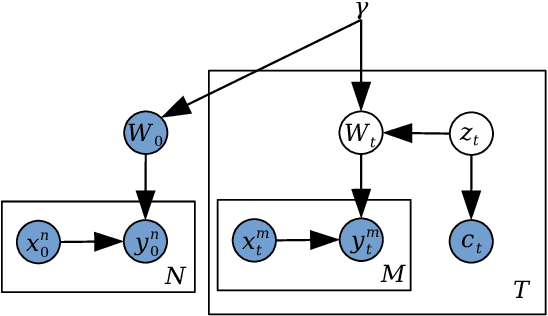
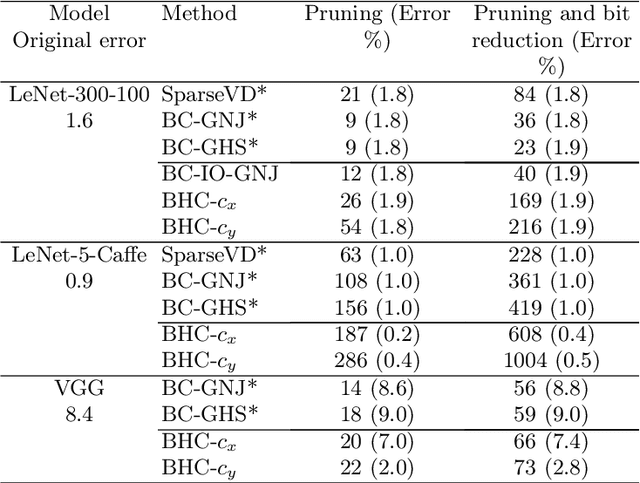
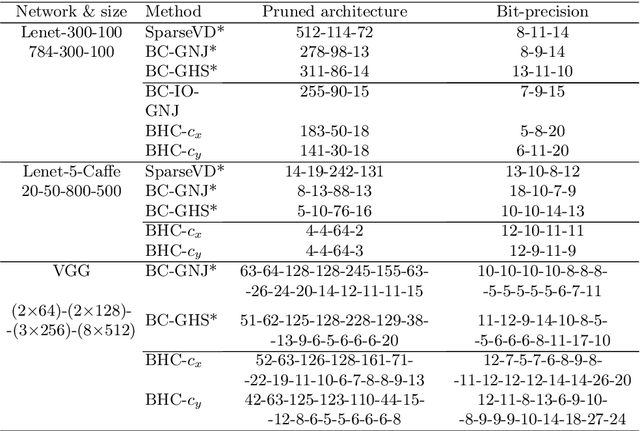
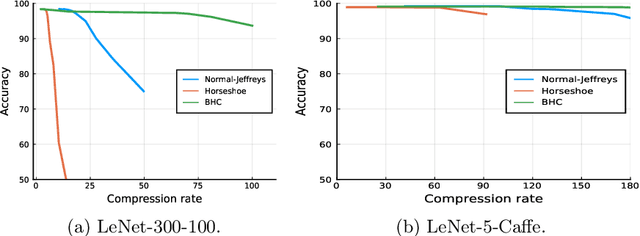
We introduce a conditional compression problem and propose a fast framework for tackling it. The problem is how to quickly compress a pretrained large neural network into optimal smaller networks given target contexts, e.g. a context involving only a subset of classes or a context where only limited compute resource is available. To solve this, we propose an efficient Bayesian framework to compress a given large network into much smaller size tailored to meet each contextual requirement. We employ a hypernetwork to parameterize the posterior distribution of weights given conditional inputs and minimize a variational objective of this Bayesian neural network. To further reduce the network sizes, we propose a new input-output group sparsity factorization of weights to encourage more sparseness in the generated weights. Our methods can quickly generate compressed networks with significantly smaller sizes than baseline methods.