 Add to Chrome
 Add to Firefox
 Add to Edge
Learning Graph Topology with Functional Priors via Bilevel Optimization
Jun 11, 2026
Learning graph topology of complex networks is challenging due to limited data availability and imprecise data models. Different from prior works that focus on structural priors with explicit control on macroscopic properties such as sparsity, this paper proposes a novel functional prior approach for graph topology learning. We postulate that complex networks are inherently optimized to perform a certain task (e.g., social networks specialize at optimizing a welfare function, biological networks are resilient towards node/edge deletion), which can be incorporated as a regularizer to assist in graph learning. Mathematically, we formulate a bilevel optimization problem where the lower-level problem solves the associated task on a candidate graph topology and the upper-level problem trades off between data fitting and task performance. We design a two-timescale gradient descent (TTGD) algorithm and show that under verifiable conditions, it finds a stationary point to the bilevel graph learning problem with a sublinear convergence rate. We provide theoretical insights on the graph topology learned from the functional priors and show that the resulting regularizers subsume a broad class of graph filter regularizers, including polynomial graph regularizers as special cases. We show via extensive experiments on synthetic and real datasets that the proposed formulation gives rise to reliable estimates of graph topology, even with insufficient data.

Primal-Dual Methods for Nonsmooth Nonconvex Optimization with Orthogonality Constraints
Apr 05, 2026Recent advancements in data science have significantly elevated the importance of orthogonally constrained optimization problems. The Riemannian approach has become a popular technique for addressing these problems due to the advantageous computational and analytical properties of the Stiefel manifold. Nonetheless, the interplay of nonsmoothness alongside orthogonality constraints introduces substantial challenges to current Riemannian methods, including scalability, parallelizability, complicated subproblems, and cumulative numerical errors that threaten feasibility. In this paper, we take a retraction-free primal-dual approach and propose a linearized smoothing augmented Lagrangian method specifically designed for nonsmooth and nonconvex optimization with orthogonality constraints. Our proposed method is single-loop and free of subproblem solving. We establish its iteration complexity of $O(ε^{-3})$ for finding $ε$-KKT points, matching the best-known results in the Riemannian optimization literature. Additionally, by invoking the standard Kurdyka-Lojasiewicz (KL) property, we demonstrate asymptotic sequential convergence of the proposed algorithm. Numerical experiments on both smooth and nonsmooth orthogonal constrained problems demonstrate the superior computational efficiency and scalability of the proposed method compared with state-of-the-art algorithms.
Network Games Induced Prior for Graph Topology Learning
Oct 31, 2024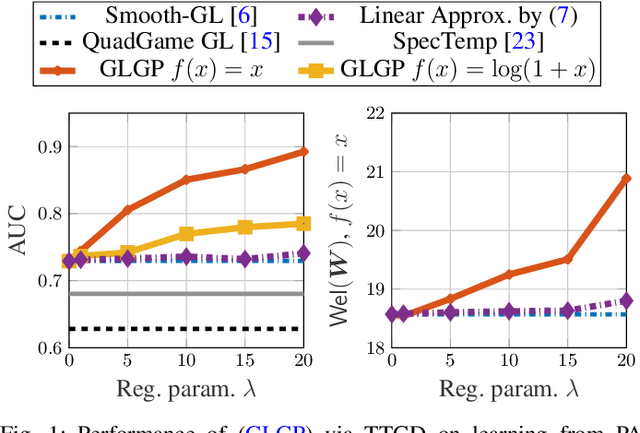
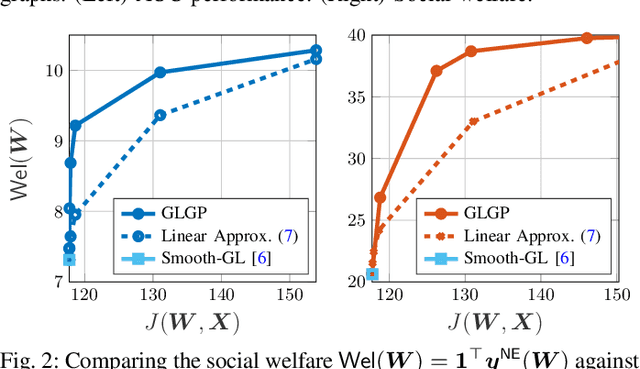
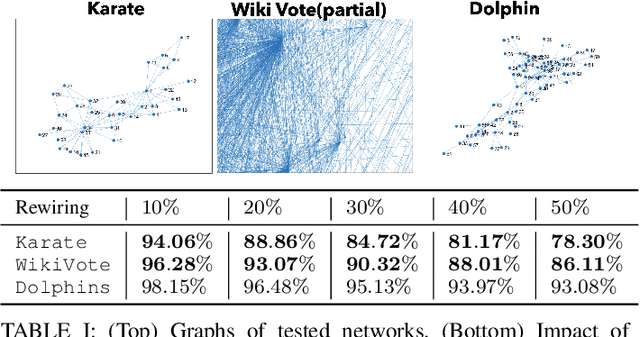
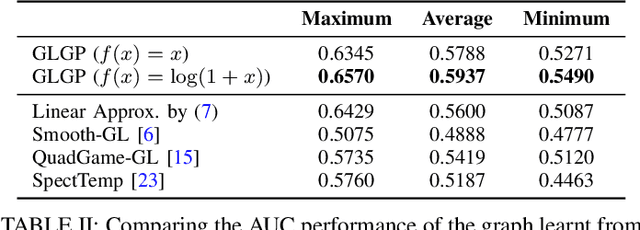
Learning the graph topology of a complex network is challenging due to limited data availability and imprecise data models. A common remedy in existing works is to incorporate priors such as sparsity or modularity which highlight on the structural property of graph topology. We depart from these approaches to develop priors that are directly inspired by complex network dynamics. Focusing on social networks with actions modeled by equilibriums of linear quadratic games, we postulate that the social network topologies are optimized with respect to a social welfare function. Utilizing this prior knowledge, we propose a network games induced regularizer to assist graph learning. We then formulate the graph topology learning problem as a bilevel program. We develop a two-timescale gradient algorithm to tackle the latter. We draw theoretical insights on the optimal graph structure of the bilevel program and show that they agree with the topology in several man-made networks. Empirically, we demonstrate the proposed formulation gives rise to reliable estimate of graph topology.
LogSpecT: Feasible Graph Learning Model from Stationary Signals with Recovery Guarantees
May 02, 2023Graph learning from signals is a core task in Graph Signal Processing (GSP). One of the most commonly used models to learn graphs from stationary signals is SpecT. However, its practical formulation rSpecT is known to be sensitive to hyperparameter selection and, even worse, to suffer from infeasibility. In this paper, we give the first condition that guarantees the infeasibility of rSpecT and design a novel model (LogSpecT) and its practical formulation (rLogSpecT) to overcome this issue. Contrary to rSpecT, the novel practical model rLogSpecT is always feasible. Furthermore, we provide recovery guarantees of rLogSpecT, which are derived from modern optimization tools related to epi-convergence. These tools could be of independent interest and significant for various learning problems. To demonstrate the advantages of rLogSpecT in practice, a highly efficient algorithm based on the linearized alternating direction method of multipliers (L-ADMM) is proposed. The subproblems of L-ADMM admit closed-form solutions and the convergence is guaranteed. Extensive numerical results on both synthetic and real networks corroborate the stability and superiority of our proposed methods, underscoring their potential for various graph learning applications.