 Add to Chrome
 Add to Firefox
 Add to Edge
Prefer-DAS: Learning from Local Preferences and Sparse Prompts for Domain Adaptive Segmentation of Electron Microscopy
Feb 23, 2026
Domain adaptive segmentation (DAS) is a promising paradigm for delineating intracellular structures from various large-scale electron microscopy (EM) without incurring extensive annotated data in each domain. However, the prevalent unsupervised domain adaptation (UDA) strategies often demonstrate limited and biased performance, which hinders their practical applications. In this study, we explore sparse points and local human preferences as weak labels in the target domain, thereby presenting a more realistic yet annotation-efficient setting. Specifically, we develop Prefer-DAS, which pioneers sparse promptable learning and local preference alignment. The Prefer-DAS is a promptable multitask model that integrates self-training and prompt-guided contrastive learning. Unlike SAM-like methods, the Prefer-DAS allows for the use of full, partial, and even no point prompts during both training and inference stages and thus enables interactive segmentation. Instead of using image-level human preference alignment for segmentation, we introduce Local direct Preference Optimization (LPO) and sparse LPO (SLPO), plug-and-play solutions for alignment with spatially varying human feedback or sparse feedback. To address potential missing feedback, we also introduce Unsupervised Preference Optimization (UPO), which leverages self-learned preferences. As a result, the Prefer-DAS model can effectively perform both weakly-supervised and unsupervised DAS, depending on the availability of points and human preferences. Comprehensive experiments on four challenging DAS tasks demonstrate that our model outperforms SAM-like methods as well as unsupervised and weakly-supervised DAS methods in both automatic and interactive segmentation modes, highlighting strong generalizability and flexibility. Additionally, the performance of our model is very close to or even exceeds that of supervised models.

Weakly-Supervised Cross-Domain Segmentation of Electron Microscopy with Sparse Point Annotation
Mar 31, 2024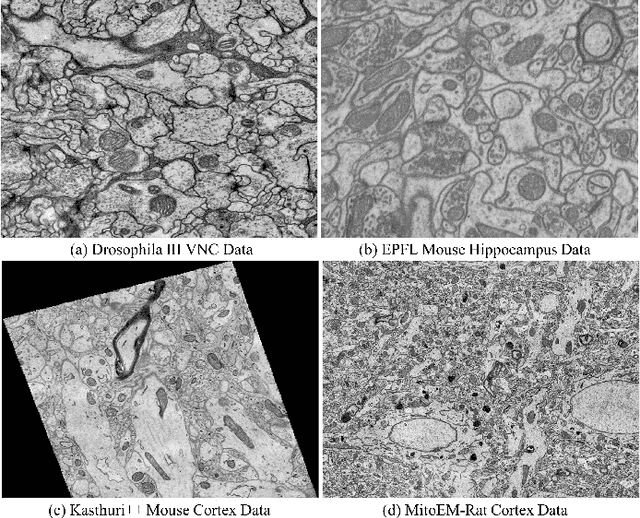
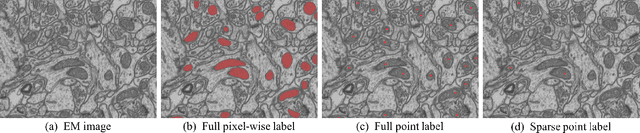

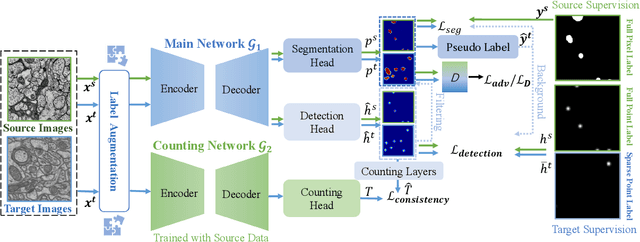
Accurate segmentation of organelle instances from electron microscopy (EM) images plays an essential role in many neuroscience researches. However, practical scenarios usually suffer from high annotation costs, label scarcity, and large domain diversity. While unsupervised domain adaptation (UDA) that assumes no annotation effort on the target data is promising to alleviate these challenges, its performance on complicated segmentation tasks is still far from practical usage. To address these issues, we investigate a highly annotation-efficient weak supervision, which assumes only sparse center-points on a small subset of object instances in the target training images. To achieve accurate segmentation with partial point annotations, we introduce instance counting and center detection as auxiliary tasks and design a multitask learning framework to leverage correlations among the counting, detection, and segmentation, which are all tasks with partial or no supervision. Building upon the different domain-invariances of the three tasks, we enforce counting estimation with a novel soft consistency loss as a global prior for center detection, which further guides the per-pixel segmentation. To further compensate for annotation sparsity, we develop a cross-position cut-and-paste for label augmentation and an entropy-based pseudo-label selection. The experimental results highlight that, by simply using extremely weak annotation, e.g., 15\% sparse points, for model training, the proposed model is capable of significantly outperforming UDA methods and produces comparable performance as the supervised counterpart. The high robustness of our model shown in the validations and the low requirement of expert knowledge for sparse point annotation further improve the potential application value of our model.