 Add to Chrome
 Add to Firefox
 Add to Edge
XAI-CF -- Examining the Role of Explainable Artificial Intelligence in Cyber Forensics
Feb 07, 2024
With the rise of complex cyber devices Cyber Forensics (CF) is facing many new challenges. For example, there are dozens of systems running on smartphones, each with more than millions of downloadable applications. Sifting through this large amount of data and making sense requires new techniques, such as from the field of Artificial Intelligence (AI). To apply these techniques successfully in CF, we need to justify and explain the results to the stakeholders of CF, such as forensic analysts and members of the court, for them to make an informed decision. If we want to apply AI successfully in CF, there is a need to develop trust in AI systems. Some other factors in accepting the use of AI in CF are to make AI authentic, interpretable, understandable, and interactive. This way, AI systems will be more acceptable to the public and ensure alignment with legal standards. An explainable AI (XAI) system can play this role in CF, and we call such a system XAI-CF. XAI-CF is indispensable and is still in its infancy. In this paper, we explore and make a case for the significance and advantages of XAI-CF. We strongly emphasize the need to build a successful and practical XAI-CF system and discuss some of the main requirements and prerequisites of such a system. We present a formal definition of the terms CF and XAI-CF and a comprehensive literature review of previous works that apply and utilize XAI to build and increase trust in CF. We discuss some challenges facing XAI-CF. We also provide some concrete solutions to these challenges. We identify key insights and future research directions for building XAI applications for CF. This paper is an effort to explore and familiarize the readers with the role of XAI applications in CF, and we believe that our work provides a promising basis for future researchers interested in XAI-CF.

MAIL: Malware Analysis Intermediate Language
Nov 06, 2022This paper introduces and presents a new language named MAIL (Malware Analysis Intermediate Language). MAIL is basically used for building malware analysis and detection tools. MAIL provides an abstract representation of an assembly program and hence the ability of a tool to automate malware analysis and detection. By translating binaries compiled for different platforms to MAIL, a tool can achieve platform independence. Each MAIL statement is annotated with patterns that can be used by a tool to optimize malware analysis and detection.
A Recipe for Social Media Analysis
Jun 14, 2021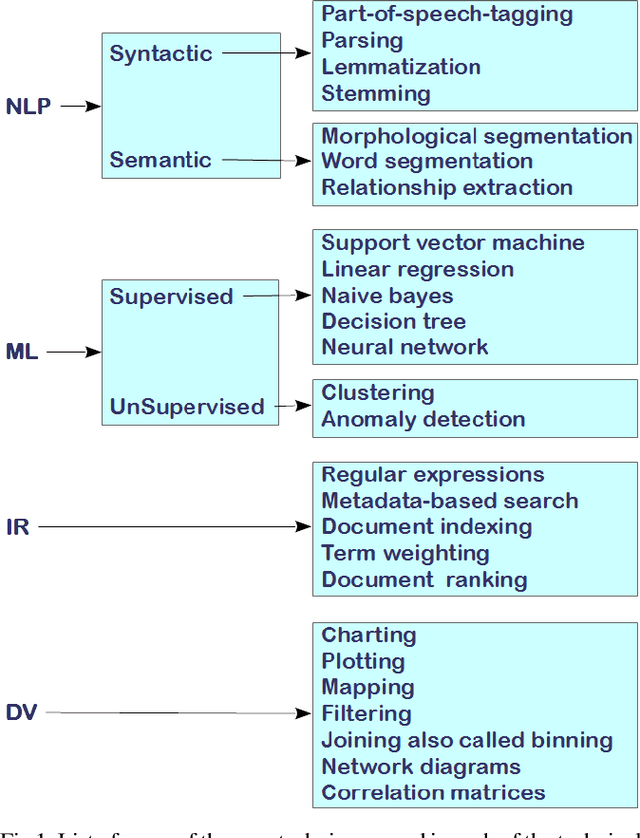
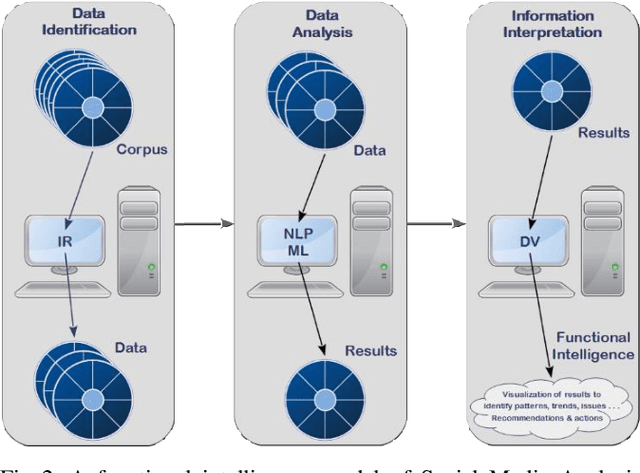
The Ubiquitous nature of smartphones has significantly increased the use of social media platforms, such as Facebook, Twitter, TikTok, and LinkedIn, etc., among the public, government, and businesses. Facebook generated ~70 billion USD in 2019 in advertisement revenues alone, a ~27% increase from the previous year. Social media has also played a strong role in outbreaks of social protests responsible for political changes in different countries. As we can see from the above examples, social media plays a big role in business intelligence and international politics. In this paper, we present and discuss a high-level functional intelligence model (recipe) of Social Media Analysis (SMA). This model synthesizes the input data and uses operational intelligence to provide actionable recommendations. In addition, it also matches the synthesized function of the experiences and learning gained from the environment. The SMA model presented is independent of the application domain, and can be applied to different domains, such as Education, Healthcare and Government, etc. Finally, we also present some of the challenges faced by SMA and how the SMA model presented in this paper solves them.