 Add to Chrome
 Add to Firefox
 Add to Edge
Architecture Design for Rise/Fall Asymmetry Glitch Minimization in Current-Steering DACs
Dec 09, 2025
Current-steering digital-to-analog converter (DAC) is a prominent architecture that is commonly used in high-speed applications such as optical communications. One of the shortcomings of this architecture is the output glitches that are input dependent and degrade the dynamic performance of the DAC. We investigate DAC glitches that arise from asymmetry in the fall/rise response of DAC switches. We formulate a glitch metric that defines the overall DAC performance, which is then used to find a novel DAC weighting scheme. Numerical simulations show that the proposed architecture can potentially provide a significant performance advantage compared to the segmented structure.

Timing-Error Optimized Architecture for Current-Steering DACs
Dec 09, 2025
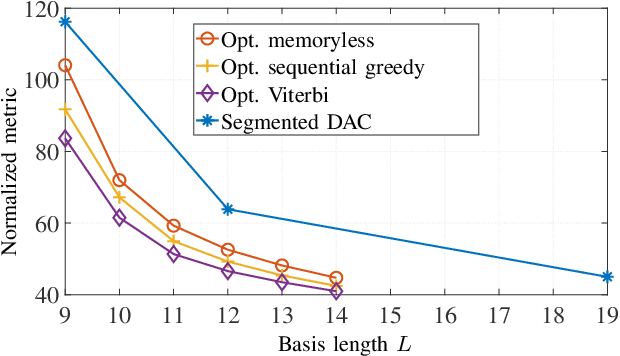
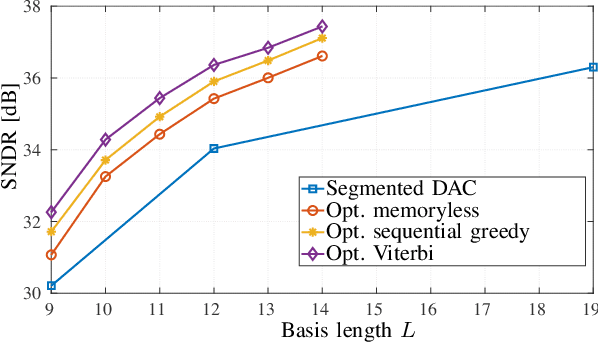
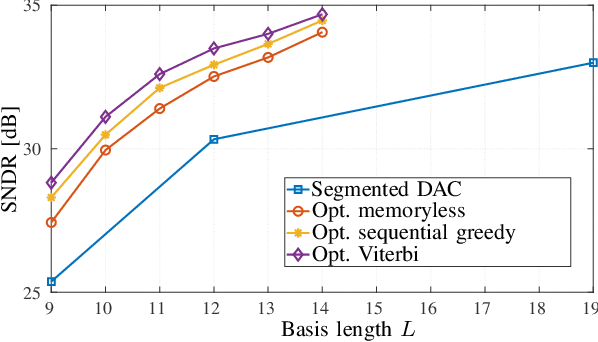
We propose a novel digital-to-analog converter (DAC) weighting architecture that statistically minimizes the distortion caused by random timing mismatches among current sources. To decode the DAC input codewords into corresponding DAC switches, we present three algorithms with varying computational complexities. We perform high-level Matlab simulations to illustrate the dynamic performance improvement over the segmented structure.
Current-Steering DAC Architecture Design for Amplitude Mismatch Error Minimization
May 23, 2025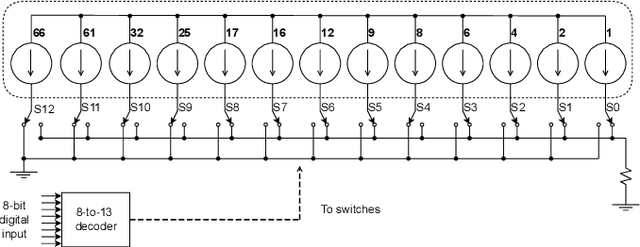
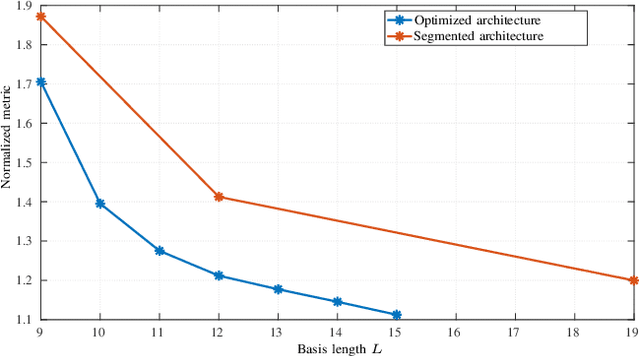
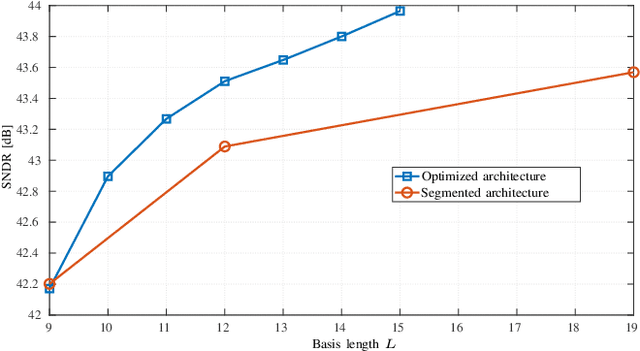
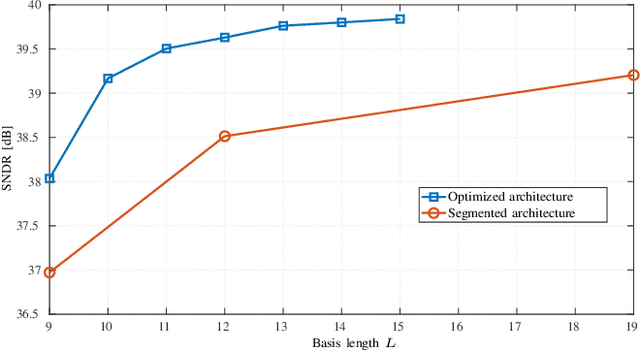
We propose a novel digital-to-analog converter (DAC) weighting architecture that statistically minimizes the distortion caused by random current mismatches. Unlike binary, thermometer-coded, and segmented DACs, the current weights of the proposed architecture are not an integer power of 2 or any other integer number. We present a heuristic algorithm for a static mapping of DAC input codewords into corresponding DAC switches. High-level Matlab simulations are performed to illustrate the static performance improvement over the segmented structure.