 Add to Chrome
 Add to Firefox
 Add to Edge
CiteCheck: Retrieval-Grounded Detection of LLM Citation Hallucinations in Scientific Text
May 26, 2026
Large language models (LLMs) are increasingly used to generate scientific reports, but they can produce references that appear plausible while containing corrupted metadata or pointing to papers that do not exist. We introduce CiteCheck, a hybrid framework for citation hallucination detection that verifies whether a citation corresponds to a real scholarly work and whether its metadata is faithful to that work. CiteCheck retrieves candidate publications from external scholarly sources, compares the citation against the retrieved candidate using a structured LLM verifier, and maps verifier scores into three labels: Exact, Minor, and Major. We also construct a 982-citation physics benchmark with controlled corruptions that capture both subtle metadata drift and fully fabricated references. On the held-out test set, CiteCheck achieves 88.7 macro-F1 and 88.9% accuracy, outperforming GPT, Claude, and Gemini baselines, including web-search and few-shot variants. These results show that reliable citation verification benefits from combining scholarly retrieval, structured LLM-based comparison, and calibrated decision rules.

DeepSciVerify: Verifying Scientific Claim--Citation Alignment via LLM-Driven Evidence Escalation
May 26, 2026Misalignment between claims and their cited evidence is a common failure mode in reports generated by large language models, limiting their reliability in scientific and other high-stakes settings. We present DeepSciVerify, a two-stage pipeline for scientific claim-citation verification that combines abstract-level reasoning with selective escalation to passage-level evidence. The system first verifies claims using the abstract and defers uncertain cases, retrieving and analyzing full-text passages only when necessary. This design leverages complementary behaviors across LLMs, as some models are more conservative while others are more decisive under uncertainty. On the SCitance benchmark, DeepSciVerify achieves 86.7 Micro-F1, outperforming strong abstract-only baselines by +4.5 points while resolving 67% of instances without full-text retrieval. These results suggest that selective evidence escalation improves both accuracy and efficiency in claim-citation verification.
Whitening Not Recommended for Classification Tasks in LLMs
Jul 16, 2024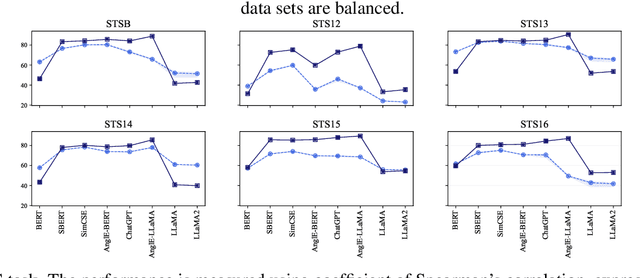
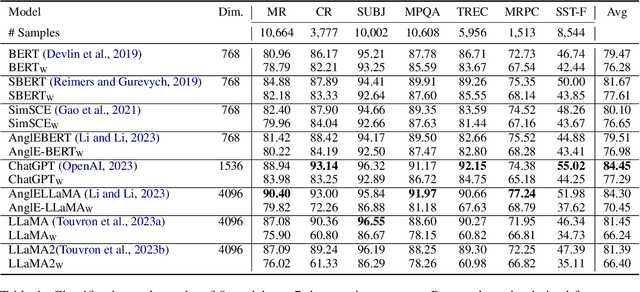
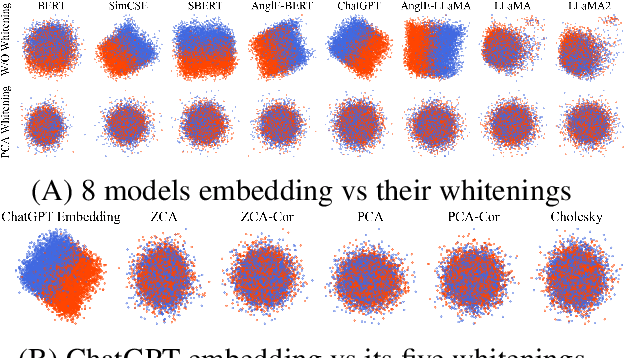
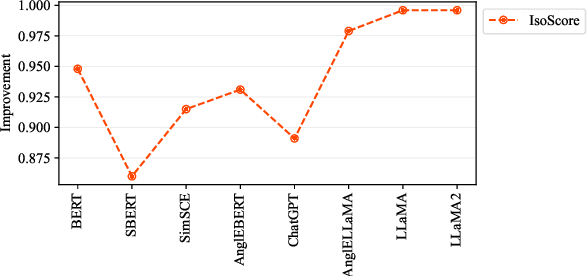
Sentence embedding is a cornerstone in NLP. Whitening has been claimed to be an effective operation to improve embedding quality obtained from Large Language Models (LLMs). However, we find that the efficacy of whitening is model-dependent and task-dependent. In particular, whitening degenerates embeddings for classification tasks. The conclusion is supported by extensive experiments. We also explored a variety of whitening operations, including PCA, ZCA, PCA-Cor, ZCA-Cor and Cholesky whitenings. A by-product of our research is embedding evaluation platform for LLMs called SentEval+.