 Add to Chrome
 Add to Firefox
 Add to Edge
Tool-MAD: A Multi-Agent Debate Framework for Fact Verification with Diverse Tool Augmentation and Adaptive Retrieval
Jan 08, 2026
Large Language Models (LLMs) suffer from hallucinations and factual inaccuracies, especially in complex reasoning and fact verification tasks. Multi-Agent Debate (MAD) systems aim to improve answer accuracy by enabling multiple LLM agents to engage in dialogue, promoting diverse reasoning and mutual verification. However, existing MAD frameworks primarily rely on internal knowledge or static documents, making them vulnerable to hallucinations. While MADKE introduces external evidence to mitigate this, its one-time retrieval mechanism limits adaptability to new arguments or emerging information during the debate. To address these limitations, We propose Tool-MAD, a multi-agent debate framework that enhances factual verification by assigning each agent a distinct external tool, such as a search API or RAG module. Tool-MAD introduces three key innovations: (1) a multi-agent debate framework where agents leverage heterogeneous external tools, encouraging diverse perspectives, (2) an adaptive query formulation mechanism that iteratively refines evidence retrieval based on the flow of the debate, and (3) the integration of Faithfulness and Answer Relevance scores into the final decision process, allowing the Judge agent to quantitatively assess the coherence and question alignment of each response and effectively detect hallucinations. Experimental results on four fact verification benchmarks demonstrate that Tool-MAD consistently outperforms state-of-the-art MAD frameworks, achieving up to 5.5% accuracy improvement. Furthermore, in medically specialized domains, Tool-MAD exhibits strong robustness and adaptability across various tool configurations and domain conditions, confirming its potential for broader real-world fact-checking applications.

CovRL: Fuzzing JavaScript Engines with Coverage-Guided Reinforcement Learning for LLM-based Mutation
Feb 19, 2024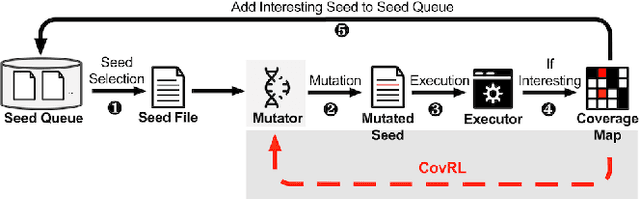
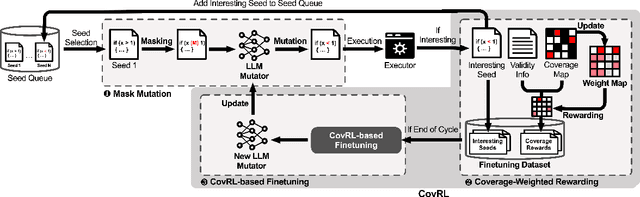
Fuzzing is an effective bug-finding technique but it struggles with complex systems like JavaScript engines that demand precise grammatical input. Recently, researchers have adopted language models for context-aware mutation in fuzzing to address this problem. However, existing techniques are limited in utilizing coverage guidance for fuzzing, which is rather performed in a black-box manner. This paper presents a novel technique called CovRL (Coverage-guided Reinforcement Learning) that combines Large Language Models (LLMs) with reinforcement learning from coverage feedback. Our fuzzer, CovRL-Fuzz, integrates coverage feedback directly into the LLM by leveraging the Term Frequency-Inverse Document Frequency (TF-IDF) method to construct a weighted coverage map. This map is key in calculating the fuzzing reward, which is then applied to the LLM-based mutator through reinforcement learning. CovRL-Fuzz, through this approach, enables the generation of test cases that are more likely to discover new coverage areas, thus improving vulnerability detection while minimizing syntax and semantic errors, all without needing extra post-processing. Our evaluation results indicate that CovRL-Fuzz outperforms the state-of-the-art fuzzers in terms of code coverage and bug-finding capabilities: CovRL-Fuzz identified 48 real-world security-related bugs in the latest JavaScript engines, including 39 previously unknown vulnerabilities and 11 CVEs.