 Add to Chrome
 Add to Firefox
 Add to Edge
Robust multi-task boosting using clustering and local ensembling
Feb 15, 2026
Multi-Task Learning (MTL) aims to boost predictive performance by sharing information across related tasks, yet conventional methods often suffer from negative transfer when unrelated or noisy tasks are forced to share representations. We propose Robust Multi-Task Boosting using Clustering and Local Ensembling (RMB-CLE), a principled MTL framework that integrates error-based task clustering with local ensembling. Unlike prior work that assumes fixed clusters or hand-crafted similarity metrics, RMB-CLE derives inter-task similarity directly from cross-task errors, which admit a risk decomposition into functional mismatch and irreducible noise, providing a theoretically grounded mechanism to prevent negative transfer. Tasks are grouped adaptively via agglomerative clustering, and within each cluster, a local ensemble enables robust knowledge sharing while preserving task-specific patterns. Experiments show that RMB-CLE recovers ground-truth clusters in synthetic data and consistently outperforms multi-task, single-task, and pooling-based ensemble methods across diverse real-world and synthetic benchmarks. These results demonstrate that RMB-CLE is not merely a combination of clustering and boosting but a general and scalable framework that establishes a new basis for robust multi-task learning.

Robust-Multi-Task Gradient Boosting
Jul 15, 2025Multi-task learning (MTL) has shown effectiveness in exploiting shared information across tasks to improve generalization. MTL assumes tasks share similarities that can improve performance. In addition, boosting algorithms have demonstrated exceptional performance across diverse learning problems, primarily due to their ability to focus on hard-to-learn instances and iteratively reduce residual errors. This makes them a promising approach for learning multi-task problems. However, real-world MTL scenarios often involve tasks that are not well-aligned (known as outlier or adversarial tasks), which do not share beneficial similarities with others and can, in fact, deteriorate the performance of the overall model. To overcome this challenge, we propose Robust-Multi-Task Gradient Boosting (R-MTGB), a novel boosting framework that explicitly models and adapts to task heterogeneity during training. R-MTGB structures the learning process into three sequential blocks: (1) learning shared patterns, (2) partitioning tasks into outliers and non-outliers with regularized parameters, and (3) fine-tuning task-specific predictors. This architecture enables R-MTGB to automatically detect and penalize outlier tasks while promoting effective knowledge transfer among related tasks. Our method integrates these mechanisms seamlessly within gradient boosting, allowing robust handling of noisy or adversarial tasks without sacrificing accuracy. Extensive experiments on both synthetic benchmarks and real-world datasets demonstrate that our approach successfully isolates outliers, transfers knowledge, and consistently reduces prediction errors for each task individually, and achieves overall performance gains across all tasks. These results highlight robustness, adaptability, and reliable convergence of R-MTGB in challenging MTL environments.
A Gradient Boosting Approach for Training Convolutional and Deep Neural Networks
Feb 23, 2023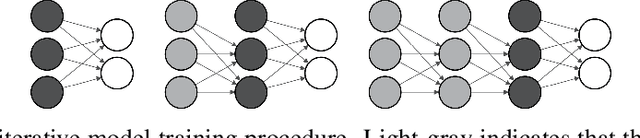
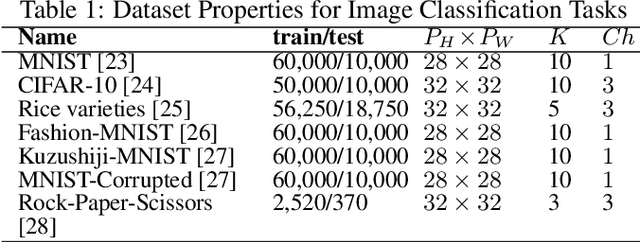
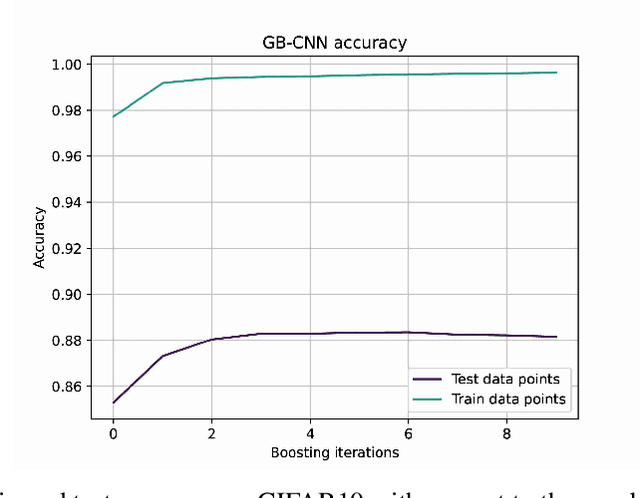
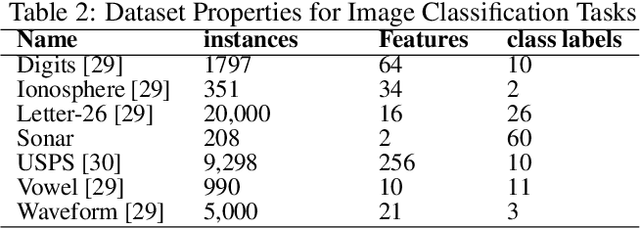
Deep learning has revolutionized the computer vision and image classification domains. In this context Convolutional Neural Networks (CNNs) based architectures are the most widely applied models. In this article, we introduced two procedures for training Convolutional Neural Networks (CNNs) and Deep Neural Network based on Gradient Boosting (GB), namely GB-CNN and GB-DNN. These models are trained to fit the gradient of the loss function or pseudo-residuals of previous models. At each iteration, the proposed method adds one dense layer to an exact copy of the previous deep NN model. The weights of the dense layers trained on previous iterations are frozen to prevent over-fitting, permitting the model to fit the new dense as well as to fine-tune the convolutional layers (for GB-CNN) while still utilizing the information already learned. Through extensive experimentation on different 2D-image classification and tabular datasets, the presented models show superior performance in terms of classification accuracy with respect to standard CNN and Deep-NN with the same architectures.
Condensed Gradient Boosting
Nov 26, 2022This paper presents a computationally efficient variant of gradient boosting for multi-class classification and multi-output regression tasks. Standard gradient boosting uses a 1-vs-all strategy for classifications tasks with more than two classes. This strategy translates in that one tree per class and iteration has to be trained. In this work, we propose the use of multi-output regressors as base models to handle the multi-class problem as a single task. In addition, the proposed modification allows the model to learn multi-output regression problems. An extensive comparison with other multi-ouptut based gradient boosting methods is carried out in terms of generalization and computational efficiency. The proposed method showed the best trade-off between generalization ability and training and predictions speeds.