 Add to Chrome
 Add to Firefox
 Add to Edge
Deep Learning-Based Burned Area Mapping Using Bi-Temporal Siamese Networks and AlphaEarth Foundation Datasets
Sep 09, 2025
Accurate and timely mapping of burned areas is crucial for environmental monitoring, disaster management, and assessment of climate change. This study presents a novel approach to automated burned area mapping using the AlphaEArth dataset combined with the Siamese U-Net deep learning architecture. The AlphaEArth Dataset, comprising high-resolution optical and thermal infrared imagery with comprehensive ground-truth annotations, provides an unprecedented resource for training robust burned area detection models. We trained our model with the Monitoring Trends in Burn Severity (MTBS) dataset in the contiguous US and evaluated it with 17 regions cross in Europe. Our experimental results demonstrate that the proposed ensemble approach achieves superior performance with an overall accuracy of 95%, IoU of 0.6, and F1-score of 74% on the test dataset. The model successfully identifies burned areas across diverse ecosystems with complex background, showing particular strength in detecting partially burned vegetation and fire boundaries and its transferability and high generalization in burned area mapping. This research contributes to the advancement of automated fire damage assessment and provides a scalable solution for global burn area monitoring using the AlphaEarth dataset.

Unveiling the Power of Wavelets: A Wavelet-based Kolmogorov-Arnold Network for Hyperspectral Image Classification
Jun 12, 2024Hyperspectral image classification is a crucial but challenging task due to the high dimensionality and complex spatial-spectral correlations inherent in hyperspectral data. This paper employs Wavelet-based Kolmogorov-Arnold Network (wav-kan) architecture tailored for efficient modeling of these intricate dependencies. Inspired by the Kolmogorov-Arnold representation theorem, Wav-KAN incorporates wavelet functions as learnable activation functions, enabling non-linear mapping of the input spectral signatures. The wavelet-based activation allows Wav-KAN to effectively capture multi-scale spatial and spectral patterns through dilations and translations. Experimental evaluation on three benchmark hyperspectral datasets (Salinas, Pavia, Indian Pines) demonstrates the superior performance of Wav-KAN compared to traditional multilayer perceptrons (MLPs) and the recently proposed Spline-based KAN (Spline-KAN) model. In this work we are: (1) conducting more experiments on additional hyperspectral datasets (Pavia University, WHU-Hi, and Urban Hyperspectral Image) to further validate the generalizability of Wav-KAN; (2) developing a multiresolution Wav-KAN architecture to capture scale-invariant features; (3) analyzing the effect of dimensional reduction techniques on classification performance; (4) exploring optimization methods for tuning the hyperparameters of KAN models; and (5) comparing Wav-KAN with other state-of-the-art models in hyperspectral image classification.
Exploring the Potential of Polynomial Basis Functions in Kolmogorov-Arnold Networks: A Comparative Study of Different Groups of Polynomials
May 30, 2024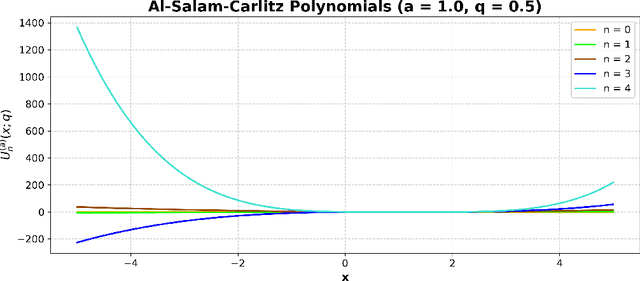
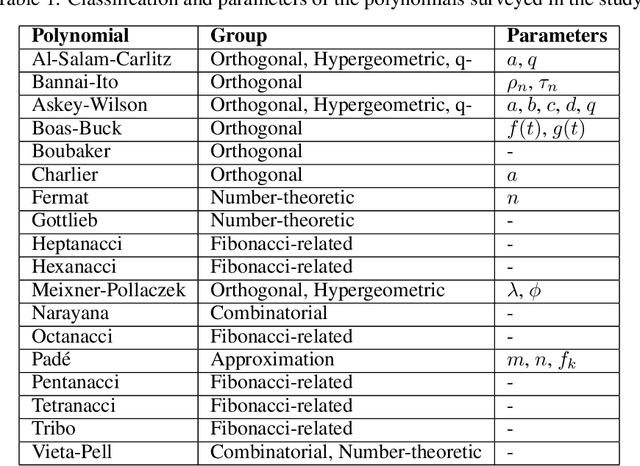
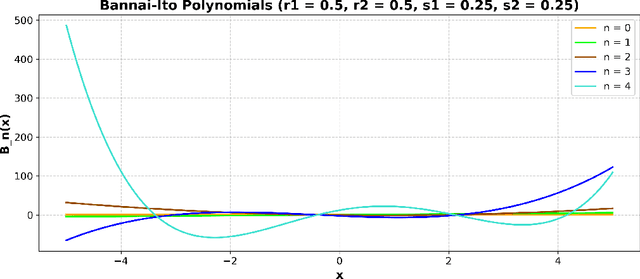
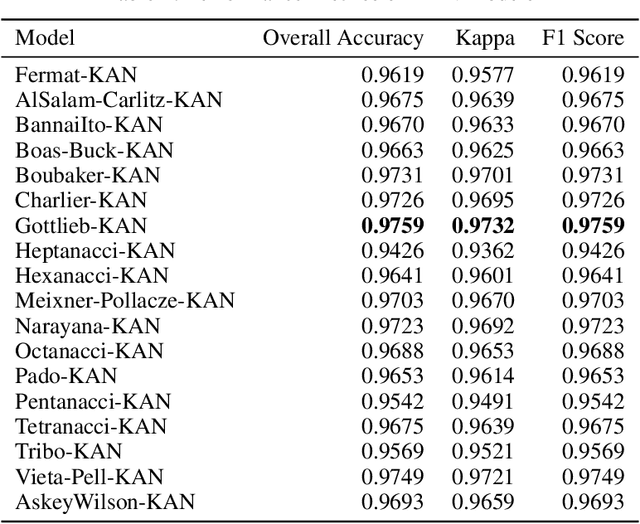
This paper presents a comprehensive survey of 18 distinct polynomials and their potential applications in Kolmogorov-Arnold Network (KAN) models as an alternative to traditional spline-based methods. The polynomials are classified into various groups based on their mathematical properties, such as orthogonal polynomials, hypergeometric polynomials, q-polynomials, Fibonacci-related polynomials, combinatorial polynomials, and number-theoretic polynomials. The study aims to investigate the suitability of these polynomials as basis functions in KAN models for complex tasks like handwritten digit classification on the MNIST dataset. The performance metrics of the KAN models, including overall accuracy, Kappa, and F1 score, are evaluated and compared. The Gottlieb-KAN model achieves the highest performance across all metrics, suggesting its potential as a suitable choice for the given task. However, further analysis and tuning of these polynomials on more complex datasets are necessary to fully understand their capabilities in KAN models. The source code for the implementation of these KAN models is available at https://github.com/seydi1370/Basis_Functions .