 Add to Chrome
 Add to Firefox
 Add to Edge
Enabling Automatic Self-Talk Detection via Earables
Nov 10, 2025
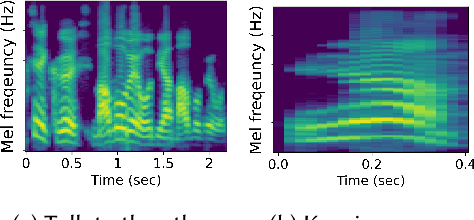
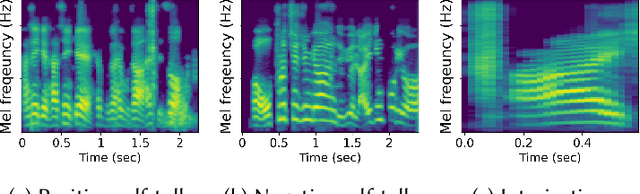

Self-talk-an internal dialogue that can occur silently or be spoken aloud-plays a crucial role in emotional regulation, cognitive processing, and motivation, yet has remained largely invisible and unmeasurable in everyday life. In this paper, we present MutterMeter, a mobile system that automatically detects vocalized self-talk from audio captured by earable microphones in real-world settings. Detecting self-talk is technically challenging due to its diverse acoustic forms, semantic and grammatical incompleteness, and irregular occurrence patterns, which differ fundamentally from assumptions underlying conventional speech understanding models. To address these challenges, MutterMeter employs a hierarchical classification architecture that progressively integrates acoustic, linguistic, and contextual information through a sequential processing pipeline, adaptively balancing accuracy and computational efficiency. We build and evaluate MutterMeter using a first-of-its-kind dataset comprising 31.1 hours of audio collected from 25 participants. Experimental results demonstrate that MutterMeter achieves robust performance with a macro-averaged F1 score of 0.84, outperforming conventional approaches, including LLM-based and speech emotion recognition models.

Automatic Detection of Reactions to Music via Earable Sensing
Apr 06, 2023We present GrooveMeter, a novel system that automatically detects vocal and motion reactions to music via earable sensing and supports music engagement-aware applications. To this end, we use smart earbuds as sensing devices, which are already widely used for music listening, and devise reaction detection techniques by leveraging an inertial measurement unit (IMU) and a microphone on earbuds. To explore reactions in daily music-listening situations, we collect the first kind of dataset, MusicReactionSet, containing 926-minute-long IMU and audio data with 30 participants. With the dataset, we discover a set of unique challenges in detecting music listening reactions accurately and robustly using audio and motion sensing. We devise sophisticated processing pipelines to make reaction detection accurate and efficient. We present a comprehensive evaluation to examine the performance of reaction detection and system cost. It shows that GrooveMeter achieves the macro F1 scores of 0.89 for vocal reaction and 0.81 for motion reaction with leave-one-subject-out cross-validation. More importantly, GrooveMeter shows higher accuracy and robustness compared to alternative methods. We also show that our filtering approach reduces 50% or more of the energy overhead. Finally, we demonstrate the potential use cases through a case study.