 Add to Chrome
 Add to Firefox
 Add to Edge
Edit-As-Act: Goal-Regressive Planning for Open-Vocabulary 3D Indoor Scene Editing
Mar 18, 2026
Editing a 3D indoor scene from natural language is conceptually straightforward but technically challenging. Existing open-vocabulary systems often regenerate large portions of a scene or rely on image-space edits that disrupt spatial structure, resulting in unintended global changes or physically inconsistent layouts. These limitations stem from treating editing primarily as a generative task. We take a different view. A user instruction defines a desired world state, and editing should be the minimal sequence of actions that makes this state true while preserving everything else. This perspective motivates Edit-As-Act, a framework that performs open-vocabulary scene editing as goal-regressive planning in 3D space. Given a source scene and free-form instruction, Edit-As-Act predicts symbolic goal predicates and plans in EditLang, a PDDL-inspired action language that we design with explicit preconditions and effects encoding support, contact, collision, and other geometric relations. A language-driven planner proposes actions, and a validator enforces goal-directedness, monotonicity, and physical feasibility, producing interpretable and physically coherent transformations. By separating reasoning from low-level generation, Edit-As-Act achieves instruction fidelity, semantic consistency, and physical plausibility - three criteria that existing paradigms cannot satisfy together. On E2A-Bench, our benchmark of 63 editing tasks across 9 indoor environments, Edit-As-Act significantly outperforms prior approaches across all edit types and scene categories.

From Assumptions to Actions: Turning LLM Reasoning into Uncertainty-Aware Planning for Embodied Agents
Feb 04, 2026Embodied agents operating in multi-agent, partially observable, and decentralized environments must plan and act despite pervasive uncertainty about hidden objects and collaborators' intentions. Recent advances in applying Large Language Models (LLMs) to embodied agents have addressed many long-standing challenges, such as high-level goal decomposition and online adaptation. Yet, uncertainty is still primarily mitigated through frequent inter-agent communication. This incurs substantial token and time costs, and can disrupt established workflows, when human partners are involved. We introduce PCE, a Planner-Composer-Evaluator framework that converts the fragmented assumptions latent in LLM reasoning traces into a structured decision tree. Internal nodes encode environment assumptions and leaves map to actions; each path is then scored by scenario likelihood, goal-directed gain, and execution cost to guide rational action selection without heavy communication. Across two challenging multi-agent benchmarks (C-WAH and TDW-MAT) and three diverse LLM backbones, PCE consistently outperforms communication-centric baselines in success rate and task efficiency while showing comparable token usage. Ablation results indicate that the performance gains obtained by scaling model capacity or reasoning depth persist even when PCE is applied, while PCE consistently raises the baseline across both capacity and reasoning-depth scales, confirming that structured uncertainty handling complements both forms of scaling. A user study further demonstrates that PCE produces communication patterns that human partners perceive as more efficient and trustworthy. Together, these results establish a principled route for turning latent LLM assumptions into reliable strategies for uncertainty-aware planning.
LLM-Based Cooperative Agents using Information Relevance and Plan Validation
May 27, 2024
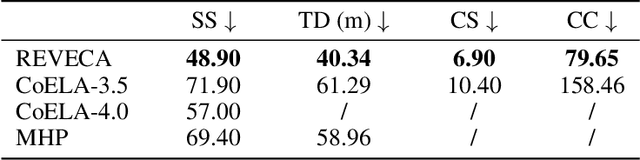
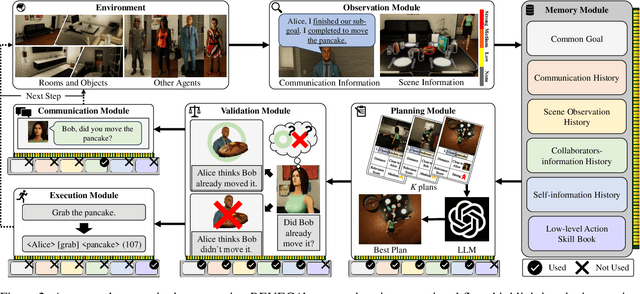
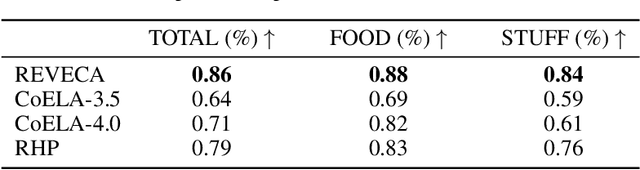
We address the challenge of multi-agent cooperation, where agents achieve a common goal by interacting with a 3D scene and cooperating with decentralized agents under complex partial observations. This involves managing communication costs and optimizing interaction trajectories in dynamic environments. Our research focuses on three primary limitations of existing cooperative agent systems. Firstly, current systems demonstrate inefficiency in managing acquired information through observation, resulting in declining planning performance as the environment becomes more complex with additional objects or goals. Secondly, the neglect of false plans in partially observable settings leads to suboptimal cooperative performance, as agents struggle to adapt to environmental changes influenced by the unseen actions of other agents. Lastly, the failure to incorporate spatial data into decision-making processes restricts the agent's ability to construct optimized trajectories. To overcome these limitations, we propose the RElevance and Validation-Enhanced Cooperative Language Agent (REVECA), a novel cognitive architecture powered by GPT-3.5. REVECA leverages relevance assessment, plan validation, and spatial information to enhance the efficiency and robustness of agent cooperation in dynamic and partially observable environments while minimizing continuous communication costs and effectively managing irrelevant dummy objects. Our extensive experiments demonstrate the superiority of REVECA over previous approaches, including those driven by GPT-4.0. Additionally, a user study highlights REVECA's potential for achieving trustworthy human-AI cooperation. We expect that REVECA will have significant applications in gaming, XR applications, educational tools, and humanoid robots, contributing to substantial economic, commercial, and academic advancements.