 Add to Chrome
 Add to Firefox
 Add to Edge
Prior Availability in Industrial Visual Sim-to-Real: A Review of CAD-Guided and CAD-Unavailable Regimes
Jun 01, 2026
Industrial visual sim-to-real is often described as transferring from synthetic images to real images, but industrial deployment usually involves a broader mismatch between available evidence and required decisions. A system may be built from CAD renderings, simulated RGB-D observations, normal reference images, synthetic defects, pretrained feature spaces, or language prompts, yet deployed under different sensors, lighting, materials, fixtures, calibration, production variation, and rare defect modes. This review reframes industrial visual sim-to-real as a domain-gap problem organized by prior availability. We distinguish CAD-available settings, where explicit object geometry can support rendering, calibration, pose estimation, segmentation, and test-time geometric verification; CAD-unavailable settings, where geometry is replaced by normal-reference appearance, feature distributions, teacher-student residuals, synthetic anomaly assumptions, foundation features, or vision-language priors; and boundary-prior settings, where approximate models, templates, reference views, or semantic correspondences preserve only part of the CAD role. This framing connects CAD-based detection and 6D pose-estimation literature with industrial anomaly and surface-inspection literature that is usually reviewed separately. To make the taxonomy concrete, we use empirical anchors on T-LESS/BOP, MVTec AD, and VisA. The anchors show that CAD render count alone does not close transfer; source-distribution design, detector capacity, and small real calibration can matter more. They also show that CAD at test time creates a distinct verification channel through mask, pose, and depth consistency, whereas CAD-unavailable inspection relies on calibrated normality and feature deviation. The review therefore argues against a single cross-task leaderboard and instead asks what prior grounds the deployment decision.

Neural ATTF: A Scalable Solution to Lifelong Multi-Agent Path Planning
Apr 21, 2025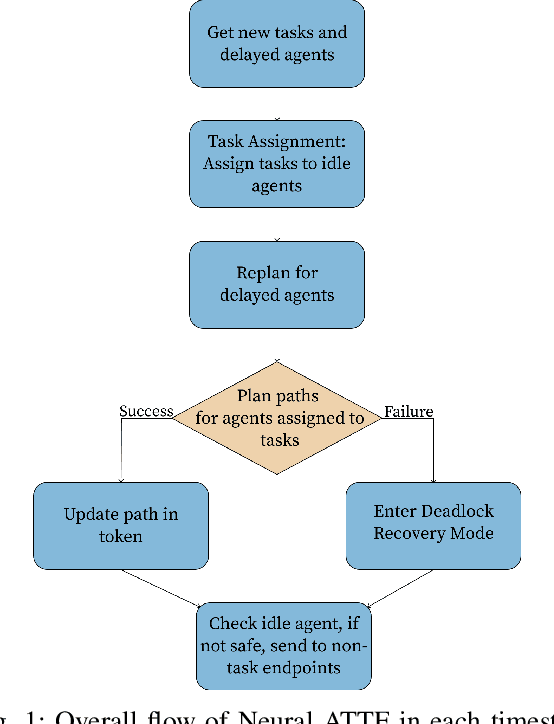
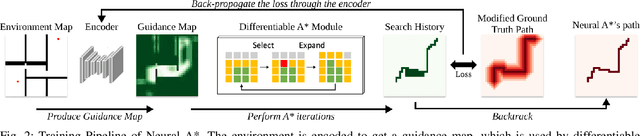

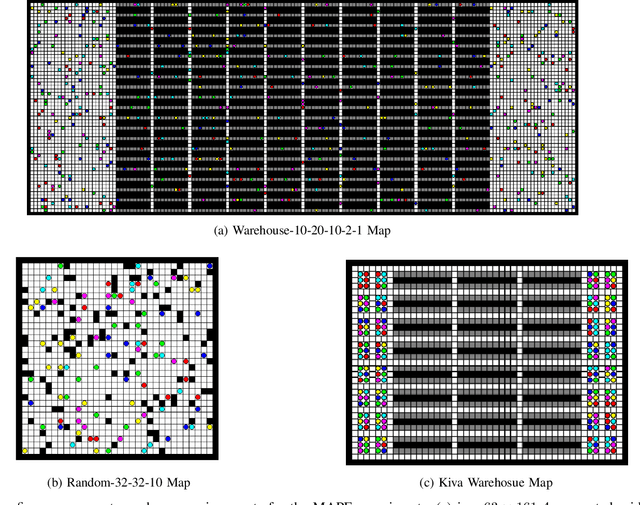
Multi-Agent Pickup and Delivery (MAPD) is a fundamental problem in robotics, particularly in applications such as warehouse automation and logistics. Existing solutions often face challenges in scalability, adaptability, and efficiency, limiting their applicability in dynamic environments with real-time planning requirements. This paper presents Neural ATTF (Adaptive Task Token Framework), a new algorithm that combines a Priority Guided Task Matching (PGTM) Module with Neural STA* (Space-Time A*), a data-driven path planning method. Neural STA* enhances path planning by enabling rapid exploration of the search space through guided learned heuristics and ensures collision avoidance under dynamic constraints. PGTM prioritizes delayed agents and dynamically assigns tasks by prioritizing agents nearest to these tasks, optimizing both continuity and system throughput. Experimental evaluations against state-of-the-art MAPD algorithms, including TPTS, CENTRAL, RMCA, LNS-PBS, and LNS-wPBS, demonstrate the superior scalability, solution quality, and computational efficiency of Neural ATTF. These results highlight the framework's potential for addressing the critical demands of complex, real-world multi-agent systems operating in high-demand, unpredictable settings.