 Add to Chrome
 Add to Firefox
 Add to Edge
TDAD: Test-Driven Agentic Development - Reducing Code Regressions in AI Coding Agents via Graph-Based Impact Analysis
Mar 19, 2026
AI coding agents can resolve real-world software issues, yet they frequently introduce regressions -- breaking tests that previously passed. Current benchmarks focus almost exclusively on resolution rate, leaving regression behavior under-studied. This paper presents TDAD (Test-Driven Agentic Development), an open-source tool that performs pre-change impact analysis for AI coding agents. TDAD builds a dependency map between source code and tests so that before committing a patch, the agent knows which tests to verify and can self-correct. The map is delivered as a lightweight agent skill -- a static text file the agent queries at runtime. Evaluated on SWE-bench Verified with two open-weight models running on consumer hardware (Qwen3-Coder 30B, 100 instances; Qwen3.5-35B-A3B, 25 instances), TDAD reduced regressions by 70% (6.08% to 1.82%) compared to a vanilla baseline. In contrast, adding TDD procedural instructions without targeted test context increased regressions to 9.94% -- worse than no intervention at all. When deployed as an agent skill with a different model and framework, TDAD improved issue-resolution rate from 24% to 32%, confirming that surfacing contextual information outperforms prescribing procedural workflows. All code, data, and logs are publicly available at https://github.com/pepealonso95/TDAD.

Congruence-based Learning of Probabilistic Deterministic Finite Automata
Dec 12, 2024This work studies the question of learning probabilistic deterministic automata from language models. For this purpose, it focuses on analyzing the relations defined on algebraic structures over strings by equivalences and similarities on probability distributions. We introduce a congruence that extends the classical Myhill-Nerode congruence for formal languages. This new congruence is the basis for defining regularity over language models. We present an active learning algorithm that computes the quotient with respect to this congruence whenever the language model is regular. The paper also defines the notion of recognizability for language models and shows that it coincides with regularity for congruences. For relations which are not congruences, it shows that this is not the case. Finally, it discusses the impact of this result on learning in the context of language models.
Analyzing constrained LLM through PDFA-learning
Jun 12, 2024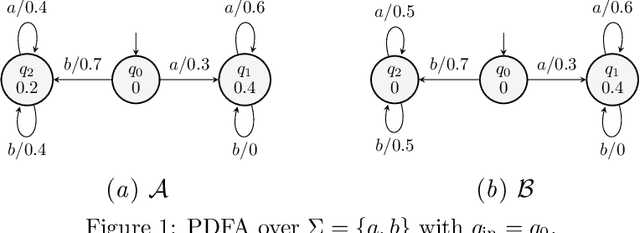
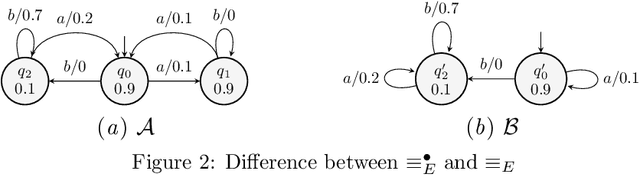

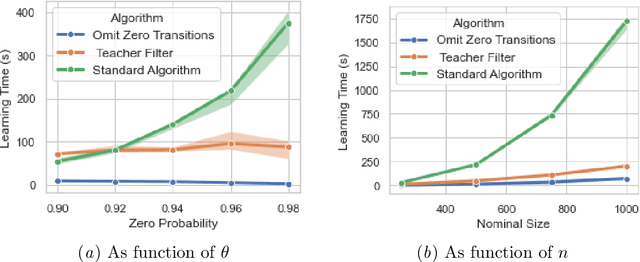
We define a congruence that copes with null next-symbol probabilities that arise when the output of a language model is constrained by some means during text generation. We develop an algorithm for efficiently learning the quotient with respect to this congruence and evaluate it on case studies for analyzing statistical properties of LLM.
Towards Efficient Active Learning of PDFA
Jun 17, 2022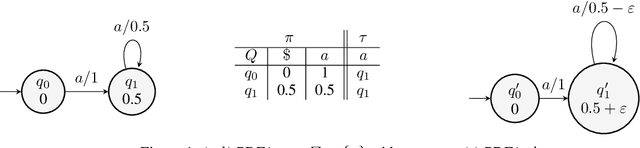
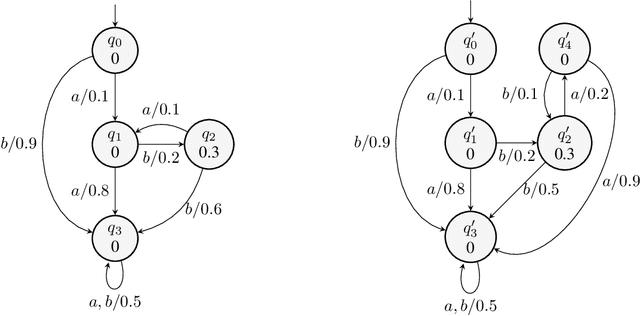
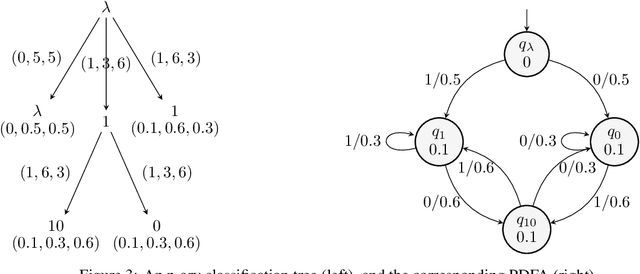
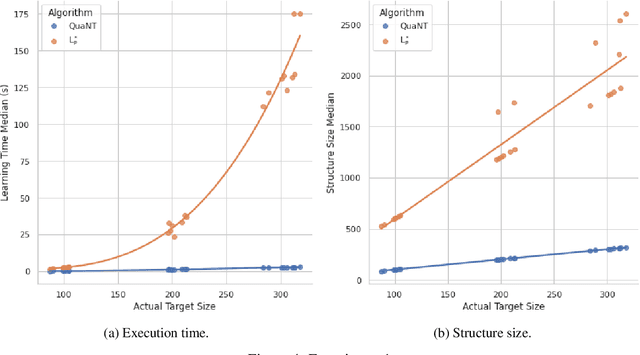
We propose a new active learning algorithm for PDFA based on three main aspects: a congruence over states which takes into account next-symbol probability distributions, a quantization that copes with differences in distributions, and an efficient tree-based data structure. Experiments showed significant performance gains with respect to reference implementations.