 Add to Chrome
 Add to Firefox
 Add to Edge
LeLaR: The First In-Orbit Demonstration of an AI-Based Satellite Attitude Controller
Dec 23, 2025
Attitude control is essential for many satellite missions. Classical controllers, however, are time-consuming to design and sensitive to model uncertainties and variations in operational boundary conditions. Deep Reinforcement Learning (DRL) offers a promising alternative by learning adaptive control strategies through autonomous interaction with a simulation environment. Overcoming the Sim2Real gap, which involves deploying an agent trained in simulation onto the real physical satellite, remains a significant challenge. In this work, we present the first successful in-orbit demonstration of an AI-based attitude controller for inertial pointing maneuvers. The controller was trained entirely in simulation and deployed to the InnoCube 3U nanosatellite, which was developed by the Julius-Maximilians-Universität Würzburg in cooperation with the Technische Universität Berlin, and launched in January 2025. We present the AI agent design, the methodology of the training procedure, the discrepancies between the simulation and the observed behavior of the real satellite, and a comparison of the AI-based attitude controller with the classical PD controller of InnoCube. Steady-state metrics confirm the robust performance of the AI-based controller during repeated in-orbit maneuvers.

UWB Anchor Based Localization of a Planetary Rover
Apr 10, 2025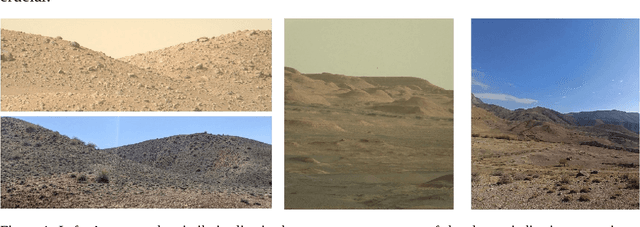
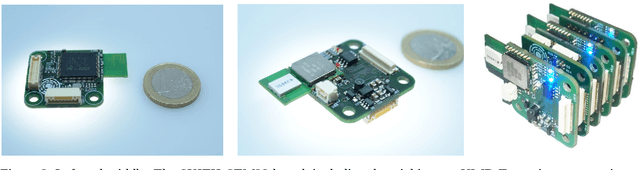
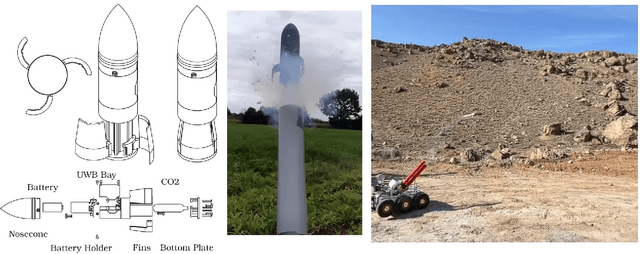

Localization of an autonomous mobile robot during planetary exploration is challenging due to the unknown terrain, the difficult lighting conditions and the lack of any global reference such as satellite navigation systems. We present a novel approach for robot localization based on ultra-wideband (UWB) technology. The robot sets up its own reference coordinate system by distributing UWB anchor nodes in the environment via a rocket-propelled launcher system. This allows the creation of a localization space in which UWB measurements are employed to supplement traditional SLAM-based techniques. The system was developed for our involvement in the ESA-ESRIC challenge 2021 and the AMADEE-24, an analog Mars simulation in Armenia by the Austrian Space Forum (\"OWF).