 Add to Chrome
 Add to Firefox
 Add to Edge
OSMa-Bench++: Toward Open-Ended Benchmarking of Semantic Mapping for Manipulation with Prompt-Generated Synthetic Scenes
May 26, 2026
Semantic mapping methods are increasingly used as intermediate scene representations for downstream robotic reasoning and manipulation, yet their evaluation is still largely tied to fixed benchmark datasets with limited coverage of manipulation-relevant corner cases. In this work, we extend OSMa-Bench toward controllable benchmarking with prompt-generated synthetic indoor scenes. Our pipeline automatically generates scene descriptions, synthesizes corresponding environments with SceneSmith, and adapts the resulting assets into an OSMa-Bench-compatible simulation format. This adaptation requires a nontrivial intermediate layer, including semantic normalization, material and texture repair, shader fallback policies, floor handling, navigation setup, and controlled lighting configuration. A key advantage of the proposed setup is that the original scene-generation prompt is known in advance and can therefore serve as an auxiliary semantic specification of the intended scene. We use this property to extend the VQA component of OSMa-Bench with a prompt-grounded question category. The resulting framework supports targeted stress-testing of semantic scene representations under conditions such as clutter, small objects, partial occlusions, and lighting variation, and makes benchmarking more extensible and better aligned with downstream manipulation requirements. Our code is available at https://github.com/be2rlab/OSMa-Bench-v2.

R5DGS: Semantic-Aware 4D Gaussian Splatting with Rigid Body Constraints for Efficient Dynamic Scene Reconstruction
May 25, 2026Reconstructing and predicting dynamic 3D scenes from multi-view videos is a foundational task for robotics, AR/VR, and digital twins. Recent physics-informed Gaussian Splatting methods achieve impressive future frame extrapolation but lack semantic awareness and suffer from large computational overhead. We introduce $\textbf{R5DGS}$, a framework that augments a physics-driven 4D Gaussian representation with compact Identity Encoding vectors, enabling precise Gaussian-to-object association. By constructing an offline CLIP-based object lookup table, we support open-vocabulary text prompting to retrieve and render object-specific Gaussians across arbitrary timestamps and viewpoints. Furthermore, we propose a rigid-body inference constraint that predicts and integrates physical dynamics exclusively for object centroids, propagating motion to associated Gaussians via relative transformations. This optimization yields a 11 FPS speedup during extrapolation without compromising trajectories plausibility.
AgentGrounder: Zero-Shot 3D Visual Pointcloud Grounding using Multimodal Language Models
May 25, 20263D Visual Grounding (3DVG) is an essential capability for embodied AI, requiring agents to localize objects in 3D scenes based on natural language descriptions. Recent zero-shot methods leverage 2D vision-language models (LVLMs). However, they often rely on existing sets of multi-view images and struggle with the limited semantic and spatial details provided by standard 3D segmentation tools. We present $\textbf{AgentGrounder}$, a zero-shot 3D visual grounding framework that operates directly on colored point clouds without task-specific 3D training. Our approach follows a two-stage design: (1) an offline stage that applies 3D model to build an Object Lookup Table (OLT) with instance IDs, semantic labels, 3D bounding boxes; and (2) an online tool-driven agent that decomposes each query, retrieves only relevant candidates from the OLT, performs geometric scoring, and triggers image rendering on demand when additional visual evidence (e.g., color, material, or viewpoint-sensitive cues) is required. Compared with fixed anchor-target matching pipelines, this design reduces cascading matching errors and improves context-window efficiency by avoiding prompts overloaded with irrelevant objects. We evaluate on ScanRefer and Nr3D under a zero-shot setting and observe consistent improvements over SeeGround in our setup, including +2.5% Acc@0.5 on ScanRefer and +6.3% on Nr3D, with a notable +6.3% gain on Nr3D view-independent queries. These results show that combining selective retrieval, geometric reasoning, and adaptive visual inspection yields a practical and robust foundation for open-vocabulary 3D grounding. Our code is available at https://github.com/be2rlab/AgentGrounder.
OSMa-Bench: Evaluating Open Semantic Mapping Under Varying Lighting Conditions
Mar 13, 2025Open Semantic Mapping (OSM) is a key technology in robotic perception, combining semantic segmentation and SLAM techniques. This paper introduces a dynamically configurable and highly automated LLM/LVLM-powered pipeline for evaluating OSM solutions called OSMa-Bench (Open Semantic Mapping Benchmark). The study focuses on evaluating state-of-the-art semantic mapping algorithms under varying indoor lighting conditions, a critical challenge in indoor environments. We introduce a novel dataset with simulated RGB-D sequences and ground truth 3D reconstructions, facilitating the rigorous analysis of mapping performance across different lighting conditions. Through experiments on leading models such as ConceptGraphs, BBQ and OpenScene, we evaluate the semantic fidelity of object recognition and segmentation. Additionally, we introduce a Scene Graph evaluation method to analyze the ability of models to interpret semantic structure. The results provide insights into the robustness of these models, forming future research directions for developing resilient and adaptable robotic systems. Our code is available at https://be2rlab.github.io/OSMa-Bench/.
Synergizing Morphological Computation and Generative Design: Automatic Synthesis of Tendon-Driven Grippers
Oct 10, 2024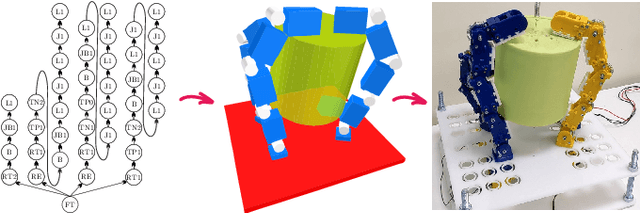
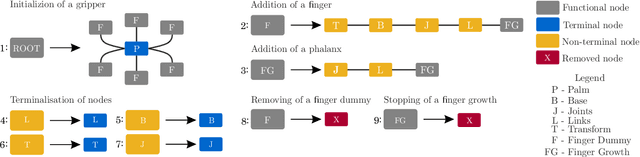
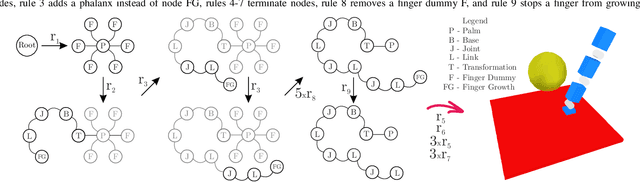
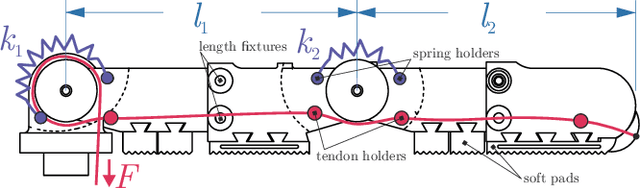
Robots' behavior and performance are determined both by hardware and software. The design process of robotic systems is a complex journey that involves multiple phases. Throughout this process, the aim is to tackle various criteria simultaneously, even though they often contradict each other. The ultimate goal is to uncover the optimal solution that resolves these conflicting factors. Generative, computation or automatic designs are the paradigms aimed at accelerating the whole design process. Within this paper we propose a design methodology to generate linkage mechanisms for robots with morphological computation. We use a graph grammar and a heuristic search algorithm to create robot mechanism graphs that are converted into simulation models for testing the design output. To verify the design methodology we have applied it to a relatively simple quasi-static problem of object grasping. We found a way to automatically design an underactuated tendon-driven gripper that can grasp a wide range of objects. This is possible because of its structure, not because of sophisticated planning or learning.
GSplatLoc: Grounding Keypoint Descriptors into 3D Gaussian Splatting for Improved Visual Localization
Sep 24, 2024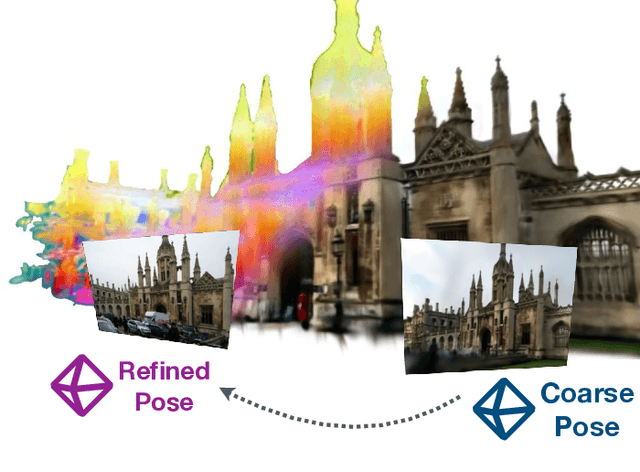
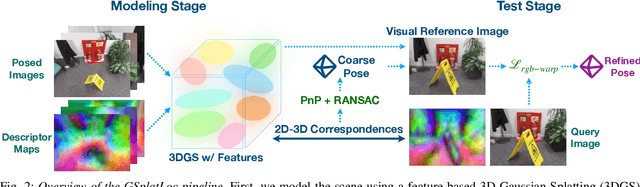
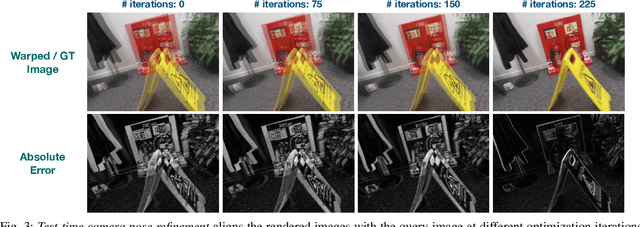
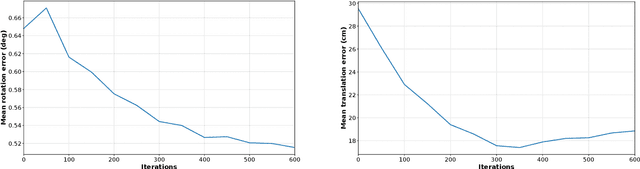
Although various visual localization approaches exist, such as scene coordinate and pose regression, these methods often struggle with high memory consumption or extensive optimization requirements. To address these challenges, we utilize recent advancements in novel view synthesis, particularly 3D Gaussian Splatting (3DGS), to enhance localization. 3DGS allows for the compact encoding of both 3D geometry and scene appearance with its spatial features. Our method leverages the dense description maps produced by XFeat's lightweight keypoint detection and description model. We propose distilling these dense keypoint descriptors into 3DGS to improve the model's spatial understanding, leading to more accurate camera pose predictions through 2D-3D correspondences. After estimating an initial pose, we refine it using a photometric warping loss. Benchmarking on popular indoor and outdoor datasets shows that our approach surpasses state-of-the-art Neural Render Pose (NRP) methods, including NeRFMatch and PNeRFLoc.