 Add to Chrome
 Add to Firefox
 Add to Edge
IntentCUA: Learning Intent-level Representations for Skill Abstraction and Multi-Agent Planning in Computer-Use Agents
Feb 19, 2026
Computer-use agents operate over long horizons under noisy perception, multi-window contexts, evolving environment states. Existing approaches, from RL-based planners to trajectory retrieval, often drift from user intent and repeatedly solve routine subproblems, leading to error accumulation and inefficiency. We present IntentCUA, a multi-agent computer-use framework designed to stabilize long-horizon execution through intent-aligned plan memory. A Planner, Plan-Optimizer, and Critic coordinate over shared memory that abstracts raw interaction traces into multi-view intent representations and reusable skills. At runtime, intent prototypes retrieve subgroup-aligned skills and inject them into partial plans, reducing redundant re-planning and mitigating error propagation across desktop applications. In end-to-end evaluations, IntentCUA achieved a 74.83% task success rate with a Step Efficiency Ratio of 0.91, outperforming RL-based and trajectory-centric baselines. Ablations show that multi-view intent abstraction and shared plan memory jointly improve execution stability, with the cooperative multi-agent loop providing the largest gains on long-horizon tasks. These results highlight that system-level intent abstraction and memory-grounded coordination are key to reliable and efficient desktop automation in large, dynamic environments.

Log2Plan: An Adaptive GUI Automation Framework Integrated with Task Mining Approach
Sep 26, 2025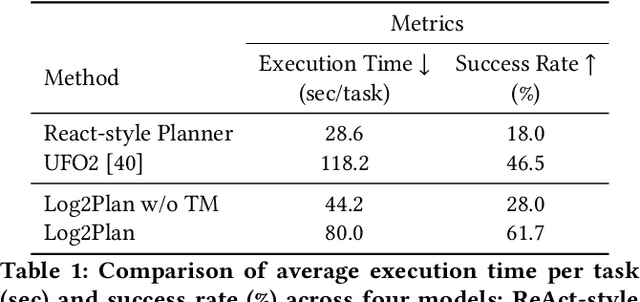
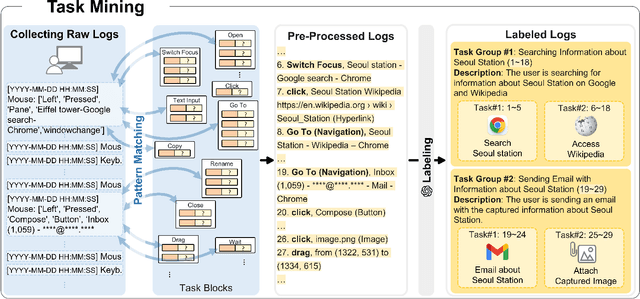
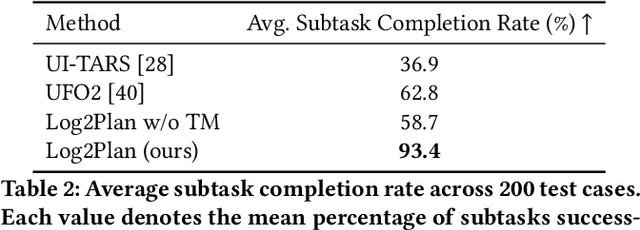
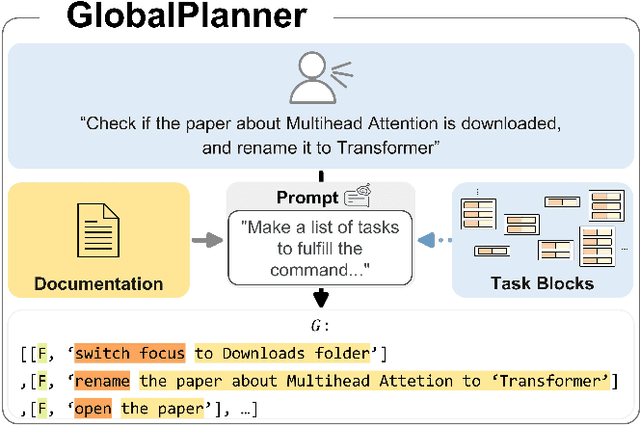
GUI task automation streamlines repetitive tasks, but existing LLM or VLM-based planner-executor agents suffer from brittle generalization, high latency, and limited long-horizon coherence. Their reliance on single-shot reasoning or static plans makes them fragile under UI changes or complex tasks. Log2Plan addresses these limitations by combining a structured two-level planning framework with a task mining approach over user behavior logs, enabling robust and adaptable GUI automation. Log2Plan constructs high-level plans by mapping user commands to a structured task dictionary, enabling consistent and generalizable automation. To support personalization and reuse, it employs a task mining approach from user behavior logs that identifies user-specific patterns. These high-level plans are then grounded into low-level action sequences by interpreting real-time GUI context, ensuring robust execution across varying interfaces. We evaluated Log2Plan on 200 real-world tasks, demonstrating significant improvements in task success rate and execution time. Notably, it maintains over 60.0% success rate even on long-horizon task sequences, highlighting its robustness in complex, multi-step workflows.