 Add to Chrome
 Add to Firefox
 Add to Edge
WorldComp2D: Spatio-semantic Representations of Object Identity and Location from Local Views
May 12, 2026
Learning latent representations that capture both semantic and spatial information is central to efficient spatio-semantic reasoning. However, many existing approaches rely on implicit latent structures combined with dense feature maps or task-specific heads, limiting computational efficiency and flexibility. We propose WorldComp2D, a novel lightweight representation learning framework that explicitly structures latent space geometry according to object identity and spatial proximity using multiscale local receptive fields. This framework consists of (i) a proximity-dependent encoder that maps a given observation into a spatio-semantic latent space and (ii) a localizer that infers the coordinates of objects in the input from the resulting spatio-semantic representation. Using facial landmark localization as a proof-of-concept, we show that, compared to SoTA lightweight models, WorldComp2D reduces the numbers of parameters and FLOPs by up to 4.0X and 2.2X, respectively, while maintaining real-time performance on CPU. These results demonstrate that explicitly structured latent spaces provide an efficient and general foundation for spatio-semantic reasoning. This framework is open-sourced at https://github.com/JinSeongmin/WorldComp2D.

IterNorm: Fast Iterative Normalization
Dec 06, 2024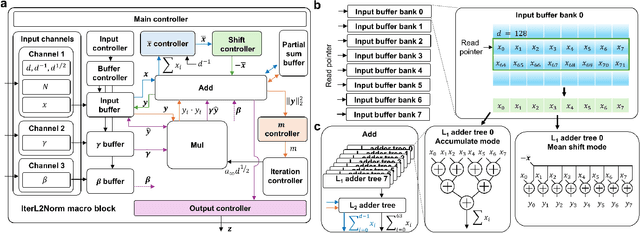
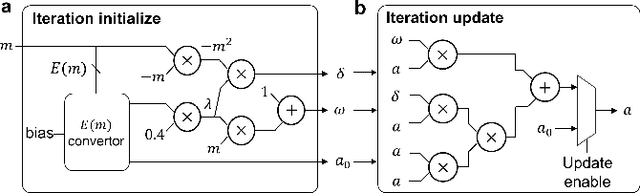
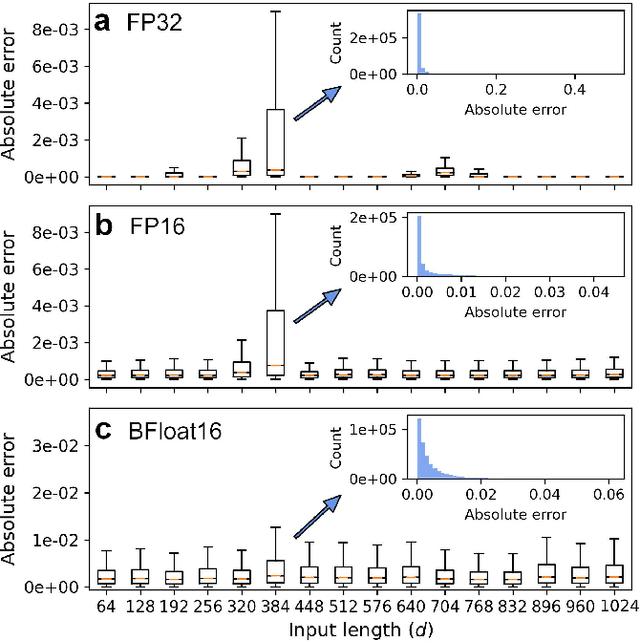
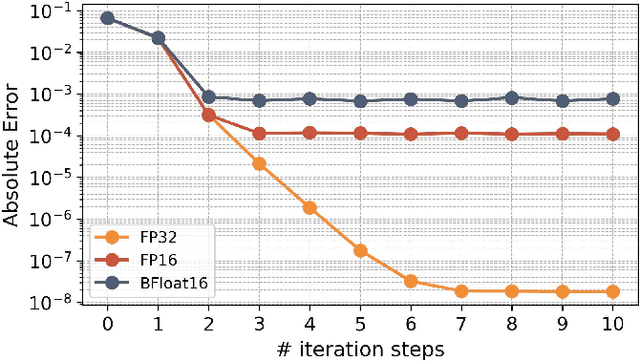
Transformer-based large language models are a memory-bound model whose operation is based on a large amount of data that are marginally reused. Thus, the data movement between a host and accelerator likely dictates the total wall-clock time. Layer normalization is one of the key workloads in the transformer model, following each of multi-head attention and feed-forward network blocks. To reduce data movement, layer normalization needs to be performed on the same chip as the matrix-matrix multiplication engine. To this end, we introduce an iterative L2-normalization method for 1D input (IterNorm), ensuring fast convergence to the steady-state solution within five iteration steps and high precision, outperforming the fast inverse square root algorithm in six out of nine cases for FP32 and five out of nine for BFloat16 across the embedding lengths used in the OPT models. Implemented in 32/28nm CMOS, the IterNorm macro normalizes $d$-dimensional vectors, where $64 \leq d \leq 1024$, with a latency of 112-227 cycles at 100MHz/1.05V.