 Add to Chrome
 Add to Firefox
 Add to Edge
LiM-YOLO: Less is More with Pyramid Level Shift and Normalized Auxiliary Branch for Ship Detection in Optical Remote Sensing Imagery
Dec 10, 2025
Applying general-purpose object detectors to ship detection in satellite imagery presents significant challenges due to the extreme scale disparity and morphological anisotropy of maritime targets. Standard architectures utilizing stride-32 (P5) layers often fail to resolve narrow vessels, resulting in spatial feature dilution. In this work, we propose LiM-YOLO, a specialized detector designed to resolve these domain-specific conflicts. Based on a statistical analysis of ship scales, we introduce a Pyramid Level Shift Strategy that reconfigures the detection head to P2-P4. This shift ensures compliance with Nyquist sampling criteria for small objects while eliminating the computational redundancy of deep layers. To further enhance training stability on high-resolution inputs, we incorporate a Group Normalized Convolutional Block for Linear Projection (GN-CBLinear), which mitigates gradient volatility in micro-batch settings. Validated on SODA-A, DOTA-v1.5, FAIR1M-v2.0, and ShipRSImageNet-V1, LiM-YOLO demonstrates superior detection accuracy and efficiency compared to state-of-the-art models. The code is available at https://github.com/egshkim/LiM-YOLO.

Conditional Brownian Bridge Diffusion Model for VHR SAR to Optical Image Translation
Aug 15, 2024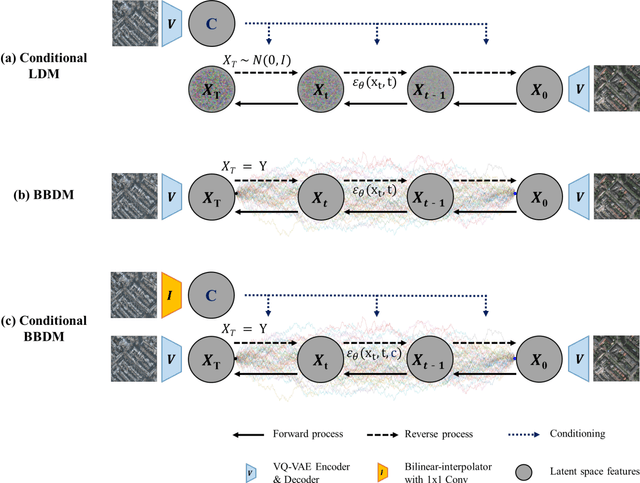
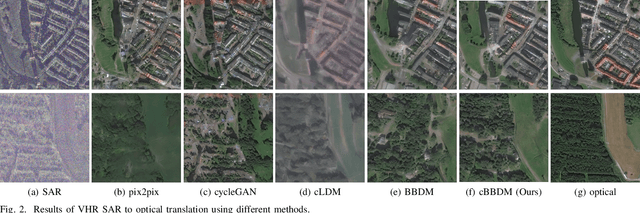
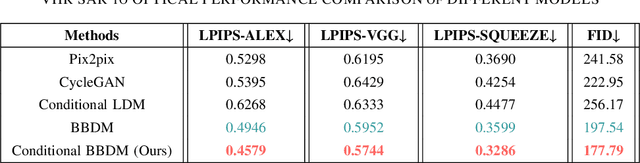
Synthetic Aperture Radar (SAR) imaging technology provides the unique advantage of being able to collect data regardless of weather conditions and time. However, SAR images exhibit complex backscatter patterns and speckle noise, which necessitate expertise for interpretation. To deal with this challenge, research has been conducted on translating SAR images into optical-like representations to aid the interpretation of SAR data. Nevertheless, existing studies have predominantly utilized low-resolution satellite imagery datasets and have largely been based on Generative Adversarial Network (GAN) which are known for their training instability and low fidelity. To overcome these limitations of low-resolution data usage and GAN-based approaches, this paper introduces a conditional image-to-image translation approach based on Brownian Bridge Diffusion Model (BBDM). We conducted comprehensive experiments on the MSAW dataset, a paired SAR and optical images collection of 0.5m Very-High-Resolution (VHR) images. The experimental results indicate that our method surpasses both the Conditional Diffusion Model (CDM) and the GAN-based models in diverse perceptual quality metrics.