 Add to Chrome
 Add to Firefox
 Add to Edge
One Click per Cell Type Suffices: Training-free Group Interaction for Cell Instance Segmentation
May 28, 2026
Cell instance segmentation models trained on cell-specific datasets suffer severe performance drops on out-of-distribution cell types, while interactive foundation models overcome this through per-instance prompting at a cost that is prohibitively expensive for histopathology images containing hundreds to thousands of densely packed instances. We introduce Group Prompting, a new paradigm that shifts interactive segmentation from per-instance $O(N)$ to per-type $O(T)$, where a single click per cell type suffices to segment all instances of that type. Our key observation is that the frozen image encoder of the Segment Anything Model (SAM) already clusters same-type cells in its feature space before any prompt is given. Exploiting this property, we propose Chain-of-Prompts (CoP), a training-free framework that recursively expands a single user click by (1) identifying reliable same-type locations through non-parametric gating of multi-scale encoder features, and (2) selecting the most spatially distant reliable point as the next prompt to maximize coverage. On three cell-type-annotated benchmarks, CoP with one click per type retains over 90% of per-instance performance and surpasses fully-supervised methods without any additional training. On four morphologically homogeneous benchmarks, a single click retains over 99%. Project Page: https://shjo-april.github.io/Chain-of-Prompts/

COIN: Confidence Score-Guided Distillation for Annotation-Free Cell Segmentation
Mar 17, 2025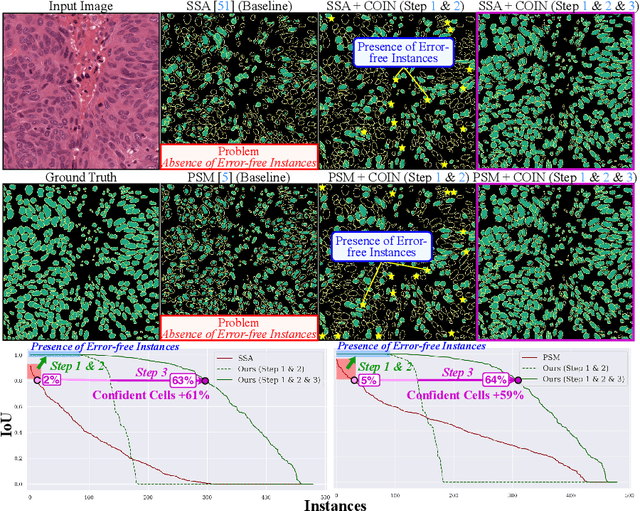
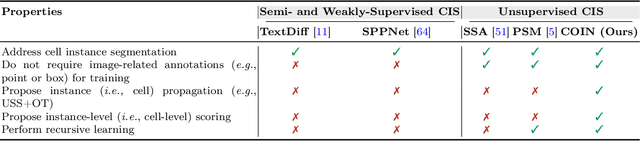
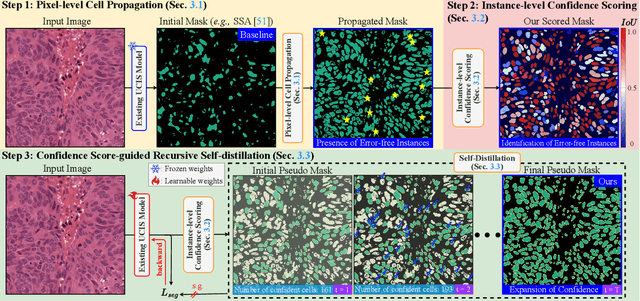
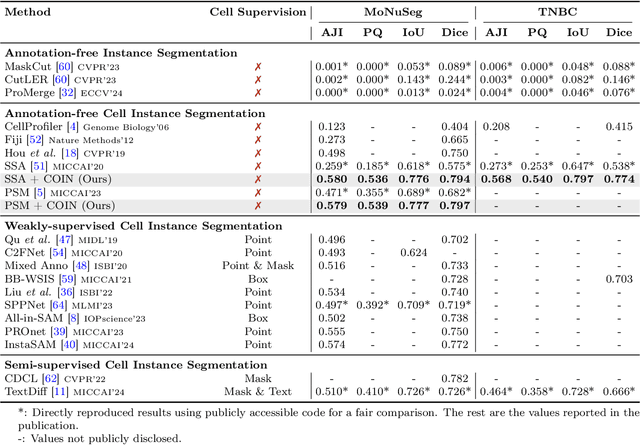
Cell instance segmentation (CIS) is crucial for identifying individual cell morphologies in histopathological images, providing valuable insights for biological and medical research. While unsupervised CIS (UCIS) models aim to reduce the heavy reliance on labor-intensive image annotations, they fail to accurately capture cell boundaries, causing missed detections and poor performance. Recognizing the absence of error-free instances as a key limitation, we present COIN (COnfidence score-guided INstance distillation), a novel annotation-free framework with three key steps: (1) Increasing the sensitivity for the presence of error-free instances via unsupervised semantic segmentation with optimal transport, leveraging its ability to discriminate spatially minor instances, (2) Instance-level confidence scoring to measure the consistency between model prediction and refined mask and identify highly confident instances, offering an alternative to ground truth annotations, and (3) Progressive expansion of confidence with recursive self-distillation. Extensive experiments across six datasets show COIN outperforming existing UCIS methods, even surpassing semi- and weakly-supervised approaches across all metrics on the MoNuSeg and TNBC datasets. The code is available at https://github.com/shjo-april/COIN.