 Add to Chrome
 Add to Firefox
 Add to Edge
3D-GlioPREDICT: 3D Latent Diffusion for Post-Radiotherapy Brain MRI Prediction in Patients with Glioma
Jun 03, 2026
Radiotherapy is a cornerstone of glioma treatment inducing complex structural changes in brain tissue that are difficult to anticipate. Predicting these changes from pretreatment data could improve understanding of treatment-related effects and support the development of image-based outcome prediction methods. Recent studies have shown that follow-up brain magnetic resonance imaging can be synthesized from baseline imaging and treatment information, but most existing approaches operate on single 2D slices and represent treatment as a global parameter, rather than a spatially dynamic variable. In this work, we address both limitations with a 3D latent diffusion framework that conditions image generation on the spatially resolved voxel-wise dose distribution, alongside a pretreatment image and follow-up time. To make volumetric synthesis computationally feasible, the model combines latent-space compression with ControlNet-based spatial conditioning. The method was trained and evaluated on a public dataset comprising 257 scans from 25 glioma patients. Prediction quality was assessed using mean squared error, peak signal-to-noise ratio, and structural similarity index. Anatomical consistency was further evaluated using Dice scores for cerebrospinal fluid, gray matter, and white matter segmentations, together with hippocampus volume prediction error and deformation analysis based on log Jacobian determinant maps. Compared with our previously proposed 2D approach, the 3D model achieved improved image similarity while maintaining good agreement with ground truth anatomy and deformation patterns. Overall, these results support the feasibility of 3D treatment-aware generative modeling for predicting post-radiotherapy brain MRI using only pretreatment information. Code is available at https://github.com/nordinbelkacemi/fu-pred-3d

Rectified flow-based prediction of post-treatment brain MRI from pre-radiotherapy priors for patients with glioma
Mar 09, 2026Purpose/Objective: Brain tumors result in 20 years of lost life on average. Standard therapies induce complex structural changes in the brain that are monitored through MRI. Recent developments in artificial intelligence (AI) enable conditional multimodal image generation from clinical data. In this study, we investigate AI-driven generation of follow-up MRI in patients with in- tracranial tumors through conditional image generation. This approach enables realistic modeling of post-radiotherapy changes, allowing for treatment optimization. Material/Methods: The public SAILOR dataset of 25 patients was used to create a 2D rectified flow model conditioned on axial slices of pre-treatment MRI and RT dose maps. Cross-attention conditioning was used to incorporate temporal and chemotherapy data. The resulting images were validated with structural similarity index measure (SSIM), peak signal-to-noise ratio (PSNR), Dice scores and Jacobian determinants. Results: The resulting model generates realistic follow-up MRI for any time point, while integrating treatment information. Comparing real versus predicted images, SSIM is 0.88, and PSNR is 22.82. Tissue segmentations from real versus predicted MRI result in a mean Dice-Sørensen coefficient (DSC) of 0.91. The rectified flow (RF) model enables up to 250x faster inference than Denoising Diffusion Probabilistic Models (DDPM). Conclusion: The proposed model generates realistic follow-up MRI in real-time, preserving both semantic and visual fidelity as confirmed by image quality metrics and tissue segmentations. Conditional generation allows counterfactual simulations by varying treatment parameters, producing predicted morphological changes. This capability has potential to support adaptive treatment dose planning and personalized outcome prediction for patients with intracranial tumors.
Deep learning-based brain segmentation model performance validation with clinical radiotherapy CT
Jun 25, 2024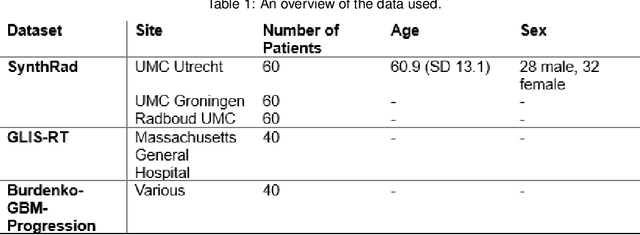


Manual segmentation of medical images is labor intensive and especially challenging for images with poor contrast or resolution. The presence of disease exacerbates this further, increasing the need for an automated solution. To this extent, SynthSeg is a robust deep learning model designed for automatic brain segmentation across various contrasts and resolutions. This study validates the SynthSeg robust brain segmentation model on computed tomography (CT), using a multi-center dataset. An open access dataset of 260 paired CT and magnetic resonance imaging (MRI) from radiotherapy patients treated in 5 centers was collected. Brain segmentations from CT and MRI were obtained with SynthSeg model, a component of the Freesurfer imaging suite. These segmentations were compared and evaluated using Dice scores and Hausdorff 95 distance (HD95), treating MRI-based segmentations as the ground truth. Brain regions that failed to meet performance criteria were excluded based on automated quality control (QC) scores. Dice scores indicate a median overlap of 0.76 (IQR: 0.65-0.83). The median HD95 is 2.95 mm (IQR: 1.73-5.39). QC score based thresholding improves median dice by 0.1 and median HD95 by 0.05mm. Morphological differences related to sex and age, as detected by MRI, were also replicated with CT, with an approximate 17% difference between the CT and MRI results for sex and 10% difference between the results for age. SynthSeg can be utilized for CT-based automatic brain segmentation, but only in applications where precision is not essential. CT performance is lower than MRI based on the integrated QC scores, but low-quality segmentations can be excluded with QC-based thresholding. Additionally, performing CT-based neuroanatomical studies is encouraged, as the results show correlations in sex- and age-based analyses similar to those found with MRI.