 Add to Chrome
 Add to Firefox
 Add to Edge
Neural Network Models for Contextual Regression
Mar 25, 2026
We propose a neural network model for contextual regression in which the regression model depends on contextual features that determine the active submodel and an algorithm to fit the model. The proposed simple contextual neural network (SCtxtNN) separates context identification from context-specific regression, resulting in a structured and interpretable architecture with fewer parameters than a fully connected feed-forward network. We show mathematically that the proposed architecture is sufficient to represent contextual linear regression models using only standard neural network components. Numerical experiments are provided to support the theoretical result, showing that the proposed model achieves lower excess mean squared error and more stable performance than feed-forward neural networks with comparable numbers of parameters, while larger networks improve accuracy only at the cost of increased complexity. The results suggest that incorporating contextual structure can improve model efficiency while preserving interpretability.

Ungeneralizable Contextual Logistic Bandit in Credit Scoring
Dec 15, 2022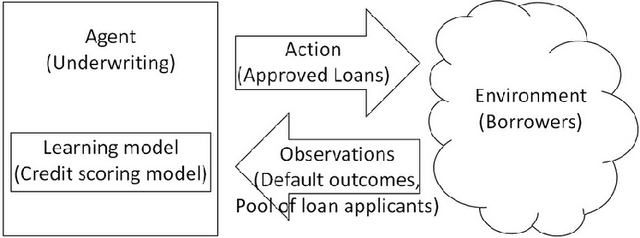
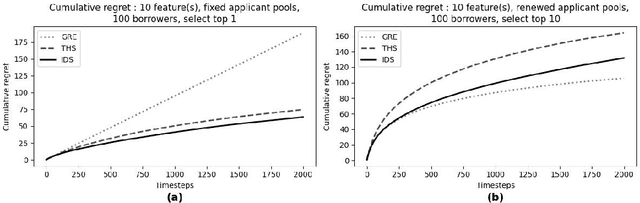
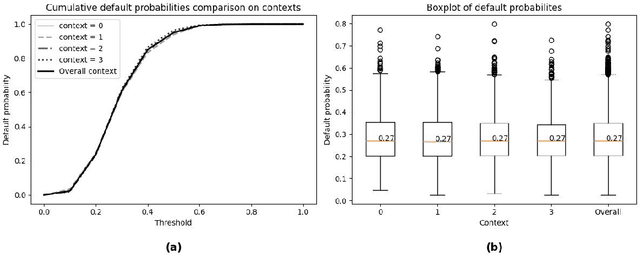
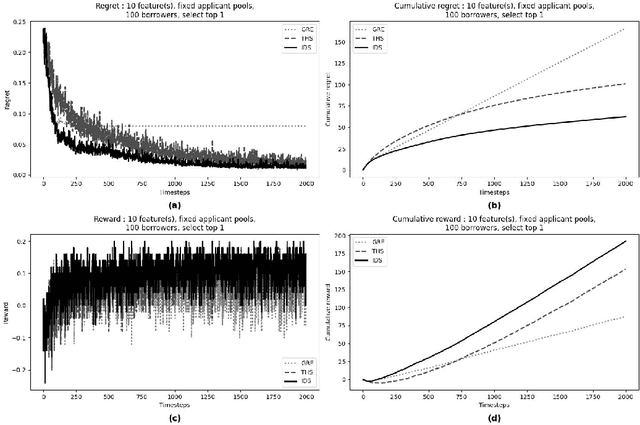
The application of reinforcement learning in credit scoring has created a unique setting for contextual logistic bandit that does not conform to the usual exploration-exploitation tradeoff but rather favors exploration-free algorithms. Through sufficient randomness in a pool of observable contexts, the reinforcement learning agent can simultaneously exploit an action with the highest reward while still learning more about the structure governing that environment. Thus, it is the case that greedy algorithms consistently outperform algorithms with efficient exploration, such as Thompson sampling. However, in a more pragmatic scenario in credit scoring, lenders can, to a degree, classify each borrower as a separate group, and learning about the characteristics of each group does not infer any information to another group. Through extensive simulations, we show that Thompson sampling dominates over greedy algorithms given enough timesteps which increase with the complexity of underlying features.